






Book at our Chiswick clinic
Blood Test
Follicle stimulating hormone (FSH) is made by the pituitary gland at the base of the brain. In women it drives the growth of egg-containing follicles in the ovaries each month, and in men it supports sperm production in the testes. Because the ovaries and testes "talk back" to the pituitary, FSH rises when they are working less, which is why it is often checked around fertility, irregular periods and menopause.
This guide explains what FSH does, how ranges change across the menstrual cycle and after menopause, what high and low results can mean for women and men, when an FSH test is and is not useful, and how to prepare.
Test it in Chiswick: our Follicle Stimulating Hormone blood test costs £49, with your result explained in person by a practitioner. No GP referral needed. Book this test or call 020 4515 0000. Prefer to test at home? A home finger-prick kit is also available, ask us when you enquire.
Quick answer
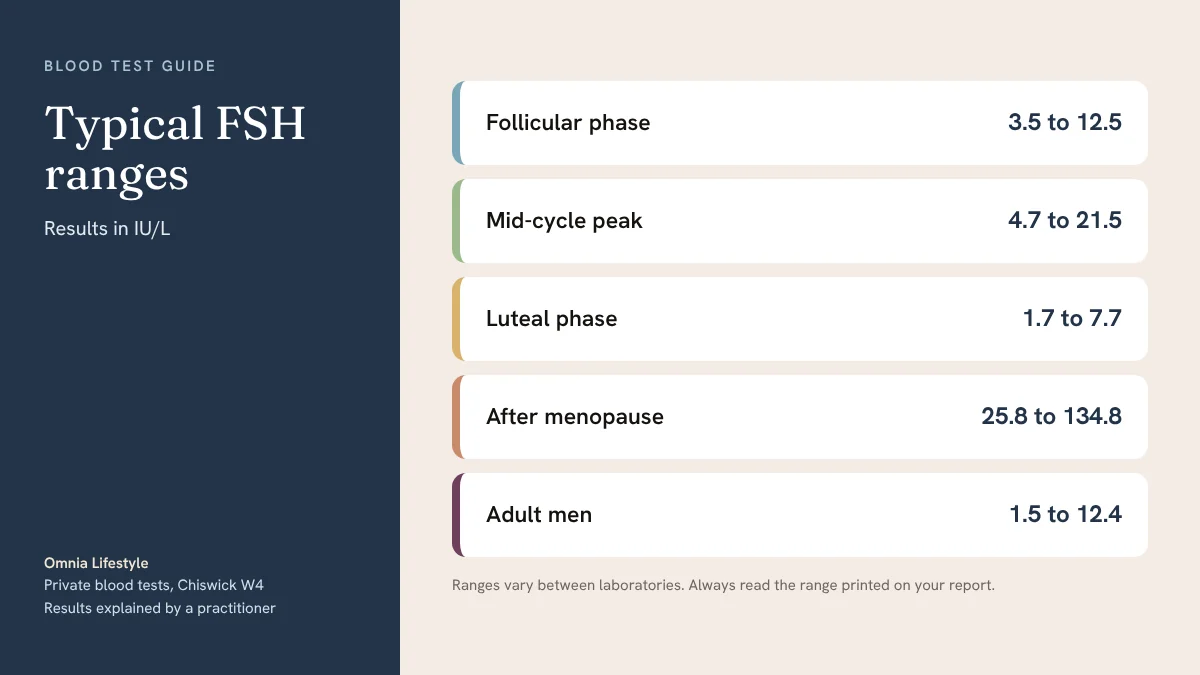
FSH is measured in IU/L and its range depends on the stage of the cycle. One NHS laboratory quotes 3.5 to 12.5 IU/L in the follicular phase, 4.7 to 21.5 at the mid-cycle peak, 1.7 to 7.7 in the luteal phase, 25.8 to 134.8 after menopause, and 1.5 to 12.4 IU/L in adult men. A raised FSH can point to the ovaries or testes working less, but NICE advises that people aged 45 or over with typical symptoms do not need an FSH test to diagnose menopause. Ranges vary between laboratories, so always read the range on your report.
What FSH does
In the first half of the menstrual cycle, FSH stimulates follicles in the ovaries to grow and to make oestradiol. As oestradiol and a hormone called inhibin rise, they signal the pituitary to ease off. In men, FSH acts on cells in the testes that support sperm production, and inhibin from the testes keeps FSH in check.
When the ovaries or testes produce less of these hormones, the brake comes off and FSH climbs. The Society for Endocrinology describes this as the usual reason for a raised FSH: a problem at the level of the ovaries or testes, or the natural decline in ovarian function before menopause.
What your FSH result means
These ranges come from one NHS laboratory using a Roche assay. Other laboratories use different methods and ranges, so compare your result with the range printed on your own report.
- Follicular phase (early cycle): 3.5 to 12.5 IU/L.
- Mid-cycle peak: 4.7 to 21.5 IU/L. FSH rises briefly alongside the LH surge around ovulation.
- Luteal phase (after ovulation): 1.7 to 7.7 IU/L.
- After menopause: 25.8 to 134.8 IU/L.
- Adult men: 1.5 to 12.4 IU/L.
Higher than expected
In women, a raised FSH early in the cycle can reflect perimenopause, menopause or, in someone under 40, premature ovarian insufficiency. In perimenopause FSH often swings up and down from month to month, so one result can look normal or high depending on the timing. In men, a raised FSH together with a low sperm count can suggest the testes are not making sperm as expected, and conditions such as Klinefelter syndrome can cause this.
Lower than expected
A low FSH can be normal in the luteal phase or while using hormonal contraception. Persistently low FSH, especially with missed periods or low testosterone, may suggest that the pituitary or hypothalamus is not sending enough signal. The Society for Endocrinology notes that testosterone or anabolic steroid use can suppress FSH and LH and reduce sperm production.
FSH and menopause: what NICE says
The NICE menopause guideline (NG23) advises that perimenopause and menopause are identified from symptoms, without laboratory tests, in otherwise healthy people aged 45 or over. In practice:
- Aged 45 or over with symptoms: an FSH test is not needed to diagnose menopause.
- Aged 40 to 45: NICE says an FSH test may be considered to help confirm menopause in people with symptoms, including a change in their cycle.
- Under 40: if menopause is suspected, premature ovarian insufficiency is diagnosed on symptoms plus raised FSH on two blood samples taken 4 to 6 weeks apart, never on a single test.
- Using combined hormonal contraception or high-dose progestogen: NICE advises against using FSH to identify menopause, because these medicines affect the result.
An FSH test can still be useful in other situations, such as irregular or absent periods, fertility questions, or symptoms in men, where it is read alongside LH, oestradiol or testosterone.
FSH in men
For men, FSH is usually checked with LH and testosterone when there are concerns about fertility, low sex drive or erection problems. A high FSH with low testosterone points towards the testes, while low FSH and LH with low testosterone points towards the pituitary or hypothalamus. Our Testosterone Check Plus (£79) measures FSH and LH with testosterone, SHBG and oestradiol.
When to see your GP
- Your periods have stopped or become irregular before the age of 40, or before 45 with menopausal symptoms.
- You have missed three periods in a row, or your periods have become irregular.
- You have any vaginal bleeding after your menopause, even a small amount once. The NHS advises seeing a GP for this.
- You have not conceived after a year of trying, or sooner if you are 36 or over or know of a possible fertility problem.
- You are a man with low sex drive, erection problems, breast swelling or a testicular lump. A new testicular lump should always be checked by a GP.
Call 999 or go to A&E if you have a headache that comes on suddenly and is extremely painful, or a very painful headache with loss of vision, as the NHS advises.
Preparing for your FSH test
- Timing in the cycle: if you have periods, NHS laboratories recommend a sample early in the cycle, usually within days 1 to 5 (day 1 is the first day of bleeding). Note the cycle day when you book.
- Fasting: not needed.
- Hormonal medicines: tell us about contraception, HRT or testosterone, as these change FSH.
- Biotin: if you take high-dose biotin (more than 5 mg a day), NHS laboratories advise leaving at least 8 hours after your last dose before the sample.
How often to retest
Because FSH varies from cycle to cycle, one result rarely tells the whole story. If premature ovarian insufficiency is being considered, NICE recommends a second sample 4 to 6 weeks later. Otherwise, your practitioner or GP can advise whether a repeat test, or a wider hormone panel, would help.
Frequently asked questions
Is an FSH of 30 high?
For someone with periods, 30 IU/L is above the early-cycle range of 3.5 to 12.5 IU/L quoted by one NHS laboratory and falls within that laboratory's postmenopausal range. It may reflect perimenopause, but FSH fluctuates, so the result is read with your age, symptoms and cycle day. Under 40, a repeat test 4 to 6 weeks later and a GP review are advised.
Can an FSH test tell me if I am in perimenopause?
Not reliably on its own. FSH rises and falls during perimenopause, and NICE advises diagnosing perimenopause from symptoms in people aged 45 or over. The test is more useful between 40 and 45, or under 40 when early menopause is suspected.
Does FSH show whether I can get pregnant?
No single hormone can predict that. The NICE fertility guideline (NG257, 2026) advises against using FSH to predict response to IVF stimulation, and recommends AMH or an ultrasound follicle count instead. Our AMH guide explains more.
What does high FSH mean in a man?
It usually suggests the testes are working less, which can affect sperm production. A practitioner will look at it alongside LH, testosterone and, where relevant, a semen analysis arranged through your GP.
Can I test FSH while on the pill?
You can, but the result mainly reflects the pill rather than your own ovarian activity. NICE advises against using FSH to identify menopause in people using combined hormonal contraception or high-dose progestogen.
FSH testing in Chiswick
Our clinic is at 8 to 9 Bedford Corner, The Avenue, Chiswick, London W4 1LZ, a short walk from Turnham Green station (District line; Piccadilly line trains stop there early morning and late evening only), and close to buses 94, E3 and 272. Limited parking is available on request when you book. Your sample is taken at the clinic and analysed at the Randox accredited laboratory, and most results are ready within a few working days. You do not need a GP referral, a practitioner explains your result with you, and a GP feedback report is available on request.
Book the FSH blood test on its own, or choose the Hormone Health Check (£69), which adds LH, oestradiol, progesterone, prolactin, testosterone and SHBG. You can also compare every blood test and price, or read our guides to LH levels and AMH levels.
This article is general information, not medical advice. Discuss your results with your GP or practitioner.
Ready to book?
Blood Test




.jpg)
.jpg)
