






Book at our Chiswick clinic
Blood Test
Anti-Mullerian hormone (AMH) is made by the small growing follicles in the ovaries. Because the number of these follicles reflects how many eggs remain, AMH is used as a marker of ovarian reserve. It is one of the most searched fertility tests, and also one of the most misunderstood.
This guide explains what AMH measures, how levels typically fall with age, what a low or high result can and cannot tell you, why it is useful before IVF or egg freezing, how it relates to PCOS, and how to prepare.
Test it in Chiswick: our AMH (Ovarian Reserve) blood test costs £99, with your result explained in person by a practitioner. No GP referral needed. Book this test or call 020 4515 0000. Prefer to test at home? A home finger-prick kit is also available, ask us when you enquire.
Quick answer
AMH is reported in pmol/L and falls with age. One NHS laboratory quotes 1.2 to 52.7 pmol/L at ages 26 to 30, 0.2 to 51.0 at 36 to 40, and 0 to 23.4 at 41 to 45, showing both the decline and how widely healthy results vary. AMH estimates how many eggs remain, not their quality. NICE advises it should not be used to predict natural pregnancy, but it helps predict response to IVF stimulation. A high AMH can be seen in PCOS. Ranges vary by laboratory and assay.
What AMH measures
Each month a group of follicles begins to develop in the ovaries, and these follicles release AMH. The more follicles there are, the higher the AMH tends to be. The HFEA describes an AMH test as one that reflects a person's egg count, and says tests of ovarian reserve give some indication of fertility, although the results are not guaranteed.
AMH stays fairly steady through the menstrual cycle, so unlike FSH or LH it can usually be taken on any day.
AMH by age
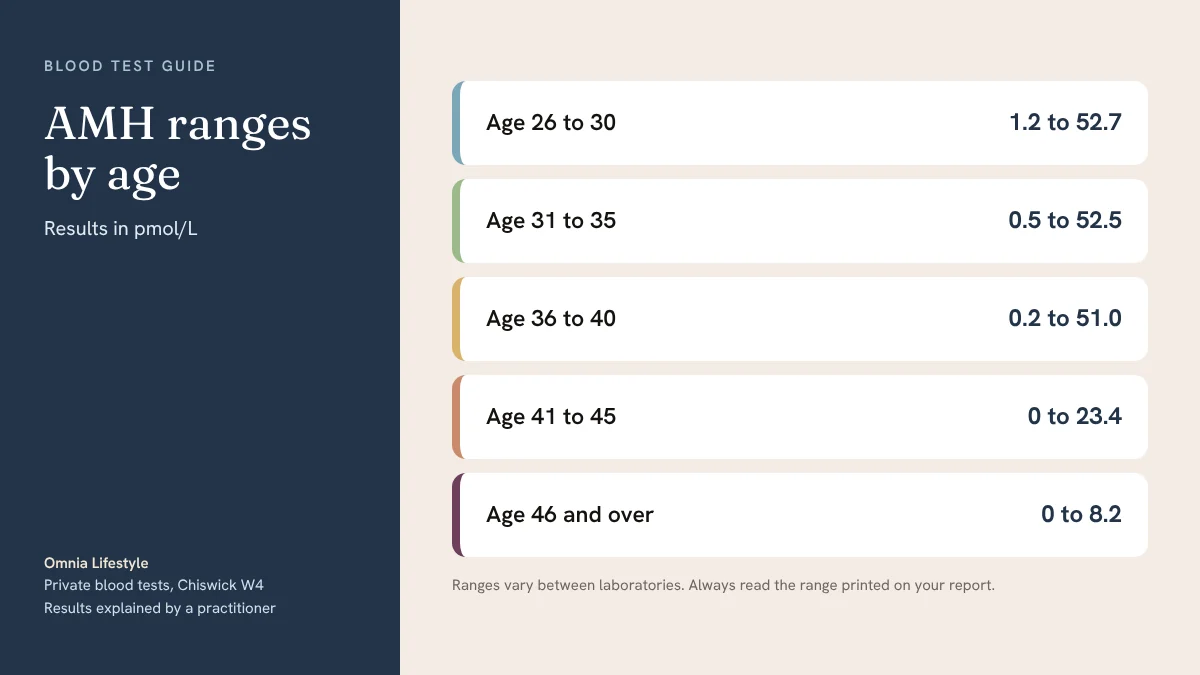
These age-related ranges come from one NHS laboratory (Worcestershire Acute Hospitals) using a Beckman Coulter assay. Other laboratories and assays give different numbers, and some report AMH in ng/mL instead of pmol/L, so always compare your result with the range on your own report.
- Age 18 to 25: 6.82 to 95.22 pmol/L.
- Age 26 to 30: 1.22 to 52.66 pmol/L.
- Age 31 to 35: 0.53 to 52.48 pmol/L.
- Age 36 to 40: 0.20 to 51.03 pmol/L.
- Age 41 to 45: 0.00 to 23.35 pmol/L.
- Age 46 and over: 0.00 to 8.19 pmol/L.
Two things stand out. First, the upper end of the range falls with age, reflecting the natural decline in egg numbers. Second, the ranges are very wide at every age, so two healthy women of the same age can have very different results. Your practitioner reads your result against your age rather than a single cut-off.
What your AMH result means
- Lower for your age: suggests fewer eggs remain than average for your age. It does not mean you cannot conceive naturally, and it says nothing about egg quality.
- Within the range for your age: your egg reserve is broadly in line with others your age.
- Higher for your age: suggests many follicles. This is common in PCOS, and before IVF it can signal a stronger response to stimulation drugs, which clinics take into account.
What AMH cannot tell you
The NICE fertility guideline (NG257, published March 2026) states that AMH should not be used as a predictor of clinical pregnancy through natural conception. Many people with a low AMH conceive naturally, and a normal AMH does not guarantee pregnancy, because egg quality, ovulation, fallopian tubes, the womb and sperm all matter too.
AMH also cannot pinpoint when menopause will happen. NICE advises against using AMH to diagnose perimenopause or menopause in people aged 45 or over, and against routinely using it to diagnose premature ovarian insufficiency.
Where AMH is useful: IVF and egg freezing
NICE recommends using AMH, or an ultrasound antral follicle count, to predict how the ovaries will respond to stimulation, and to inform decisions and counselling about the chance of a live birth after assisted conception. In practice, fertility clinics use AMH to choose drug doses and to help plan IVF or egg freezing. Knowing your AMH can also help if you are weighing up when to seek fertility advice.
High AMH and PCOS
PCOS is now called polyendocrine metabolic ovarian syndrome (PMOS) on the NHS website. The 2023 international PCOS guideline allows a raised AMH to be used instead of an ultrasound scan to show polycystic ovaries, in adults only, and not in adolescents. AMH is never enough on its own: a diagnosis also needs irregular ovulation or signs of high androgens, with other causes excluded. Our LH guide explains the full criteria.
When to see your GP
- You have not conceived after a year of regular unprotected sex. The NHS advises women aged 36 and over, and anyone who knows they may have a fertility problem, to see their GP sooner.
- Your periods have stopped or become irregular before the age of 40.
- You have missed three periods in a row.
- You have symptoms of PCOS, such as irregular periods with excess hair growth or acne.
- You have bleeding between periods or after sex.
Call 999 or go to A&E immediately if you could be pregnant and have a sharp, sudden and intense pain in your tummy, which the NHS lists as a sign of a ruptured ectopic pregnancy.
Who might consider an AMH test
- People thinking about egg freezing or IVF.
- Anyone wanting a starting point before a conversation with a fertility clinic.
- People who have had ovarian surgery, chemotherapy or radiotherapy and want to understand their reserve.
- People with irregular periods where PCOS is being considered, alongside other tests.
Preparing for your AMH test
- Timing: AMH can usually be taken on any day of the cycle.
- Fasting: not needed.
- Contraception: tell us if you use hormonal contraception, as it may affect the result and your practitioner will take it into account.
- Supplements: mention biotin supplements, as high doses can affect some hormone tests.
How often to retest
AMH changes slowly, so there is little value in checking it often. Your practitioner can advise whether a repeat test would help, for example if your plans change or before seeing a fertility clinic.
Frequently asked questions
What is a good AMH level for my age?
There is no single good number. Results are compared with the range for your age and the laboratory's method. At 31 to 35, for example, one NHS laboratory's range runs from 0.53 to 52.48 pmol/L.
Is an AMH of 5 pmol/L low?
It depends on your age and the assay. Using one NHS laboratory's ranges, 5 pmol/L is below the range for ages 18 to 25 but within the range for ages 26 to 45. It may suggest a lower reserve, but does not mean you cannot conceive naturally.
Can I get pregnant naturally with low AMH?
Yes, many people do. NICE advises that AMH should not be used to predict natural conception. If you are trying to conceive, follow NHS advice on when to see your GP.
Does high AMH mean I have PCOS?
Not on its own. A raised AMH can stand in for an ultrasound finding of polycystic ovaries in adults, but PCOS also needs irregular ovulation or high androgens.
Can AMH tell me when I will reach menopause?
No. NICE advises against using AMH to identify menopause in people aged 45 or over, or routinely to diagnose premature ovarian insufficiency.
AMH testing in Chiswick
Our clinic is at 8 to 9 Bedford Corner, The Avenue, Chiswick, London W4 1LZ, a short walk from Turnham Green station (District line; Piccadilly line trains stop there early morning and late evening only), and close to buses 94, E3 and 272. Limited parking is available on request when you book. Your sample is taken at the clinic and analysed at the Randox accredited laboratory, and most results are ready within a few working days. You do not need a GP referral, a practitioner explains your result with you, and a GP feedback report is available on request.
Book the AMH blood test on its own, or choose the Fertility Panel with AMH (£219) for a wider view including FSH, LH, oestradiol, prolactin and thyroid. Explore our women's health blood tests, compare every blood test and price, or read our FSH guide.
This article is general information, not medical advice. Discuss your results with your GP or practitioner.
Ready to book?
Blood Test




.jpg)
.jpg)
