






Book at our Chiswick clinic
Blood Test
Luteinising hormone (LH) is made by the pituitary gland and works as a partner to FSH. In women, a sharp rise in LH in the middle of the cycle, known as the LH surge, triggers the release of an egg. In men, LH tells the testes to make testosterone. Because of this, LH is checked when looking at ovulation, irregular periods, PCOS, menopause and low testosterone.
This guide explains what LH does, how ranges change through the cycle, what high and low results can mean, why the LH to FSH ratio is no longer used to diagnose PCOS, and how to prepare for the test.
Test it in Chiswick: our Luteinising Hormone blood test costs £49, with your result explained in person by a practitioner. No GP referral needed. Book this test or call 020 4515 0000. Prefer to test at home? A home finger-prick kit is also available, ask us when you enquire.
Quick answer
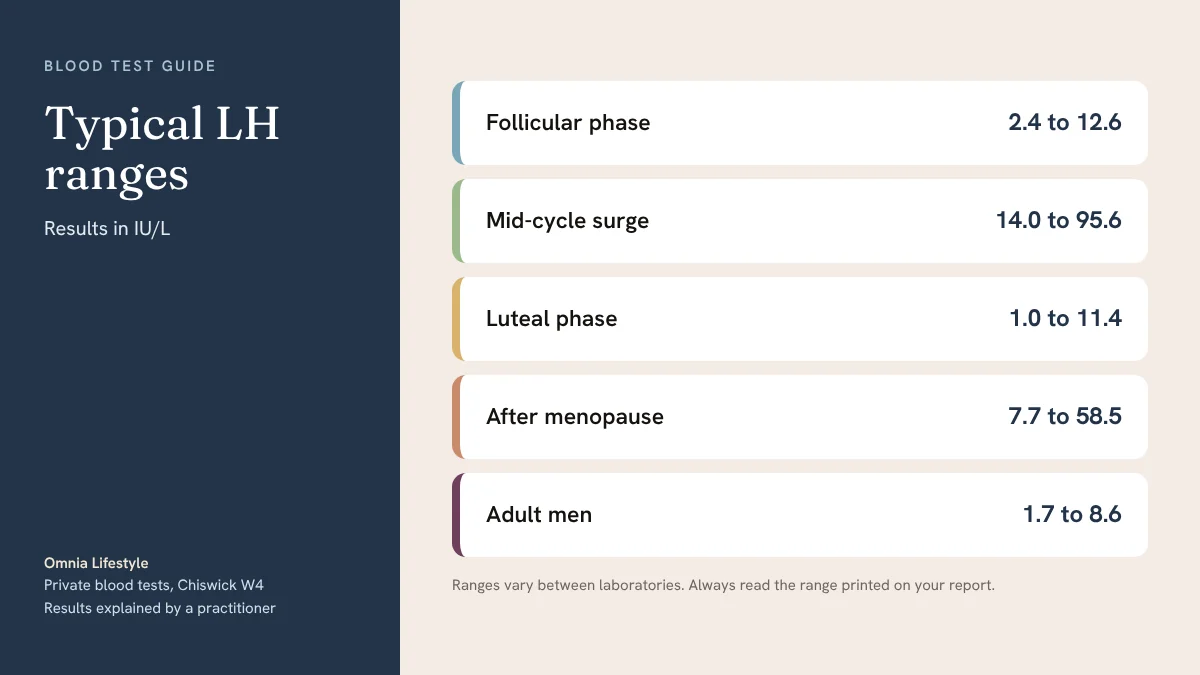
LH is measured in IU/L and changes sharply through the cycle. One NHS laboratory quotes 2.4 to 12.6 IU/L in the follicular phase, 14.0 to 95.6 during the mid-cycle surge, 1.0 to 11.4 in the luteal phase, 7.7 to 58.5 after menopause and 1.7 to 8.6 IU/L in adult men. LH is often raised in PCOS, but it is not part of the diagnostic criteria, and the LH to FSH ratio is not used to diagnose it. Ranges vary between laboratories, so read the range on your report.
What LH does
The Society for Endocrinology explains that in the first half of the cycle LH helps follicles make oestradiol. When oestradiol peaks, the pituitary releases a surge of LH, which causes the follicle to release an egg. Afterwards LH supports the corpus luteum, the structure left behind, which makes progesterone. Home ovulation predictor kits work by detecting this surge in urine.
In men, LH stimulates cells in the testes to make testosterone, which supports sperm production, sex drive, muscle and body hair.
What your LH result means
These ranges come from one NHS laboratory using a Roche assay. Other laboratories differ, so compare your result with the range on your own report.
- Follicular phase (early cycle): 2.4 to 12.6 IU/L.
- Mid-cycle surge: 14.0 to 95.6 IU/L. A high LH at mid-cycle is expected and simply reflects the surge.
- Luteal phase (after ovulation): 1.0 to 11.4 IU/L.
- After menopause: 7.7 to 58.5 IU/L.
- Adult men: 1.7 to 8.6 IU/L.
Higher than expected
Outside the mid-cycle surge, a raised LH can be seen when the ovaries or testes are working less, for example in premature ovarian insufficiency, around menopause, or in men whose testes are not making enough testosterone. LH is also commonly higher in PCOS. Genetic conditions such as Turner syndrome and Klinefelter syndrome can raise LH too.
Lower than expected
Low LH can mean the pituitary or hypothalamus is not sending enough signal. In women this can stop ovulation and periods, as in hypothalamic amenorrhoea, which may follow low body weight, intense exercise or stress. In men, low LH with low testosterone suggests a pituitary or hypothalamic cause. Taking testosterone or anabolic steroids also suppresses LH. A high prolactin level can lower LH and FSH, which is why prolactin is often checked at the same time.
LH, FSH and PCOS
PCOS is now called polyendocrine metabolic ovarian syndrome (PMOS) on the NHS website, though PCOS remains the more familiar name. Under the Rotterdam criteria, and the 2023 international evidence-based PCOS guideline that builds on them, adults are diagnosed when they have two of three features, after other causes are excluded:
- Irregular or absent ovulation: often seen as irregular periods.
- High androgens: signs such as excess hair growth or acne, or raised testosterone on a blood test.
- Polycystic ovaries: seen on ultrasound or, in adults only, suggested by a raised AMH.
LH and the LH to FSH ratio are not part of these criteria. An NHS Lothian PCOS guideline states that gonadotrophin results no longer form part of the diagnostic criteria, that a serum LH is not required for diagnosis, and that a raised LH or LH to FSH ratio is also commonly found in women who do not have the syndrome. One NHS laboratory notes the ratio is often above 2.5 in PCOS but can be normal. So a high ratio does not confirm PCOS, and a normal ratio does not rule it out.
LH and FSH are still useful, because they help rule out other causes of irregular periods, such as early menopause or a pituitary problem.
LH and menopause
LH rises after menopause, but NHS laboratories advise it is not recommended for routine diagnosis of menopause. NICE advises that menopause is identified from symptoms in people aged 45 or over. Our FSH guide covers when blood tests can help.
When to see your GP
- You have missed three periods in a row, or your periods have become irregular.
- Missed periods come with weight change, tiredness, new facial hair or skin changes.
- You have not conceived after a year of trying, or sooner if you are 36 or over.
- You are a man with low sex drive, erection problems or breast swelling.
- You notice milky discharge from the nipples when not breastfeeding.
Call 999 or go to A&E if you have a headache that comes on suddenly and is extremely painful, or a very painful headache with loss of vision, as the NHS advises.
Preparing for your LH test
- Timing: to assess hormone balance, NHS laboratories recommend a sample on days 1 to 5 of the cycle (day 1 is the first day of bleeding). If your periods are absent, any day is fine.
- Fasting: not needed.
- Medicines: tell us about contraception, HRT, testosterone or fertility treatment, as these change LH.
- Biotin: NHS laboratories advise that people taking high-dose biotin (more than 5 mg a day) leave at least 8 hours after the last dose before the sample.
How often to retest
LH changes from day to day, so a single unexpected result is often repeated early in a later cycle, ideally with FSH and oestradiol, or testosterone for men. Your practitioner or GP can advise whether a repeat would change anything.
Frequently asked questions
Is an LH of 15 high?
It depends on timing. At 15 IU/L the result is above the early-cycle range quoted by one NHS laboratory, but well within its mid-cycle surge range. Knowing your cycle day is essential. In men, 15 IU/L is above the typical adult range and is worth discussing alongside testosterone.
What is a normal LH to FSH ratio?
Early in the cycle, LH and FSH are usually broadly similar. The ratio is often raised in PCOS, but because it can be normal in PCOS and raised in people without it, it is not used for diagnosis.
Can a blood test show when I ovulate?
The LH surge is short, so one blood test is unlikely to catch it. Urine ovulation kits detect the surge at home. Clinics usually check ovulation with a blood progesterone test in the second half of the cycle; see our progesterone guide.
What does low LH mean in men?
Low LH with low testosterone suggests the pituitary or hypothalamus is not signalling the testes enough. Testosterone or anabolic steroid use is a common reason. It should be discussed with your GP.
Can I check LH on the pill?
The combined pill suppresses the LH surge, so your result mainly reflects the pill. Tell your practitioner which contraception you use.
LH testing in Chiswick
Our clinic is at 8 to 9 Bedford Corner, The Avenue, Chiswick, London W4 1LZ, a short walk from Turnham Green station (District line; Piccadilly line trains stop there early morning and late evening only), and close to buses 94, E3 and 272. Limited parking is available on request when you book. Your sample is taken at the clinic and analysed at the Randox accredited laboratory, and most results are ready within a few working days. You do not need a GP referral, a practitioner explains your result with you, and a GP feedback report is available on request.
Book the LH blood test on its own, or choose the Hormone Health Check (£69), which adds FSH, oestradiol, progesterone, prolactin, testosterone and SHBG. You can also compare every blood test and price, or read our guides to FSH levels and testosterone levels in women.
This article is general information, not medical advice. Discuss your results with your GP or practitioner.
Ready to book?
Blood Test




.jpg)
.jpg)
