






Book at our Chiswick clinic
Blood Test
Progesterone is the hormone that prepares the womb lining for a possible pregnancy. After an egg is released at ovulation, the empty follicle (the corpus luteum) produces progesterone for the second half of the cycle. If pregnancy does not happen, levels fall and a period follows.
Because progesterone only rises after ovulation, a well-timed blood test is a simple way to check whether you ovulated in that cycle. This guide explains the so-called day 21 test, how to time it if your cycle is not 28 days, what your number means, and what to do next.
Test it in Chiswick: our Progesterone blood test costs £49, with your result explained in person by a practitioner. No GP referral needed. Book this test or call 020 4515 0000. Prefer to test at home? A home finger-prick kit is also available, ask us when you enquire.
Quick answer
A progesterone blood test taken about 7 days before your next expected period, which is day 21 of a 28-day cycle, shows whether you ovulated. NHS laboratories treat a result of 30 nmol/L or more as good evidence of ovulation. A result between about 12 and 30 nmol/L is borderline and is usually repeated with careful timing, because the test may have been taken too early or too late. A lower result does not always mean you did not ovulate. Ranges vary, so read the range on your report.
What the day 21 test is
NICE fertility guidance (NG257) recommends that people having fertility investigations are offered a blood test to measure progesterone in the mid-luteal phase of the cycle, day 21 of a 28-day cycle, to confirm ovulation, even if their periods are regular.
The name is misleading. What matters is not day 21 itself but testing about 7 days before your next period is due, when progesterone should be at its peak. Count back 7 days from the day you expect your next period:
- 28-day cycle: test on day 21
- 32-day cycle: test on about day 25
- 35-day cycle: test on about day 28
Day 1 is the first day of full bleeding. If your cycle length varies, the NHS explains that the timing of the test depends on how regular your periods are, and the test may need repeating. People with irregular periods are also usually offered tests for FSH and LH.
What your progesterone result means
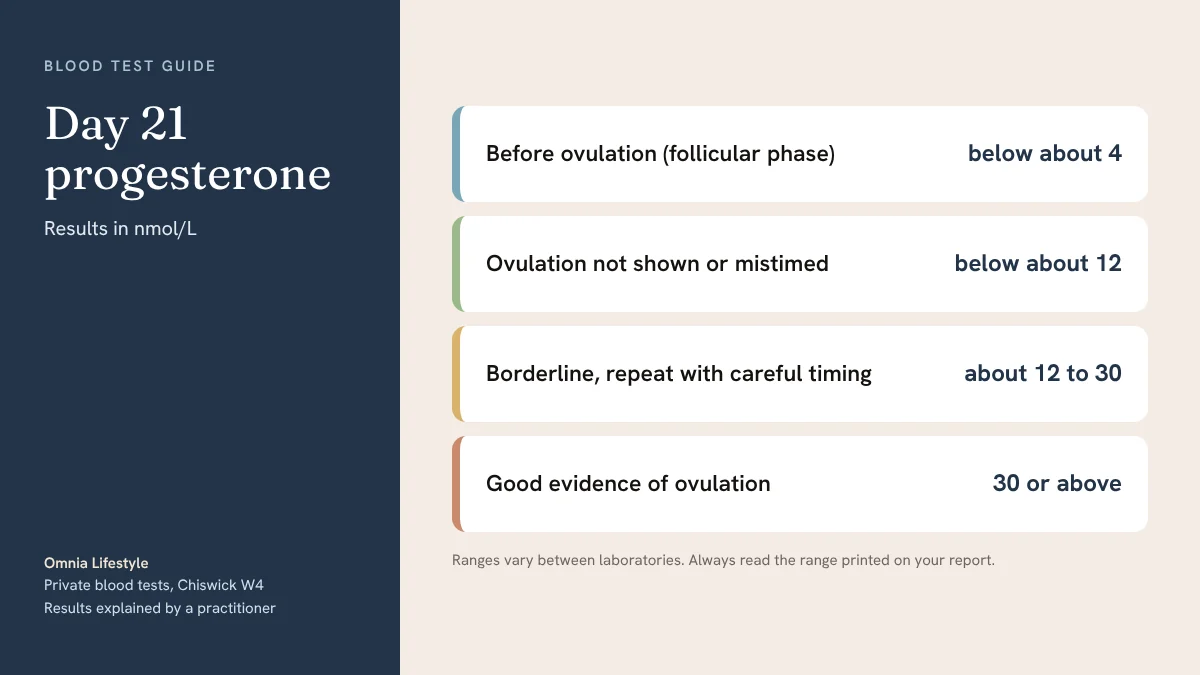
These bands follow guidance from NHS laboratories in Gloucestershire and North Bristol, for a sample taken about 7 days before your period:
- 30 nmol/L or above: good evidence that you ovulated in this cycle. Further hormone tests for ovulation are not usually needed, and attention moves to other parts of a fertility assessment.
- About 12 to 30 nmol/L: borderline. This is often a timing issue, so the test is repeated in another cycle with careful timing. North Bristol notes that a repeat above 12 nmol/L in someone with regular cycles is consistent with normal ovulation.
- Below about 12 nmol/L: ovulation is not shown in this cycle, or the sample was taken at the wrong time. In the first half of the cycle, before ovulation, progesterone is normally below about 4 nmol/L.
Laboratories set slightly different cut-offs. Royal Cornwall Hospitals, for example, treats below 15 nmol/L as suggesting no ovulation, 15 to 30 nmol/L as possible ovulation, and above 30 nmol/L as ovulation. Gloucestershire stresses that 30 nmol/L is a guide, not an absolute cut-off, and a lower value does not rule out ovulation.
Why progesterone might be low
- Timing: the most common reason. Testing too early or too late in the cycle misses the peak, especially with longer or irregular cycles.
- No ovulation that cycle: an occasional cycle without ovulation can happen, so one low result is not a diagnosis.
- PCOS: polycystic ovary syndrome, which the NHS now also calls PMOS, is a common cause of irregular or absent ovulation.
- Thyroid problems or a raised prolactin level.
- Low body weight, rapid weight loss, excessive exercise or stress.
- Perimenopause, when ovulation becomes less regular.
- Hormonal contraception, which usually stops ovulation, so the test is not useful while you are using it.
When progesterone is higher
Progesterone is naturally higher after ovulation and rises further in pregnancy. Progesterone medicines, used in fertility treatment or as part of HRT, can also raise the result. A progesterone test is not a pregnancy test: if your period is late, take a pregnancy test first.
What to do with your result
- Ovulation confirmed: if you have been trying for a while without success, other checks such as semen analysis for a partner and tests of the fallopian tubes may be the next step through your GP.
- Borderline: repeat in another cycle, timed 7 days before your expected period. Tracking your cycle length for a few months helps.
- Low on repeat testing: discuss with your GP, who may arrange FSH, LH, prolactin and thyroid tests and refer you if needed.
Our Fertility Panel (£159) includes progesterone with oestradiol, FSH, LH, prolactin, testosterone, SHBG, thyroid function and key vitamins and minerals, which can help when you want a broader picture before trying to conceive.
When to see your GP
Book a GP appointment if you:
- Have not conceived after a year of trying through regular unprotected sex
- Are 36 or over and trying to conceive, as the NHS advises seeking help sooner
- Have had cancer treatment in the past or think you may have a sexually transmitted infection
- Have missed three periods in a row, or your periods have become irregular
Get urgent help: if you might be pregnant and have a sharp, sudden and intense pain in your tummy, feel very dizzy or faint, feel sick or look very pale, call 999 or go to A&E, as these can be signs of an ectopic pregnancy. If you have a combination of these symptoms but they are milder, contact your GP or call NHS 111.
Who should consider a progesterone test
- Anyone trying to conceive who wants to confirm ovulation
- Women with irregular, infrequent or very light periods
- Women with suspected PCOS
- Anyone planning a pregnancy who wants a baseline hormone picture
Preparing for your test
- Work out your test day: count back 7 days from when your next period is due, and book for that day.
- Tell us your cycle details: the first day of your last period and your usual cycle length. Laboratories need this to interpret the result.
- Fasting: not needed.
- Medicines: tell us about any hormonal contraception, fertility drugs or progesterone medicines.
- Biotin: if you take high-dose biotin, NHS laboratories advise leaving at least 8 hours between your last dose and the sample.
- If your period comes earlier or later than expected: let us know, as this changes how the result is read.
How often to retest
One result above 30 nmol/L is usually enough for that question. A borderline or low result is worth repeating in another cycle with careful timing before drawing conclusions. If your cycles are irregular, your practitioner may suggest more than one test in the same cycle.
Frequently asked questions
Is a progesterone of 25 nmol/L on day 21 good?
It is borderline. It may mean you ovulated but the test was not perfectly timed. NHS laboratories suggest repeating in another cycle, timed 7 days before your expected period.
Can I ovulate with progesterone below 30 nmol/L?
Yes. NHS laboratory guidance states that a value below 30 nmol/L does not rule out ovulation. Timing is the most common reason for a lower result.
When should I take a progesterone test if my cycle is 35 days?
Around day 28, which is 7 days before your next period is due.
Can a progesterone test tell me I am pregnant?
No. Progesterone rises in pregnancy, but it is not a pregnancy test. Use a pregnancy test if your period is late.
Do I need to fast for a progesterone test?
No. Timing in your cycle matters far more than food.
Progesterone testing in Chiswick
You can have your blood taken at Omnia Lifestyle, 8 to 9 Bedford Corner, The Avenue, Chiswick, London W4 1LZ. We are a short walk from Turnham Green station on the District line (Piccadilly line trains stop there early in the morning and late in the evening only), and buses 94, E3 and 272 stop nearby. Limited parking is available on request when you book. Your sample is analysed at the Randox accredited laboratory, you do not need a GP referral, and a practitioner explains your result with you in person. Most results are ready within a few working days, and a GP feedback report is available on request.
Book our Progesterone test, explore our women’s health blood tests, or compare every blood test and price. If you are planning a pregnancy, read our guide to blood tests before pregnancy, and see oestradiol levels explained for the other key cycle hormone.
This article is general information, not medical advice. Discuss your results with your GP or practitioner.
Ready to book?
Blood Test




.jpg)
.jpg)
