


Book at our Chiswick clinic
Ayurveda
Herbs are central to Ayurveda. Some, such as ginger, turmeric and coriander, are everyday kitchen spices; others, such as ashwagandha and triphala, are now sold widely as supplements in the UK. Their popularity has grown far faster than the research, and herbal products can have real side effects and interactions, so it helps to know what each herb is traditionally used for, what the evidence says and how to use them safely.
This guide explains what Ayurvedic herbs are, the most common herbs and their traditional uses, Ayurvedic teas and herbal oils, what the evidence shows, and how to use Ayurvedic herbs safely in the UK.
Quick answer
Ayurvedic herbs are plants used in Ayurveda, the traditional medicine of India, to support digestion, sleep, stress, energy and joint health. Common examples include ashwagandha, turmeric, triphala, tulsi (holy basil), brahmi, shatavari, ginger and liquorice. Some have promising early research, but good-quality evidence is limited for most. Herbs can cause side effects and interact with medicines, and some imported products have been found to contain heavy metals, so buy carefully and check with your GP or pharmacist first.
What are Ayurvedic herbs?
In Ayurveda, herbs are described by their taste, their heating or cooling quality and their effect on the three doshas, Vata, Pitta and Kapha. The study of medicinal plants in Ayurveda is called dravyaguna, and Ayurvedic herbalism has a long written tradition. Herbs are rarely used alone: they are usually combined in formulas and given as powders (churna), tablets, decoctions (kashaya), medicated ghee, teas or herbal oils.
Herbs are also only one part of Ayurvedic care. A practitioner would normally consider diet, daily routine, sleep and stress first. Our guides to what Ayurveda is and the Ayurvedic diet explain that wider picture.
Common Ayurvedic herbs and what they are used for
Ashwagandha (Withania somnifera)
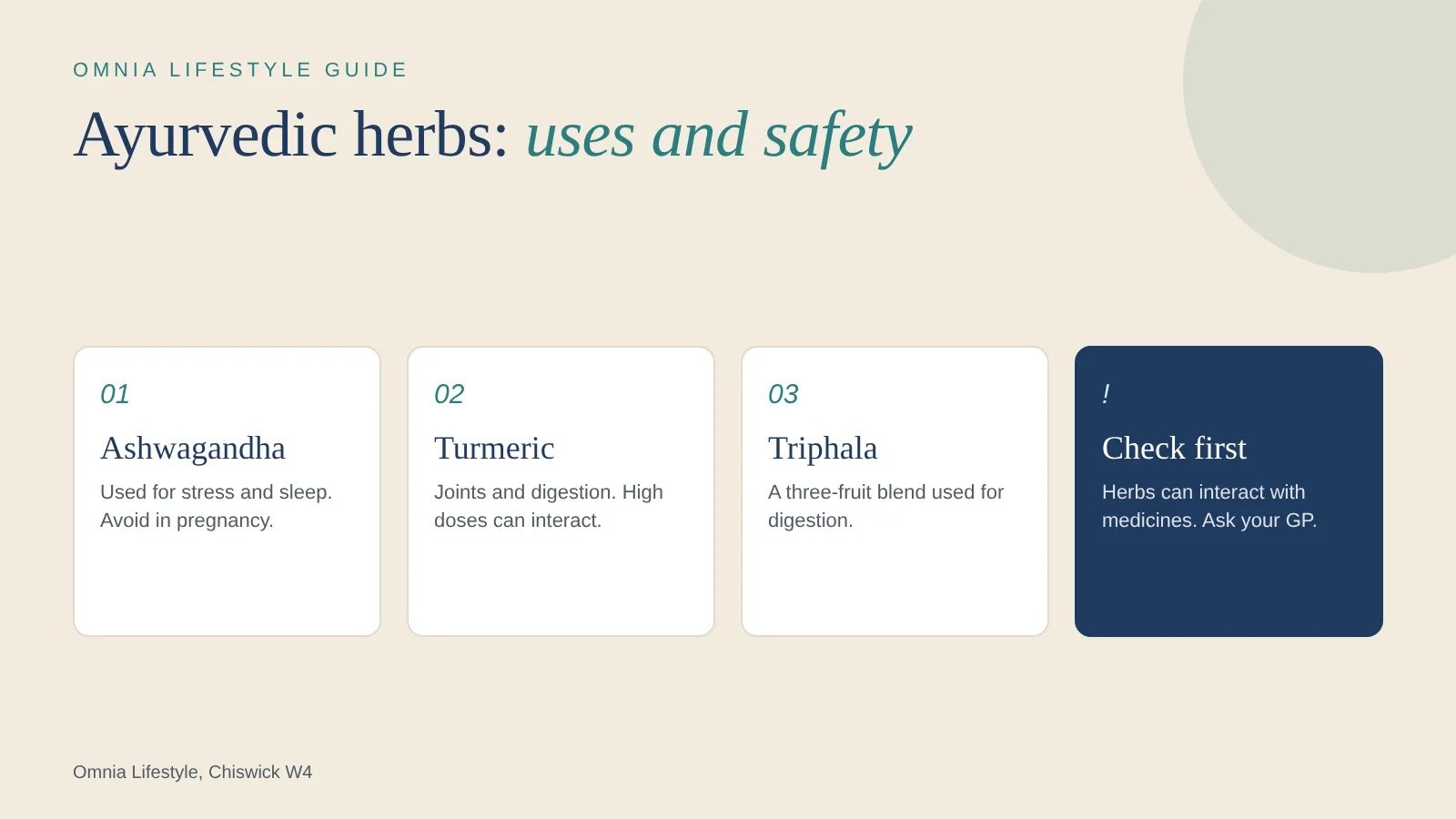
Traditional use: stress, sleep, energy and recovery. It is described as a rasayana, or rejuvenating herb.
Evidence: small trials suggest it may reduce feelings of stress and improve sleep, but they are short and of mixed quality.
Cautions: avoid in pregnancy. Speak to your GP first if you have a thyroid or autoimmune condition, or take sedatives or medicines for diabetes or blood pressure. Rare cases of liver injury have been reported, and some European countries have restricted ashwagandha supplements over safety concerns.
Turmeric (haridra)
Traditional use: inflammation, joints, digestion and skin.
Evidence: some studies of curcumin, its main active compound, suggest small benefits for joint pain, but curcumin is poorly absorbed and results vary.
Cautions: turmeric in food is safe for most people. High-dose supplements have been linked to rare liver injury and can interact with blood thinners. Avoid supplements if you have gallstones or are pregnant.
Triphala
Traditional use: a blend of three fruits (amalaki, bibhitaki and haritaki) used for digestion and regular bowel movements.
Evidence: limited, mostly small studies.
Cautions: it can have a laxative effect and cause loose stools or cramps. Avoid in pregnancy and check with your GP if you have a bowel condition.
Tulsi (holy basil)
Traditional use: stress, coughs and colds, and general wellbeing. Often drunk as tea.
Evidence: small studies suggest possible benefits for stress and blood sugar, but larger trials are lacking.
Cautions: may lower blood sugar, so take care if you have diabetes. Avoid supplements in pregnancy or if you are trying to conceive.
Brahmi (Bacopa monnieri)
Traditional use: memory, concentration and calm.
Evidence: some trials suggest small improvements in memory over several months.
Cautions: can cause nausea, cramps or loose stools, and may interact with thyroid medicines and sedatives.
Shatavari
Traditional use: women's health, including the menstrual cycle, menopause and breastfeeding.
Evidence: very little good-quality clinical research.
Cautions: speak to your GP first if you have a hormone-sensitive condition or are pregnant.
Ginger (shunthi)
Traditional use: digestion, nausea and colds. Called the universal medicine in Ayurveda.
Evidence: ginger has reasonable evidence for easing nausea, and the NHS notes it may help pregnancy sickness.
Cautions: ginger in food is safe for most people. Check with a pharmacist before taking ginger supplements in pregnancy or with blood thinners. See ginger tea for stress.
Liquorice (yashtimadhu)
Traditional use: sore throats, coughs and digestion.
Cautions: regular or large amounts can raise blood pressure and lower potassium. Avoid if you have high blood pressure, heart or kidney disease, or are pregnant.
Guduchi (giloy) and neem
Guduchi is traditionally used for immunity and fevers, and neem for the skin. Both have limited clinical evidence. Cases of liver injury have been reported with guduchi, and neem oil must never be swallowed or given to children.
Kitchen spices: coriander, cumin and fennel
These everyday spices are used in Ayurveda to support digestion and are safe in normal food amounts. Read more about coriander in Ayurveda.
Ayurvedic teas
Herbal teas are one of the simplest and safest ways to use Ayurvedic herbs, because the amounts are small.
- Cumin, coriander and fennel (CCF) tea: simmer half a teaspoon of each seed in a large mug of water for five minutes and strain. Sipped after meals for digestion.
- Fresh ginger tea: a few slices of fresh ginger steeped in hot water, with lemon if you like.
- Tulsi tea: holy basil leaves, often blended with ginger or green tea, used for calm.
- Spiced chai: black tea simmered with ginger, cardamom, cinnamon, cloves and black pepper. In Ayurveda, black tea is seen as stimulating and drying, and the spices are said to balance it.
- Green tea: lighter in caffeine than black tea and often suggested for Kapha types.
Be cautious with "detox" or slimming teas sold as Ayurvedic blends. Some contain senna or other laxatives, which are not suitable for regular use.
Herbal oils and oiling in Ayurveda
Herbs are also used in oils for the skin. Abhyanga, the Ayurvedic full-body oil massage, uses warm sesame or coconut oil infused with herbs chosen for your constitution, and oiling the scalp or feet before bed is a common part of an Ayurvedic routine. See our guide to Ayurvedic massage and Ayurvedic daily routine.
What does the evidence say?
Research into Ayurvedic herbs is growing, but most studies are small, short and of variable quality, and products differ widely in strength and purity. A herb that shows promise in a small trial may not work the same way from a different supplier. Herbs should be seen as possible support for wellbeing, not as treatment for a medical condition. Read more about whether Ayurveda is scientifically proven.
Are Ayurvedic herbs safe? How to use them safely in the UK
Natural does not always mean safe. The UK medicines regulator, the MHRA, has warned that some Ayurvedic products bought online or imported have contained harmful levels of heavy metals such as lead, mercury and arsenic, which in some traditional preparations are added on purpose.
- Look for the THR mark: herbal medicines with a Traditional Herbal Registration have been checked for quality and safety for their stated use.
- Buy from reputable UK suppliers and be wary of products making strong medical claims.
- Tell your GP and pharmacist about any herbs you take, especially if you take blood thinners, diabetes medicines, thyroid medicines, immune-suppressing medicines, antidepressants or sedatives.
- Avoid herbal supplements in pregnancy and breastfeeding unless your GP or midwife agrees, and do not give them to children without advice.
- Stop herbs before surgery and tell your surgical team what you have taken.
- Never stop prescribed medicine in favour of herbs.
Stop taking the product and see your GP urgently or contact NHS 111 if you notice: yellowing of the skin or eyes, dark urine, pale stools, itching, ongoing tummy pain or unusual tiredness, which can be signs of liver problems.
Call 999 if you have signs of a severe allergic reaction, such as swelling of the lips, mouth or throat, difficulty breathing or feeling faint.
How we help in Chiswick
At Omnia Lifestyle, Ayurveda is doctor-led. Our clinical lead Dr Palitha Serasinghe and Ayurveda doctor Dr Athira Anilkumar look at your diet, routine, sleep and stress before anything else, and can talk you through whether particular herbs are appropriate for you, taking any medicines you take into account.
- Ayurvedic consultation in Chiswick: 30 minutes £65, or 60 minutes £95.
- Veda Pulse assessment: 30 minutes, £50.
- Abhyanga herbal oil massage: 60 minutes, £90.
See what happens at a first Ayurvedic consultation and how Ayurveda differs from modern medicine, or book a consultation.
Frequently asked questions
What is the most powerful Ayurvedic herb?
There is no single most powerful herb. Ayurveda chooses herbs for the individual, and a herb that suits one person may not suit another. Ashwagandha and turmeric are the most researched.
Can I take Ayurvedic herbs with my medication?
Some herbs interact with common medicines, including blood thinners, diabetes and thyroid medicines. Always check with your GP or pharmacist first.
Are Ayurvedic herbs regulated in the UK?
Herbal medicines with a THR mark are regulated for quality and safety. Many products sold online as food supplements are not checked in the same way, so quality varies.
What is Ayurvedic tea?
Ayurvedic tea is a herbal or spiced tea made with ingredients used in Ayurveda, such as ginger, tulsi, cumin, coriander, fennel, cardamom and cinnamon, often chosen to suit your dosha.
How long do Ayurvedic herbs take to work?
Most studies run for several weeks to a few months. If a herb has not helped within that time, or causes side effects, stop and seek advice.
Ayurvedic advice at Omnia Lifestyle
If you are curious about Ayurvedic herbs but want to use them safely, a consultation is a good place to start. Omnia Lifestyle is at 8 to 9 Bedford Corner, The Avenue, Chiswick W4 1LZ, close to Turnham Green station, on bus routes 94, E3 and 272. Limited parking is available on request when booking.
This article is general information, not medical advice. If you have any of the warning signs listed above, seek medical attention.
Ready to book?
Ayurveda



.jpg)
.jpg)