


Book at our Chiswick clinic
Red Light Therapy
Light has a powerful effect on sleep. Bright daylight in the morning helps set your body clock, while bright light late in the evening can keep you awake. That has led to plenty of interest in whether red light, either as a dim night light or as red light therapy, can help you sleep better or lift your mood. Some of the claims online go well beyond the evidence.
This guide explains how light affects sleep, whether red light is good for sleep, what the research says about red light therapy for sleep and mood, how bright light therapy for seasonal affective disorder differs, and when to speak to your GP.
Quick answer
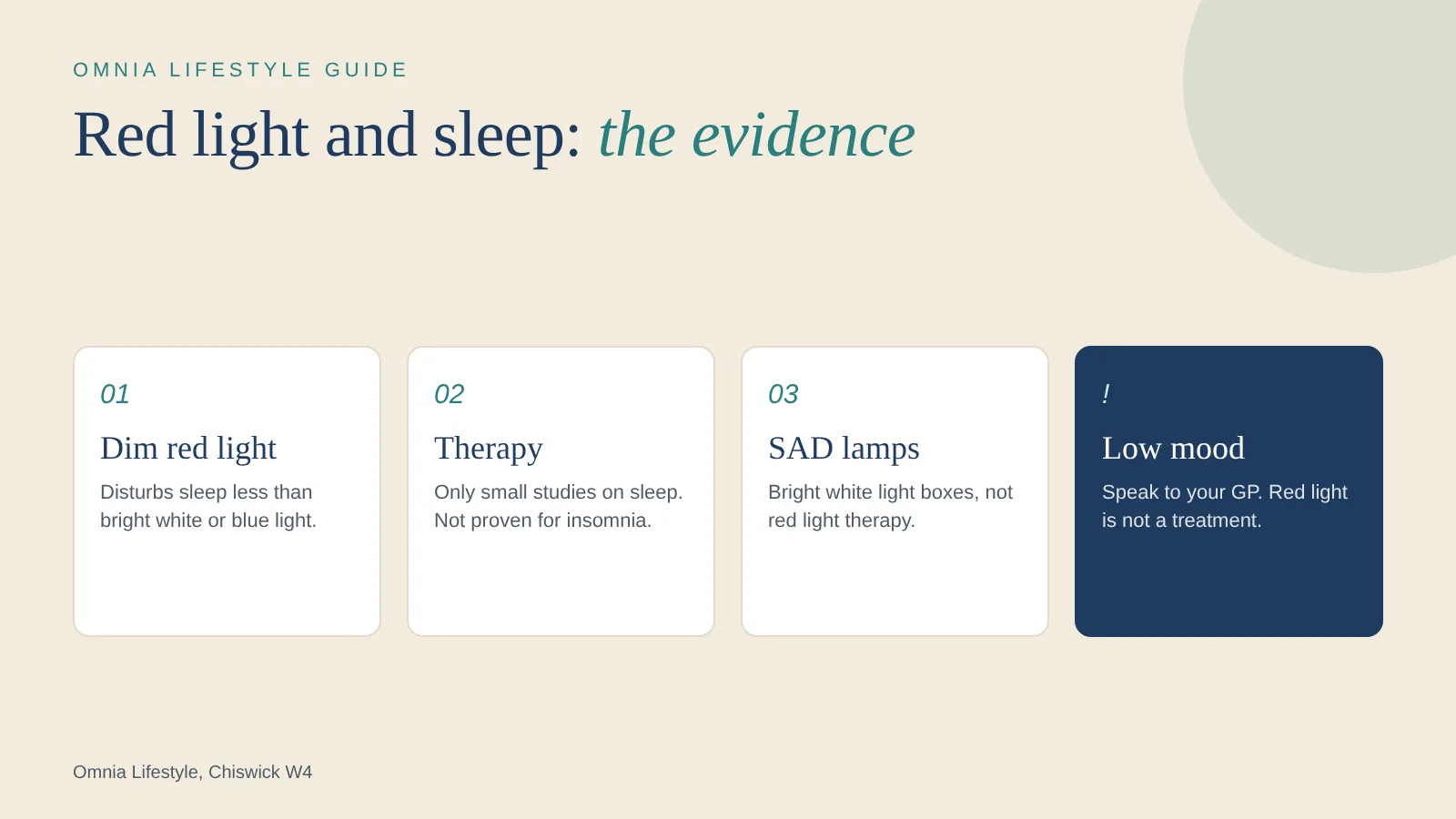
Dim red light is less likely to disrupt sleep than bright white or blue light, so a low red or amber light is a sensible choice if you need a light at night. Darkness is still best. Red light therapy, which uses stronger red and near-infrared light on the skin, has only a few small studies on sleep, and the evidence is too limited to say it improves sleep or mood. It may feel relaxing, but it is not a treatment for insomnia or depression.
How light affects your sleep
Your body clock, or circadian rhythm, runs on a cycle of roughly 24 hours and is set mainly by light reaching your eyes. Special light-sensitive cells in the retina are most responsive to blue and blue-green light. When they detect bright light, they signal the brain that it is daytime and reduce the release of melatonin, the hormone that helps you feel sleepy in the evening.
- Morning daylight helps set your clock, so you feel alert during the day and sleepy at night.
- Bright light in the evening, including from ceiling lights and screens, can delay melatonin and make it harder to fall asleep.
- Darkness at night allows melatonin to rise and supports deeper, less broken sleep.
Brightness matters as much as colour. Even light of a "sleep-friendly" colour can affect sleep if it is bright enough.
Is red light good for sleep?
Compared with white or blue light, dim red light has the smallest effect on the body clock, because the light-sensitive cells that control melatonin respond weakly to long red wavelengths. This means:
- A dim red or amber night light is a better choice than a white one if you need to see at night, for example when feeding a baby or getting up to the toilet.
- Switching to warm, dim lighting in the hour or two before bed is helpful.
- Sleeping with any light on is still less ideal than a dark room, and bright red light can still disturb sleep.
So the honest answer to "does red light help you sleep?" is that dim red light is less harmful to sleep than other light, rather than actively making you sleep better.
Is green light good for sleep?
Green light is closer to the colours that most affect melatonin, so it is more likely than red light to disturb sleep. There is no good evidence that green light helps sleep. If you need a night light, red or amber is the better choice.
Does red light therapy help you sleep?
Red light therapy, also called photobiomodulation, is different from a red night light. It uses much stronger red and near-infrared light directed at the skin and the tissue beneath, and is mainly studied for skin, muscle recovery and joint pain. Read more in red light therapy benefits.
For sleep, the research is thin:
- A small study in elite female basketball players reported better sleep quality scores after two weeks of evening red light sessions, but it was small and short.
- A few other small studies, some looking at near-infrared light applied to the head, have reported changes in sleep or mood, but they are early-stage and not consistent.
- There are no large, high-quality trials showing that red light therapy treats insomnia.
Many people find a session relaxing, and some notice they sleep well afterwards, particularly if pain or muscle soreness has been keeping them awake. That is a reasonable personal reason to try it, but it should not replace proven approaches to poor sleep.
Light therapy for SAD and depression
Seasonal affective disorder (SAD) is a type of depression that usually comes and goes with the seasons, typically worse in winter. Bright light therapy for SAD is different from red light therapy. It uses a light box giving very bright white light, usually 10,000 lux, used each morning to mimic daylight. The NHS notes that light therapy is not usually available on the NHS because there is not enough evidence to tell whether it is effective, although many people find it helps. If you buy a light box, the NHS advises choosing one that is UV-free and meets UK safety standards, and speaking to a GP first if you have an eye condition or take medicine that makes you sensitive to light.
Red light therapy is not a treatment for depression. Research into light treatment for depression beyond SAD, including near-infrared light applied to the head, is at an early stage. Depression is best treated with support from your GP, talking therapies and, where needed, medicine. In England you can refer yourself to NHS talking therapies. Read about signs of depression and depression support.
If you are struggling to cope or having thoughts of harming yourself, call NHS 111 or contact your GP urgently. You can also call Samaritans free, day or night, on 116 123. If you feel you might act on those thoughts or your life is at risk, call 999 or go to A&E.
Red light and mood
Some people say red light therapy sessions lift their mood or energy. A short period lying still in warm light can feel calming, and easing pain can improve how you feel generally. Beyond that, evidence that red light therapy improves mood is limited and comes from small studies.
How to use light to sleep better
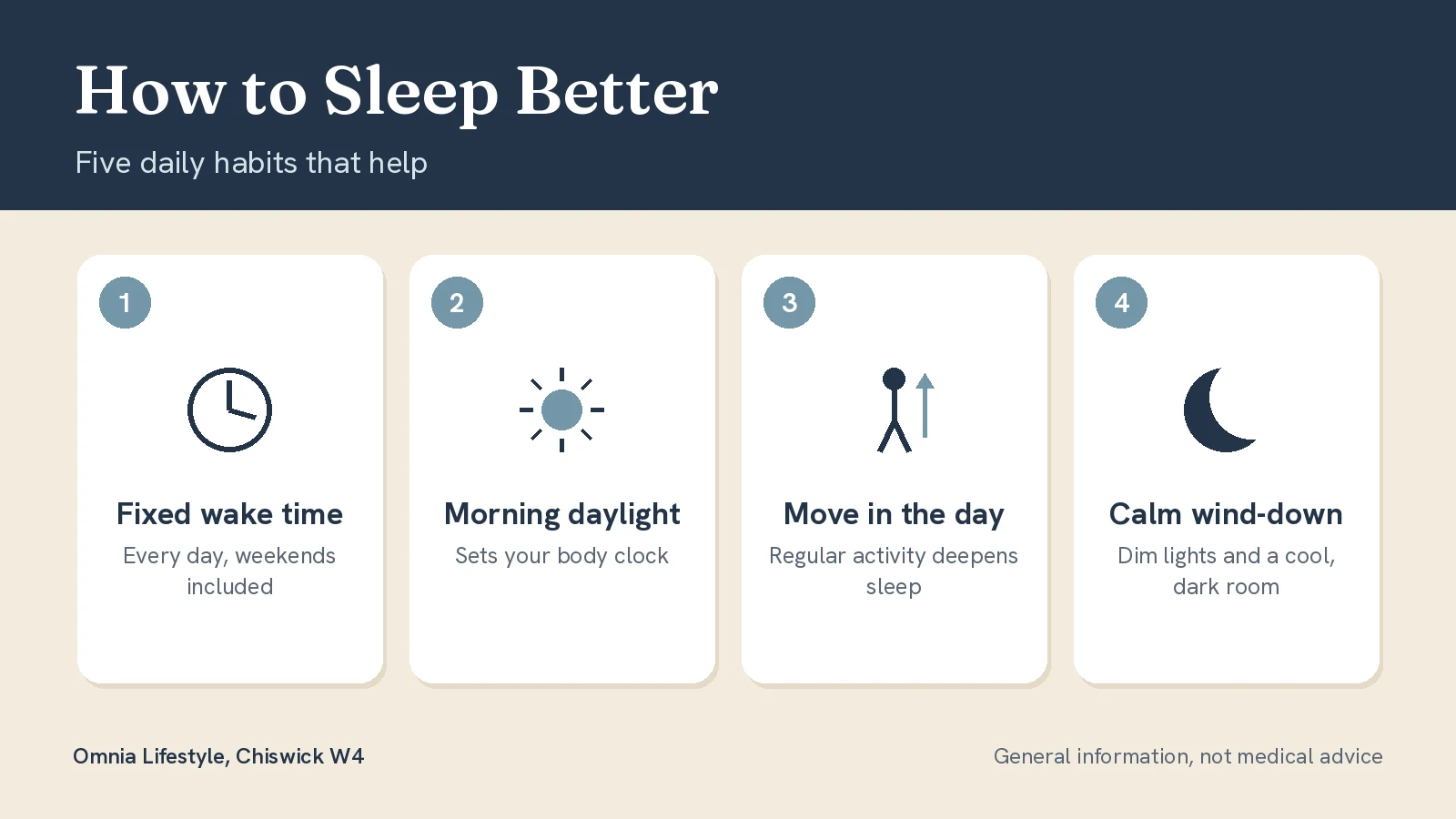
These habits have much better evidence than any device:
- Get daylight early: spend time outside in the morning, even on cloudy days.
- Dim the lights in the evening: use warm, low lamps for the last hour or two before bed.
- Limit screens before bed, or turn the brightness down and use night mode.
- Keep your bedroom dark, with blackout curtains or an eye mask, and cool and quiet.
- Use a dim red or amber night light if you need one.
- Keep regular sleep and wake times, including at weekends.
- Cut back on caffeine after midday and alcohol in the evening.
For more practical steps, see five daily habits that improve sleep and why you cannot sleep.
If you want to try red light therapy for sleep
- Keep expectations realistic: treat it as a relaxing addition to good sleep habits, not a cure.
- Timing: there is no proven best time. Some people prefer an afternoon or early evening session.
- Track your sleep with a simple sleep diary for two to four weeks so you can judge any change honestly.
- Protect your eyes with the eyewear provided, as the light is very bright.
Red light therapy is generally well tolerated, but check with your GP first if you have epilepsy triggered by light, a condition that makes you sensitive to light, a history of skin cancer, or are pregnant, and ask your pharmacist whether any medicine you take increases light sensitivity. See is red light therapy safe.
When to see your GP about sleep
See your GP if poor sleep has lasted for three months or more, or is affecting your daily life, work or mood. Also speak to them if:
- Someone notices you snore loudly, gasp or stop breathing during sleep, which can be sleep apnoea
- You have an urge to move your legs at night that stops you sleeping
- You feel very sleepy during the day, especially while driving
- Poor sleep comes with low mood, anxiety or worry you cannot switch off
The main recommended treatment for long-term insomnia is cognitive behavioural therapy for insomnia (CBT-I). Read more in what is insomnia.
How we help in Chiswick
At Omnia Lifestyle we are honest about what red light therapy can and cannot do. Sessions start with a short check of your health, medicines and goals, and we can suggest other approaches if sleep is your main concern.
- Red light therapy in Chiswick: a 20-minute full-body NovoTHOR session is £70, and a 30-minute THOR laser session is £80. The Omnia Red membership includes 8 NovoTHOR sessions a month for £225.
- Acupuncture for insomnia: traditional acupuncture is £80 for 60 minutes at our acupuncture clinic.
- Clinical psychology: with Prof (Dr) Diwakar Sukul, Chartered Clinical Psychologist, in person or by secure video, for low mood, anxiety and the worries that keep you awake.
Read more about poor sleep and insomnia and whether the NovoTHOR bed works, or book an appointment.
Frequently asked questions
Should I use red light before bed?
A dim red or amber light in the evening is less likely to disturb sleep than bright white light. There is no strong evidence that a red light therapy session before bed improves sleep.
Does red light increase melatonin?
Dim red light suppresses melatonin less than other light, which helps your natural evening rise. One small study reported higher melatonin after red light therapy, but this has not been confirmed in larger research.
Can red light therapy help insomnia?
There is not enough evidence to recommend it for insomnia. CBT-I and good sleep habits are the best-supported approaches.
Is it safe to sleep with a red light on?
A dim red night light is generally safe and less disruptive than other colours, but a dark room is best for sleep.
Can red light therapy help SAD?
The light therapy used for SAD is bright white light from a light box, not red light therapy. Speak to your GP if you think you have SAD.
Red light therapy at Omnia Lifestyle
If you would like to try red light therapy as part of a wider plan for recovery, comfort and rest, our team will talk you through what to expect. Omnia Lifestyle is at 8 to 9 Bedford Corner, The Avenue, Chiswick W4 1LZ, close to Turnham Green station, on bus routes 94, E3 and 272. Limited parking is available on request when booking.
This article is general information, not medical advice. If you have any of the warning signs listed above, seek medical attention.
Ready to book?
Red Light Therapy

.jpg)
.jpg)