






Book at our Chiswick clinic
Red Light Therapy
Back pain that lingers for months can send you looking for anything that might help, and red light therapy is often near the top of the list. This guide is for adults with ongoing lower back pain, with or without sciatica, who want a straight answer on what the research shows, what UK guidance recommends first, and whether light therapy is worth adding to their plan.
When to see someone: if you want to try light therapy as part of a wider plan for back pain, targeted red light therapy with the THOR laser is £80 for 30 minutes in Chiswick and can be combined with physiotherapy. Book online or call 020 4515 0000.
Quick answer
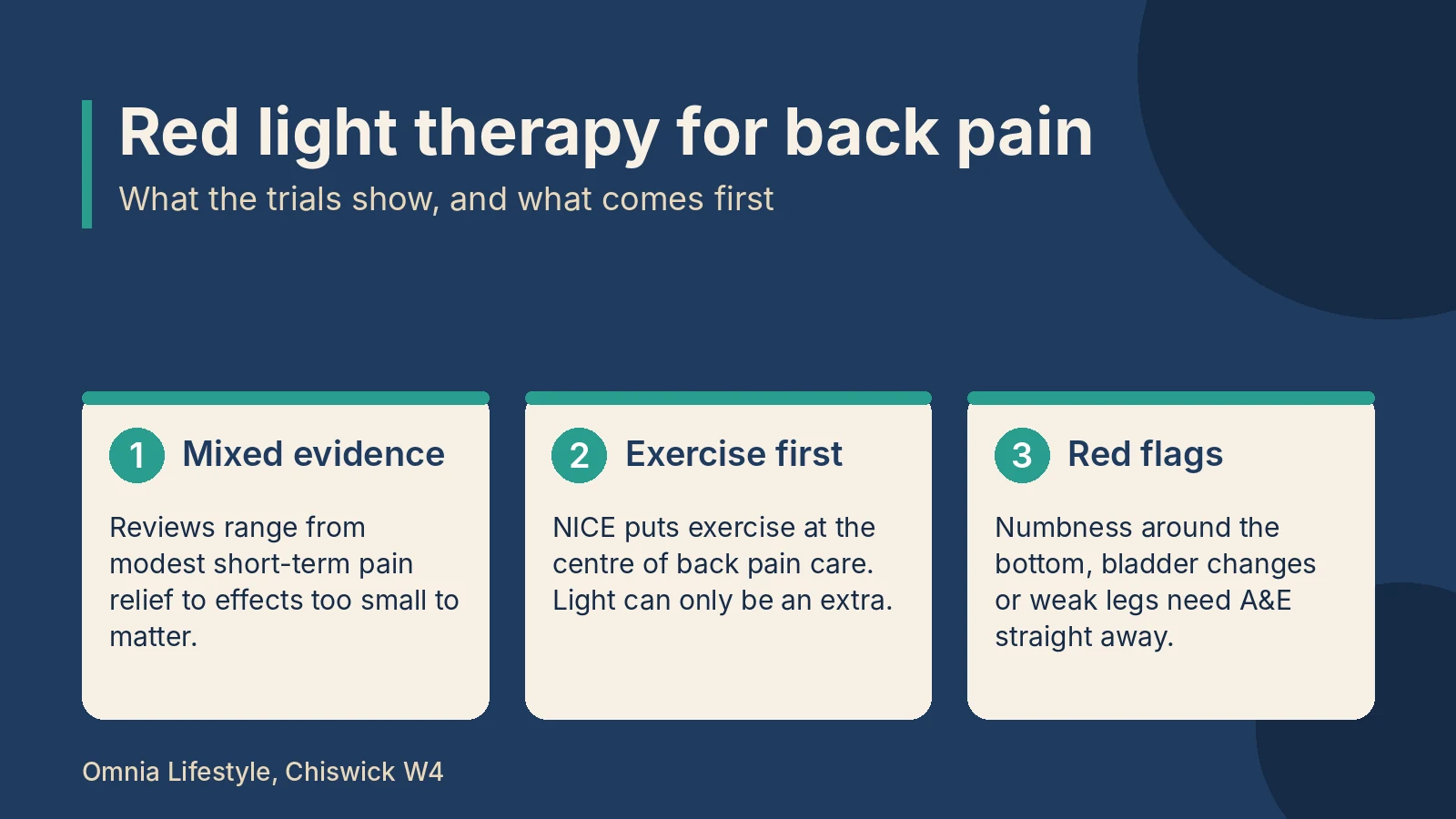
The evidence for red light therapy for back pain is mixed. One 2015 review found modest short-term pain relief compared with placebo but no clear change in disability, while a larger 2020 review concluded the effect on pain and disability was too small to matter. NICE does not include light therapy among its recommended treatments for low back pain; exercise comes first. Red light therapy is low risk and some people find it helps, but it should only ever be an extra, not the main treatment.
Does red light therapy work for back pain?
It depends on what you mean by work. Several small trials have reported less pain after a course of laser or near-infrared light, but when researchers pool the trials together, the benefit shrinks. Back pain also varies naturally from week to week, so it is easy to credit a treatment with an improvement that would have happened anyway. That is why placebo-controlled trials matter so much here.
Our honest view is that red light therapy may ease pain a little for some people with long-standing back pain, but it is unlikely to change how well you can move, work or exercise on its own. It is not a treatment for the cause of back pain, and it does not fix a slipped disc or a trapped nerve.
What the research on red light therapy for back pain shows
- 2015 review in Arthritis Research and Therapy. Seven randomised trials with 394 people with non-specific chronic low back pain. Laser therapy reduced pain scores more than placebo after treatment, by about 14 points on a 100-point scale, but there was no significant effect on disability or spinal movement.
- 2020 review in the Journal of Physiotherapy. Twelve randomised trials with 1,046 people. Compared with sham treatment, the effect on pain and disability was judged clinically unimportant, and the authors concluded that current evidence does not support light therapy to reduce pain and disability in non-specific low back pain.
- Cochrane review. An earlier Cochrane review found small, clinically unimportant pain relief over sham in three small studies, and concluded there were insufficient data to draw firm conclusions.
So the research leans towards a small effect at best. Device, wavelength, dose and number of sessions all vary between studies, which is part of why results disagree. For how lasers and LED beds differ in depth and dose, read laser vs LED red light therapy.
What NICE recommends for back pain first
NICE guideline NG59 on low back pain and sciatica puts exercise at the centre of care, including group exercise programmes, and suggests manual therapy only as part of a package that includes exercise. It advises against several passive treatments, including acupuncture, ultrasound, TENS and interferential therapy. Light therapy is not among the treatments NICE recommends.
The NHS adds that most back pain improves within a few weeks, and that keeping active, gentle exercises and stretches, and ice or heat packs are the first things to try. If you add red light therapy, it should be to make it easier to keep moving, not a reason to rest more.
Red light therapy for back pain and sciatica
Sciatica is leg pain caused by an irritated nerve in the lower back. Light therapy cannot reach the nerve root deep in the spine with any reliable dose, and there is little good research on it for sciatica specifically. The core treatments are staying active, sciatica exercises and, if needed, physiotherapy for sciatica. If you choose light therapy, see it as a way to ease the muscle ache around the lower back and buttock while you do those things.
NovoTHOR bed or THOR laser for back pain?
THOR laser. A handheld probe treats a set of points over the painful area of the back for about 30 minutes. Laser light is concentrated, so it reaches deeper into the muscles alongside the spine. It suits pain in one area, and it can be added to a physiotherapy session plan.
NovoTHOR bed. You lie in a full-body LED pod for 20 minutes. The dose at any one spot is lower, so it suits people whose back pain is part of wider aches and stiffness, or who want regular sessions for general recovery.
Whichever you choose, your session starts with a check of your symptoms and medicines, and you wear protective eyewear. It feels like gentle warmth or nothing at all.
How many sessions, and what does it cost?
Trials for back pain typically used two or three sessions a week for two to six weeks. Give a course a fair try, then judge it by what you can do, such as sitting, walking or sleeping, not only by how you feel straight after a session. If nothing has changed after six to eight sessions, put your time into exercise and other support instead.
At Omnia in Chiswick, a THOR laser session is £80 for 30 minutes, a NovoTHOR session is £70 for 20 minutes, and the Omnia Red membership gives eight NovoTHOR sessions a month for £225.
Red light therapy for back pain at home
Home panels and wraps are widely sold for back pain. Most are far less powerful than clinical devices and few have been tested in trials, so results are hard to predict. If you buy one, check the wavelengths, follow the instructions, protect your eyes and do not use it on numb skin, where you may not notice overheating. More useful at home, with better evidence, are:
- Keeping active and avoiding long spells in bed or sitting still
- Back exercises and stretches. See our lower back pain exercises.
- Heat or ice packs wrapped in a towel
- Good sleep and stress management, which both affect how much pain you feel
Who should take care, and when to seek urgent help
Tell us before treatment if you are pregnant, take medicines that increase light sensitivity, have epilepsy triggered by light, or have a history of cancer. Treatment is not given over an area of active cancer or over a new pain or lump that has not been assessed by a doctor.
Call 999 or go to A&E if back pain comes with:
- Pain, tingling, weakness or numbness in both legs
- Numbness or loss of feeling around your genitals or bottom, or changes in genital sensation or sexual function
- Changes in bladder or bowel control, or difficulty peeing
- Chest pain, or back pain after a serious accident
Ask for an urgent GP appointment or call NHS 111 if you feel hot, cold, shivery or generally unwell, or severe pain starts suddenly or is getting worse quickly.
Frequently asked questions
Does red light therapy for back pain work?
The research is mixed. One review found a modest short-term drop in pain compared with placebo, while a larger review judged the effect on pain and disability too small to be clinically important. Some people do report feeling easier after a course. It is reasonable to try as an addition to exercise, but not as your main treatment.
What does the research say about red light therapy for back pain?
Systematic reviews from 2015 and 2020 reached different conclusions, and a Cochrane review found too little good data to be sure. Trials are small and use very different devices and doses. Overall, any benefit appears small and short term, and there is no clear evidence that light therapy improves function or disability in back pain.
Can red light therapy help back pain and sciatica?
It may ease the muscle ache around the lower back and buttock, but it cannot reliably reach an irritated nerve deep in the spine, and there is little research on sciatica specifically. Staying active, exercise and physiotherapy are the main treatments. Seek urgent help for numbness around the bottom, bladder changes or weakness in both legs.
How often should I use red light therapy for back pain?
Studies usually used two or three sessions a week for a few weeks. There is no proven benefit from daily or very long sessions, and more light is not always better. Agree a short course, track what you can do, and stop if it is not helping. See how often to do red light therapy.
Red light therapy for back pain in Chiswick
Our clinic is at 8 to 9 Bedford Corner, The Avenue, Chiswick W4 1LZ, close to Turnham Green station, on bus routes 94, E3 and 272. Limited parking is available on request when booking. Our physiotherapists work in the same building, so light therapy can sit inside an exercise-based plan.
Read more about back pain, see what causes back pain and physiotherapy for back pain, or explore red light therapy in Chiswick.
Book red light therapy in Chiswick: THOR laser 30 minutes £80, NovoTHOR 20 minutes £70. Book online or call 020 4515 0000.
This article is general information, not medical advice. If you have any of the warning signs above, seek medical attention.
Ready to book?
Red Light Therapy



.jpg)
.jpg)
