






Book at our Chiswick clinic
Red Light Therapy
Stiff knees on the stairs, sore finger joints in the morning, a hip that aches after a walk: joint pain is one of the most common reasons people ask about red light therapy. This guide is for adults with arthritis or long-standing joint pain who want to know what the research shows for knees and hands, what NICE says, and how light therapy might fit around the treatments that matter most.
When to see someone: if one or two joints are holding you back, targeted red light therapy with the THOR laser is £80 for 30 minutes in Chiswick, and we check your suitability and medicines first. Book online or call 020 4515 0000.
Quick answer
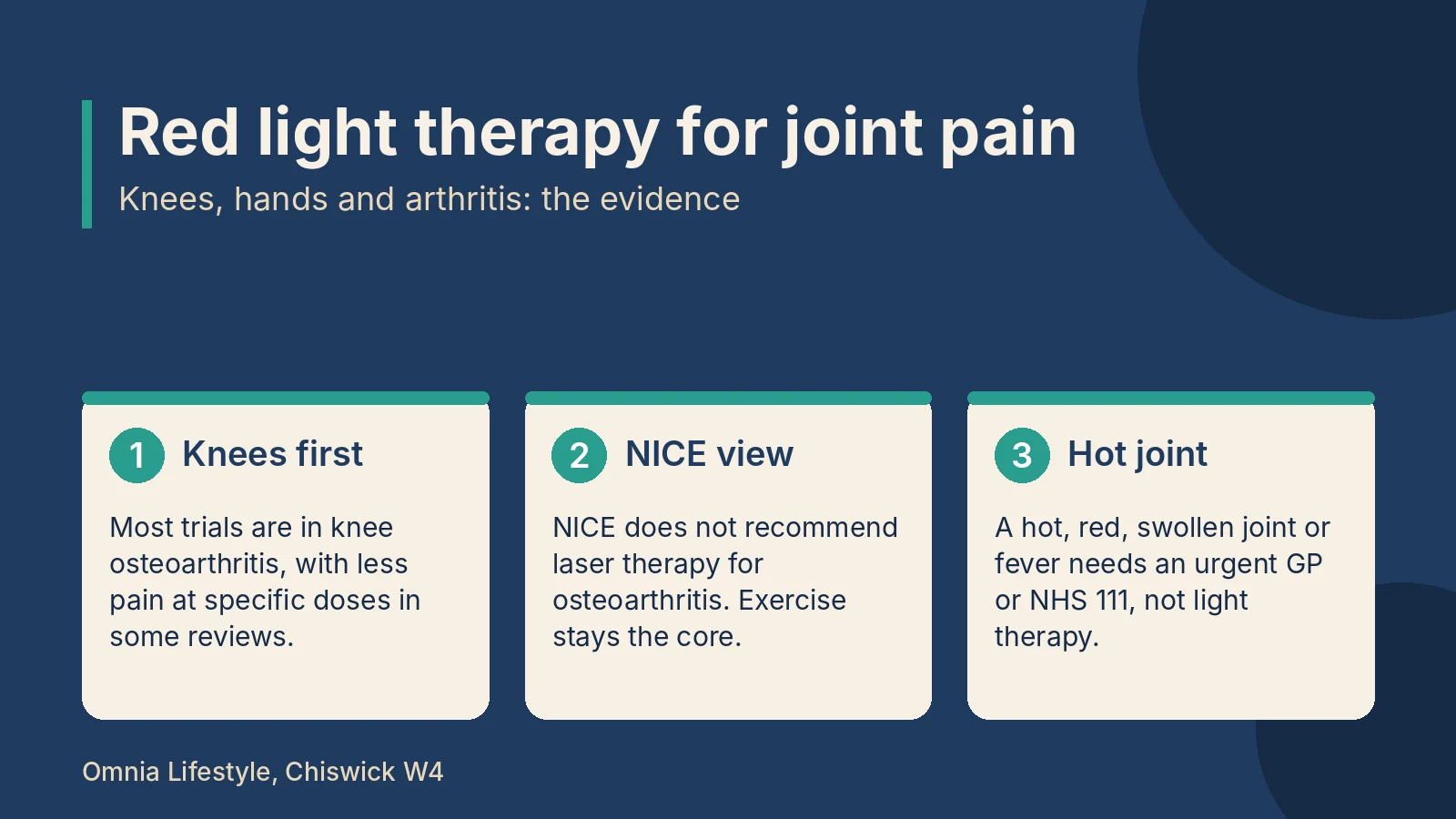
Red light therapy, also called photobiomodulation or low-level laser therapy, has been studied most for knee osteoarthritis. Some reviews of placebo-controlled trials report less pain and better function at specific doses, but results vary and NICE does not recommend laser therapy for osteoarthritis because it judges the evidence insufficient. Exercise and weight management remain the core treatments. Red light therapy is best seen as an optional, low-risk addition for some people, not a replacement for them.
How red light therapy is used for joint pain
Red and near-infrared light are absorbed by cells in and around the joint. Laboratory research suggests this can support cellular energy and calm some inflammatory signalling, which is the main reason light therapy is studied for arthritis. Near-infrared light passes deeper than visible red light, so it is the part most relevant to joints.
For a single painful joint, such as a knee, the base of the thumb or a shoulder, a targeted laser concentrates light where it is needed. A full-body bed spreads a lower dose across the whole body and suits people with aches in several places. For the general picture across skin, recovery and other uses, see our overview of red light therapy benefits. This guide focuses only on joints.
Red light therapy for joint pain: what the studies show
- Knee osteoarthritis. A 2019 BMJ Open review of 22 placebo-controlled trials (1,063 people) found that low-level laser therapy reduced knee pain and disability compared with placebo, with larger effects at the doses recommended by the World Association for Laser Therapy. Other reviews have reached more cautious conclusions, and trials differ widely in device, dose and length.
- Arthritis in the hands. Reviews in rheumatoid arthritis report less morning stiffness and better grip strength in some trials, but not clearly less pain than placebo, and the studies are small and varied.
- Other joints. Hips, shoulders and ankles have far less research. Hips in particular sit deep under muscle, so it is harder to get an effective dose to the joint.
Taken together, the evidence is emerging and mixed. Dose matters: too little light may do nothing, and more is not always better. We would rather say this clearly than promise results.
What NICE says about light and laser therapy for arthritis
NICE guideline NG226 on osteoarthritis recommends therapeutic exercise for everyone with osteoarthritis, tailored to their needs, along with weight management where relevant. It lists laser therapy among electrotherapy treatments it says not to offer, because there is insufficient evidence of benefit. It also advises against acupuncture and dry needling for osteoarthritis, and says manual therapy should only be considered alongside exercise.
So if you choose red light therapy for an arthritic joint, it should sit alongside strengthening exercise, not instead of it. Many people use it to take the edge off pain so that exercise feels more manageable. Our guide to treating osteoarthritis joint by joint explains what works best for each area.
Red light therapy for knee arthritis and joint pain in the hands
Knees. The knee is close to the surface at the front and sides, which makes it one of the easier joints to reach with targeted light. A typical laser session treats several points around the joint line and the back of the knee. Pair it with the strengthening work in our knee pain exercises guide.
Hands. Finger and thumb joints are small and superficial, so light reaches them easily. Hand osteoarthritis often affects the base of the thumb and the end joints of the fingers, and gentle hand exercises, warmth and joint protection remain the mainstays. If several finger joints are swollen and stiff for more than 30 minutes each morning, see your GP, as inflammatory arthritis needs medical treatment.
What happens at a session, and how many you need
Your first visit starts with a consultation about your joints, any diagnosis or scans, your medicines and your goals. You wear protective eyewear. For the THOR laser, your practitioner places a probe on the skin over the joint and treats a set number of points for about 30 minutes in total. It feels like nothing or mild warmth. For the NovoTHOR full-body bed, you lie in the pod for 20 minutes.
Trials have commonly used two or three sessions a week for several weeks, and effects in some knee studies were still present weeks after treatment ended. Keep a simple record of pain, stiffness and what you can do. If there is no useful change after a course, it is reasonable to stop. THOR laser can also be combined with physiotherapy so that light therapy and exercise are planned together.
Cost of red light therapy for joint pain
At Omnia in Chiswick, a targeted THOR laser session for a specific joint is £80 for 30 minutes. A NovoTHOR full-body session is £70 for 20 minutes, and the Omnia Red membership gives you eight NovoTHOR sessions a month for £225, which suits people with aches in several joints. Read NovoTHOR vs THOR laser to see which fits.
What you can do at home for joint pain
- Keep the joint moving. The NHS advises not to stop moving a painful joint completely. Regular, gentle movement prevents stiffness.
- Strengthen the muscles around it. NICE puts tailored exercise at the centre of osteoarthritis care. Pain may increase a little when you start, and that is not usually a sign of harm.
- Manage weight if it applies to you. Extra weight adds load to knees and hips.
- Use warmth or cold. Heat packs or ice wrapped in a towel can ease pain for some people.
- Be wary of home devices. Many home panels are much lower in power than clinical devices, and the dose matters.
Who should take care with red light therapy
Red light therapy is generally well tolerated, and side effects are usually mild warmth or skin redness. Always wear the eye protection provided. Tell us before treatment if you take medicines that make the skin sensitive to light, such as some antibiotics or retinoids, if you are pregnant, or if you have epilepsy triggered by light. Treatment is not given over an area of active cancer, and a lump or new pain that has not been assessed should be checked by a doctor first. Read is red light therapy safe for more detail.
When to see a doctor about joint pain
Ask for an urgent GP appointment or call NHS 111 if:
- A joint is swollen and the skin around it feels hot, or looks red
- You have joint pain and feel generally unwell, have a high temperature, or feel hot, cold or shivery
- Sudden, severe pain starts in one joint
Go to A&E or call 999 if you have very bad joint pain after a fall or injury, cannot walk or put weight on a joint, the joint looks out of place, or you have tingling or no feeling around it after an injury. A hot, swollen joint can be a sign of infection and needs checking straight away, not light therapy.
Frequently asked questions
Does red light therapy help arthritis?
For knee osteoarthritis, several trials and reviews report less pain and better function than placebo at the right dose, but the evidence is mixed and NICE does not recommend laser therapy for osteoarthritis. For arthritis in the hands, research is smaller and weaker. It may help some people as an addition to exercise, but it does not slow or reverse arthritis.
How long does red light therapy take to work for joint pain?
Some people notice easier movement after a few sessions, but most trials judge results after a course of several sessions spread over a few weeks. In some knee studies, the effect on pain was greatest a few weeks after treatment ended. If nothing has changed after a full course, it is unlikely to help you.
Is red light therapy for joint pain at home effective?
Home devices vary enormously in power and wavelength, and most have not been tested in trials for joint pain. A low-powered panel may not deliver enough light to a knee or hip. If you try one, follow the instructions, protect your eyes and keep up your exercises. See home devices vs clinic treatment.
Can red light therapy help joint pain and inflammation?
Laboratory research suggests red and near-infrared light can calm some inflammatory signals, which is why it is studied for arthritis. In people, any effect on joint inflammation is modest and not proven. A joint that is hot, red and swollen needs medical assessment first, because infection and gout need specific treatment.
Red light therapy for joint pain in Chiswick
Our clinic is at 8 to 9 Bedford Corner, The Avenue, Chiswick W4 1LZ, close to Turnham Green station, on bus routes 94, E3 and 272. Limited parking is available on request when booking. Because our physiotherapists work in the same building, THOR laser sessions can be planned around an exercise programme.
Read more about joint pain and osteoarthritis, see what arthritis feels like, or explore red light therapy in Chiswick.
Book red light therapy in Chiswick: THOR laser 30 minutes £80, NovoTHOR 20 minutes £70. Book online or call 020 4515 0000.
This article is general information, not medical advice. If you have any of the warning signs above, seek medical attention.
Ready to book?
Red Light Therapy




.jpg)
.jpg)
