






Book at our Chiswick clinic
Sports Massage
Running loads the same muscles thousands of times a week, so tight calves, heavy hamstrings and sore hips are part of life for many runners. This guide is for runners training for a 5K, a half marathon or a marathon who want to know what sports massage for runners can realistically do, when to book it around training and races, and when a niggle needs more than massage.
When to see someone: if tight or sore legs are slowing your recovery between runs, a session focused on your training can help. Sports massage at Omnia is £65 for 30 minutes or £90 for 60 minutes. Book online or call 020 4515 0000.
Quick answer
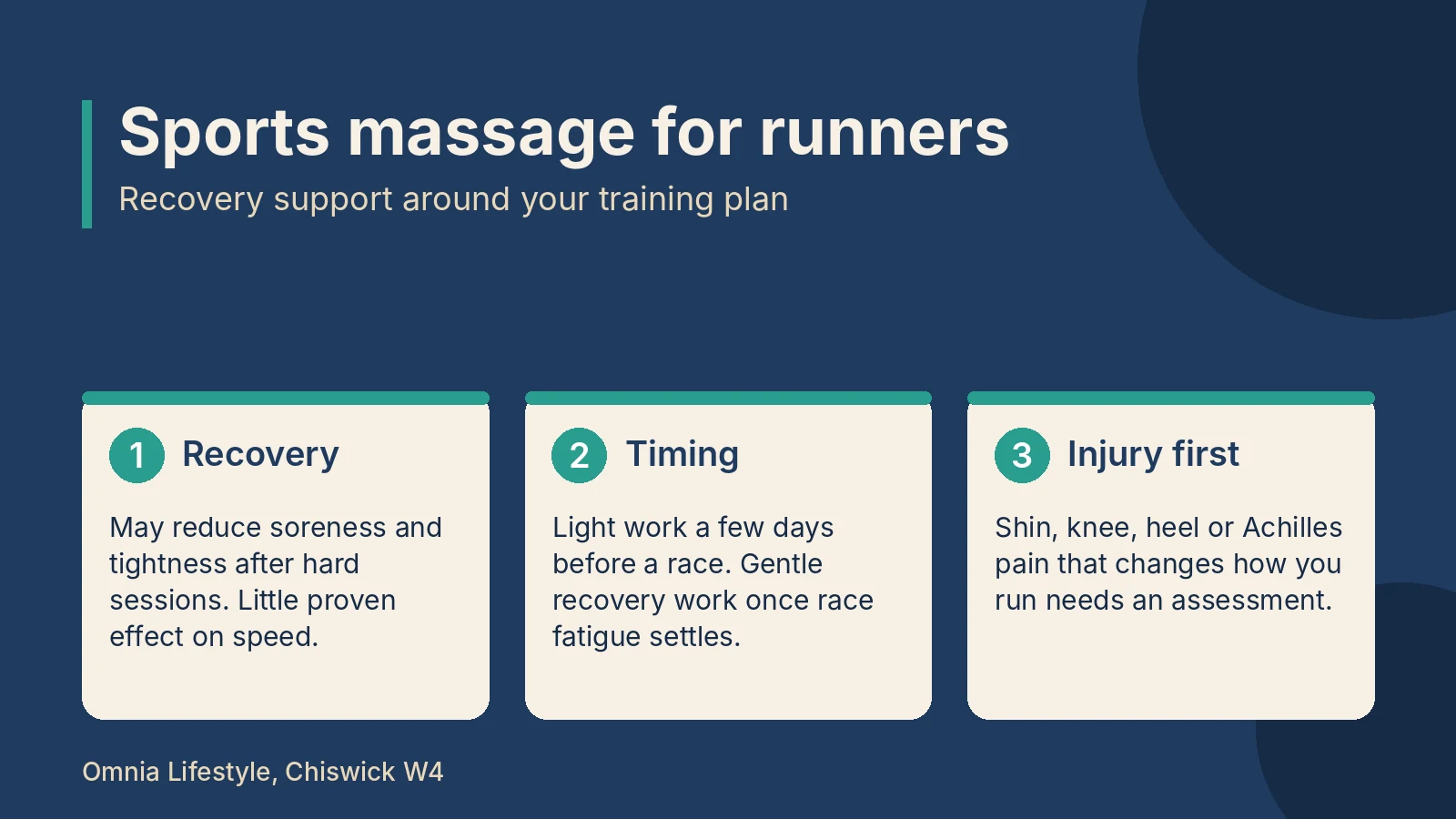
Sports massage can help runners feel less sore and tight after hard sessions, and many find it helps them move more freely. Research suggests it may reduce muscle soreness and improve how recovered you feel, but it has little proven effect on speed or injury prevention. It works alongside sensible training, sleep, strength work and rest days, not instead of them. A specific injury, such as heel, shin or knee pain, needs an assessment first. At Omnia in Chiswick, a 60-minute sports massage is £90.
What sports massage for runners involves
Sports massage is firmer and more targeted than a relaxation massage. For runners, your therapist usually works on the calves, Achilles area, hamstrings, quads, hip flexors, glutes and the outer thigh, using deep strokes, trigger point pressure and myofascial techniques, often with assisted stretching. The aim is to ease tightness, restore comfortable range and help you recover between sessions. For a fuller explanation, see what is a sports massage.
Does sports massage help runners? What the evidence shows
Research reviews of massage after exercise suggest it can reduce delayed onset muscle soreness (the ache you feel a day or two after a hard run) and improve how recovered people feel. Effects on flexibility are small and short-lived. Reviews have found little or no effect on running performance, strength or speed, and there is not good evidence that massage on its own prevents running injuries.
There is no NICE guideline on sports massage for runners. NICE guidance on low back pain (NG59) is a useful reminder of the general principle: hands-on treatment such as massage is most useful as part of a package that includes exercise. For runners, that means massage sits alongside a sensible training plan and strength work.
What happens at a session
Your therapist asks about your running: weekly mileage, recent changes in training, upcoming races, footwear and where you feel tight or sore. They check how you move, then work on the muscles that are carrying the most load, with pressure adjusted to you throughout. Wear or bring shorts so your legs and hips can be treated. Sports massage can feel intense on very tight areas but should never be sharp or unbearable. You leave with simple stretches and a suggested rhythm of sessions to fit your training. See what to wear to a sports massage.
When to book: before or after a race
- During a training block. A session every two to four weeks helps many runners manage tightness as mileage rises. Book it on or before an easy day, not right before a key session.
- Before a race. Keep it light and quick, ideally a few days before. Do not try deep work for the first time in the week of a race, as soreness can last a day or two.
- After a race. Wait until the immediate fatigue has settled, usually a few days after a marathon, then choose gentle recovery-focused work.
Read how often you should get a massage for more on timing.
Common running niggles and when massage fits
Massage can ease the muscle tightness that often comes with running niggles, but most running injuries come from doing too much too soon, and they settle with load management and specific exercises. Use massage as support, not the main treatment:
- Shin pain. The NHS says shin splints usually get better within a few weeks with rest, ice and a gradual return. See shin splints exercises.
- Kneecap and outer knee pain. Tight thighs and hips can add to it, but strength work matters most. See runner's knee exercises and outer knee pain and IT band syndrome.
- Achilles and heel pain. Loading exercises are the main treatment. See Achilles tendinopathy exercises and plantar fasciitis exercises.
- Hamstring strain. Avoid massage on a fresh strain for the first couple of days, as the NHS advises. See hamstring strain exercises.
If pain changes how you run, is getting worse or has lasted more than a couple of weeks, start with an assessment. Our sports physiotherapy team can diagnose the problem and build a return-to-running plan.
How many sessions do runners need?
There is no fixed number. For general recovery, many runners book every two to four weeks during heavier training and less often in quieter periods. For a tight area that is bothering you, two or three sessions a week or two apart, with daily stretching or mobility work, is a sensible trial. If a problem keeps returning despite massage, it is a sign to look at training load, strength or running form with a physiotherapist.
Sports massage for runners: cost
At Omnia in Chiswick, sports massage is £65 for 30 minutes, which suits one area such as calves, or £90 for 60 minutes, which suits both legs and hips. Home visit massage is available across West London from £100.
Who should take care with sports massage
Tell your therapist about any recent injuries, medical conditions or medicines. Avoid massage on a new sprain or strain for the first couple of days, and on any area with suspected fracture, open wound or skin infection. Take care if you take blood-thinning medicine or have a bleeding disorder. Massage is not suitable over a suspected blood clot (DVT). In pregnancy, choose a therapist trained in pregnancy massage.
When to seek urgent help
Call 999 or go to A&E if:
- You heard a crack when you were injured, or the limb has changed shape or is pointing at an odd angle
- The injured area is numb, tingling, blue, grey or cold to touch
- You have calf pain or swelling with breathlessness or chest pain
Call NHS 111 or go to an urgent treatment centre if an injury is very painful or getting worse, swelling or bruising is large, you cannot put weight on it, or you have throbbing pain and swelling in one calf, which can be a sign of a blood clot.
See your GP or a physiotherapist if pain is not improving after a couple of weeks of self-care, keeps coming back, or changes how you run.
Frequently asked questions
Is sports massage good for runners' knees?
Massage to tight thighs, hips and the outer thigh can make knees feel more comfortable for some runners, but it does not fix knee pain on its own. Kneecap pain and IT band pain usually improve with load changes and strengthening the hips and thighs. If knee pain is changing how you run, book a physiotherapy assessment first.
Is deep tissue massage good for runners?
It can be, especially for long-standing tightness in the calves, hamstrings or hips. Deep tissue massage is slower and more sustained, while sports massage is usually quicker and includes stretching. Both can feel intense, so avoid deep work just before a race or a key session. Read deep tissue vs sports massage.
Is a massage gun as good as sports massage for runners?
Massage guns can be handy for short self-treatment of calves and thighs, and some runners find them helpful for soreness. Use a low setting, keep moving the head, and avoid bones, the back of the knee, bruising and recent injuries. They do not replace a therapist's assessment of where tightness is coming from.
Should I get a sports massage before or after a marathon?
Both can be useful if timed well. Before, have a lighter session a few days out, and avoid anything new or very deep in race week. After, wait a few days for the immediate fatigue to settle, then choose gentle recovery work. Walking, sleep, fluids and food matter most in the first days after a marathon.
Is sports physio or sports massage better for runners?
They do different jobs. Sports massage helps with tightness and recovery. A sports physiotherapist assesses injuries, finds the cause and builds a rehabilitation and return-to-running plan. If you have pain rather than tightness, start with physiotherapy. Many runners use both. See physiotherapy vs massage.
Sports massage for runners in Chiswick
Our clinic is at 8 to 9 Bedford Corner, The Avenue, Chiswick W4 1LZ, close to Turnham Green station, on bus routes 94, E3 and 272. Limited parking is available on request when booking. We see runners from Chiswick, the river paths and parks across West London, and our massage therapists and physiotherapists work under one roof.
Explore sports massage in Chiswick, read about sports injuries, see sports physiotherapy in London, or learn what a sports massage involves.
Book sports massage in Chiswick: £65 for 30 minutes or £90 for 60 minutes. Book online or call 020 4515 0000.
This article is general information, not medical advice. If you have any of the warning signs above, seek medical attention.
Ready to book?
Sports Massage


.jpg)
.jpg)
