






Book at our Chiswick clinic
Deep Tissue Massage
If sciatica has left you with a sore buttock, a tight lower back and pain running down one leg, it is natural to wonder whether a massage would help. This guide is for adults with sciatica who want an honest answer: what massage can ease, what it cannot reach, and how to use it safely alongside the exercise that does most of the work.
When to see someone: if muscle tension in your back, hips or buttock is making sciatica harder to live with, a deep tissue massage in Chiswick starts at £65 for 30 minutes, and your therapist will check for warning signs first. Book online or call 020 4515 0000.
Quick answer
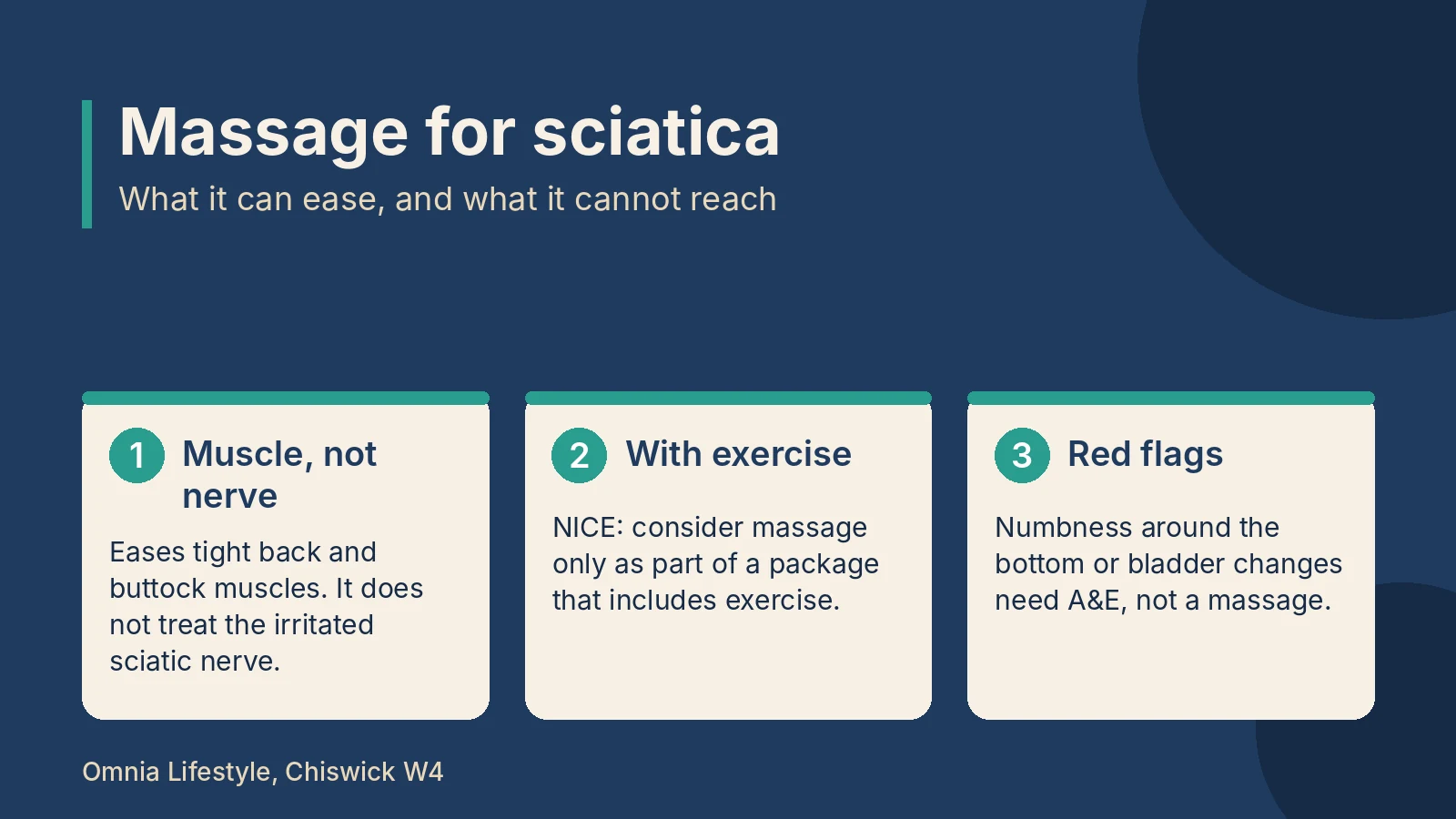
Massage can ease the muscle tension, guarding and spasm that often come with sciatica, and many people find it makes moving and sleeping easier for a while. It does not treat the irritated nerve itself, so it is not a cure. NICE suggests considering manual therapy, including massage, for sciatica only as part of a package that includes exercise. Used that way, massage is a reasonable, low-risk addition. If you have numbness around your bottom or bladder changes, skip the massage and get urgent help.
Is massage good for sciatica?
Sciatica is pain caused by irritation of the sciatic nerve, most often from a bulging disc or narrowing in the lower spine. The NHS describes it as pain, tingling, numbness or weakness that usually runs from the bottom down the back of one leg, sometimes into the foot and toes. It usually improves within a few weeks to a few months.
The nerve problem sits deep in the spine, well beyond the reach of a therapist's hands. What massage can reach is everything around it. When a nerve is irritated, the muscles of the lower back, buttock and hamstring often tighten to protect the area. That guarding can add its own ache, limit how you move and make it harder to keep active, which is exactly what helps sciatica settle.
So the honest answer is that massage is good for the muscle side of sciatica, not the nerve side. Many people describe feeling looser and moving more freely afterwards, and the relief is usually temporary. It is most useful when it helps you get on with walking and your exercises.
What the NHS and NICE say about massage for sciatica
- NICE guideline NG59 (low back pain and sciatica). NICE says to consider manual therapy, including spinal manipulation, mobilisation or soft tissue techniques such as massage, only as part of a treatment package that includes exercise. It does not recommend massage on its own.
- Exercise first. NICE puts exercise at the centre of managing low back pain and sciatica, and the NHS advises staying as active as you can and starting gentle movement as soon as possible.
- Physiotherapy. The NHS lists physiotherapy, including exercise advice and hands-on techniques such as massage, as a treatment your GP or physiotherapist may recommend.
We would rather tell you this plainly than suggest massage alone will fix sciatica. It is a support act, and a useful one when used well.
Massage for sciatica pain in the buttock and leg
Pain deep in the buttock is one of the most common sciatica complaints. The gluteal muscles and the piriformis, a small muscle that sits close to the sciatic nerve, often become tight and tender. Slow, sustained pressure on these muscles can ease that deep ache. Your therapist may also work on the lower back, hip flexors and hamstrings, which tend to stiffen when you walk or sit differently to avoid pain.
Massage for sciatica pain in the leg is different. Burning, electric or tingling pain down the leg comes from the nerve, and pressing on the leg will not change it. A good therapist will work gently around the leg rather than digging into it, and will avoid strong pressure directly over the path of the nerve. If you have buttock pain without leg symptoms, see our guide to piriformis syndrome.
Can massage aggravate sciatica?
It can, if the pressure is too deep, too early or in the wrong place. Very firm work over an irritable area can leave you sorer for a day or two, and pressing on the nerve itself can bring on tingling or sharper pain. During a flare-up, when pain is at its worst, lighter work is usually the better choice.
- Tell your therapist where the pain travels. They will adjust pressure and avoid areas that set off nerve symptoms.
- Speak up during the session. Firm pressure can feel intense on tight muscle, but it should never be sharp, burning or unbearable.
- Expect mild soreness at most. A little tenderness for a day is common. Leg pain that is clearly worse after massage is a reason to stop and get assessed.
What happens at a massage session for sciatica
Your session starts with a short conversation about where your pain is, how it started, what makes it better or worse, and any medical conditions or medicines. Your therapist checks for warning signs that need a doctor rather than a massage. They then look at how you move and choose where to work, usually the lower back, buttocks, hips and the back of the thigh.
Positioning matters with sciatica. Lying flat on your front can be uncomfortable, so you may lie on your side with a pillow between your knees, or have a cushion under your tummy. Pressure is built up gradually. You finish with simple advice on movement and, where useful, a stretch or two to keep the benefit going. If your therapist feels you need a fuller assessment, our physiotherapists are in the same building.
How often should you have a massage for sciatica, and what does it cost?
There is no fixed rule. Many people try one session a week for three to four weeks while they build up their exercises, then judge how much it has helped. Notice whether you can walk further, sit for longer or sleep better, rather than relying on how you feel on the treatment bed. If there is no useful change after a few sessions, it is better to put your time and money into physiotherapy and exercise.
At Omnia in Chiswick, deep tissue or sports massage is £65 for 30 minutes or £90 for 60 minutes. A 30-minute session suits a focused treatment of the lower back and buttock; 60 minutes allows time for the hips and legs too. If getting to the clinic is difficult while your sciatica is bad, home massage is available from £100.
Massage for sciatica at home
You can ease buttock and back tension yourself between sessions:
- Heat first. The NHS suggests heat packs on the painful area. Ten to fifteen minutes of warmth can make self-massage more comfortable.
- Tennis ball release. Sit or lean against a wall with a tennis ball under the tender part of your buttock and hold gentle pressure for 30 to 60 seconds. Stop if it sends pain or tingling down the leg.
- Gentle stretches. Knee-to-chest and glute stretches often help. See our sciatica exercises guide for the moves that help and the ones to avoid.
- Keep moving. Short, regular walks and avoiding long spells sitting or lying down help sciatica settle.
Who should take care with massage
Tell your therapist before treatment if you take blood-thinning medicine, have osteoporosis, are pregnant, have had recent spinal surgery, or have a history of cancer. Massage is not suitable over an area of suspected blood clot, an infection or broken skin. If you are pregnant, choose a therapist trained in pregnancy massage and tell your midwife about your symptoms.
When to seek urgent help
Go to A&E or call 999 if you have sciatica and:
- Sciatica on both sides, or weakness or numbness in both legs that is severe or getting worse
- Numbness around or under your genitals, or around your bottom
- Difficulty starting to pee, being unable to pee, or being unable to control when you pee, when this is not normal for you
- Not noticing when you need to poo, or being unable to control it
These can be signs of cauda equina syndrome, which needs hospital treatment quickly. Do not book a massage. See a GP if pain has not improved after a few weeks of self-care, is getting worse or is stopping you from doing normal activities.
Frequently asked questions
Is massage good for sciatica nerve pain?
Massage does not treat the nerve itself, so it will not stop the burning or tingling that comes from an irritated nerve. What it can do is ease the tight, guarded muscles around the lower back and buttock that often add to the pain. Many people find this makes it easier to move and keep up their exercises, which is what helps the nerve settle over time.
Is massage good for a sciatica flare-up?
During a bad flare-up, gentle work is usually better than deep pressure. Lighter massage, heat and keeping lightly active can help you through the worst few days. Deep tissue work over a very irritable area can make you sorer. If a flare-up comes with new numbness, weakness in both legs or bladder changes, seek urgent medical help instead.
Is massage recommended for sciatica on the NHS?
NICE guidance says to consider manual therapy, including massage, for low back pain and sciatica only as part of a treatment package that includes exercise. The NHS lists hands-on techniques such as massage as part of physiotherapy. Massage on its own is not a recommended treatment, and NHS physiotherapy focuses mainly on exercise and advice.
What type of massage is best for sciatica?
Deep tissue massage, with slow, sustained pressure, suits long-standing tension in the back and buttock. Sports massage suits active people whose tight hamstrings and hips are part of the picture. Either should be adjusted for nerve pain. Compare them in our guide to deep tissue vs sports massage.
Should I see a physio or a massage therapist for sciatica?
If sciatica is new, severe or not improving, start with a physiotherapist, who can assess what is driving it and build an exercise plan. Massage works well alongside that plan for the muscle tension. Read physiotherapy for sciatica to see what a programme involves.
Massage for sciatica in Chiswick
Our clinic is at 8 to 9 Bedford Corner, The Avenue, Chiswick W4 1LZ, close to Turnham Green station, on bus routes 94, E3 and 272. Limited parking is available on request when booking. Because our massage therapists and physiotherapists work under one roof, massage can sit alongside an exercise plan where that suits you.
Read more about sciatica, see how to relieve sciatica pain and how long sciatica lasts, or explore deep tissue massage and massage in London.
Book deep tissue massage in Chiswick: 30 minutes £65, 60 minutes £90. Book online or call 020 4515 0000.
This article is general information, not medical advice. If you have any of the warning signs above, seek medical attention.
Ready to book?
Deep Tissue Massage




.jpg)
.jpg)
