


Book at our Chiswick clinic
Vestibular First
Vertigo is the sudden, unsettling feeling that you or the room around you is spinning, tilting or moving when it is not. An attack can leave you feeling sick, unsteady and anxious about the next one. The reassuring news is that most vertigo comes from the inner ear, there are simple steps that help during an attack, and the most common causes can usually be treated rather than just waited out.
This guide explains what to do when vertigo starts, how to get rid of vertigo for good by treating the cause, whether vertigo can be cured, which home remedies are worth trying, and the warning signs that need urgent help.
Quick answer
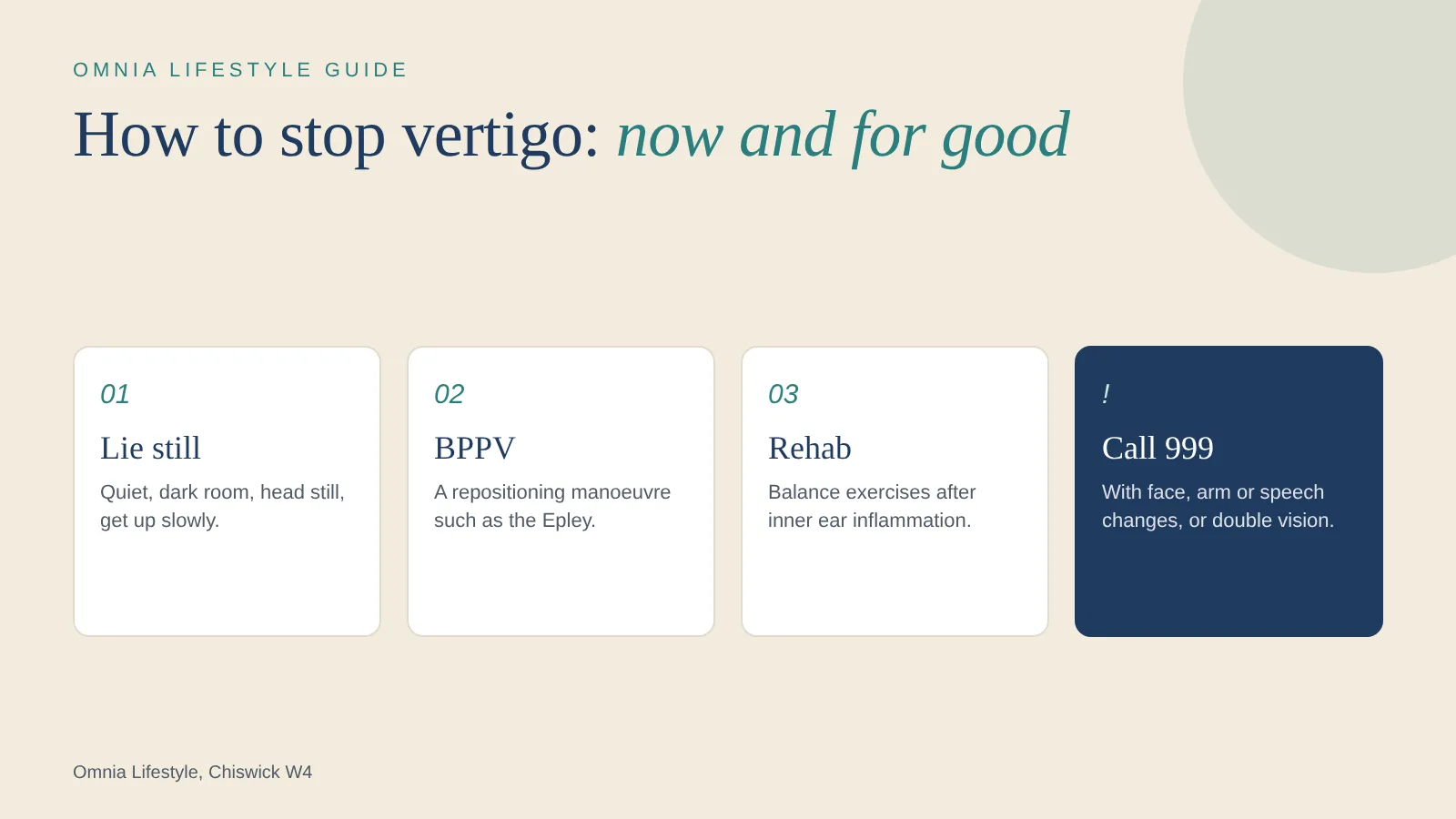
To stop vertigo during an attack, sit or lie down straight away, keep your head still and lie in a quiet, dark room until the spinning eases, then get up slowly. To get rid of vertigo for good, the cause needs treating: a repositioning manoeuvre such as the Epley for BPPV, vestibular rehabilitation exercises after inner ear inflammation, and GP care for vestibular migraine or Meniere's disease. Call 999 if vertigo comes with face, arm or speech changes, double vision, sudden hearing loss or a sudden severe headache.
What to do when you have vertigo
These steps, in line with NHS advice, help you stay safe and ease the spinning during an attack:
- Sit or lie down straight away to avoid falling.
- Lie still in a quiet, dark room until the worst passes, with your head supported.
- Keep your head still and fix your eyes on one point if you need to keep them open.
- Breathe slowly. Anxiety is a natural reaction, but it can make vertigo feel worse.
- Get up slowly, sitting on the edge of the bed or chair for a minute before you stand.
- Sip water once any sickness settles.
- Do not drive, climb ladders or use machinery until the attack has completely passed.
Between attacks, move your head slowly during everyday tasks, sleep with your head slightly raised on two or more pillows, turn on a light if you get up at night, squat rather than bend down to pick things up, and avoid stretching your neck to reach high shelves.
How to stop vertigo fast
There is no instant switch for every type of vertigo, but lying still in a comfortable position is usually the fastest way to reduce the spinning. If vertigo is triggered by a particular head position, as in BPPV, each spin typically lasts less than a minute once you keep still. A GP or pharmacist may suggest short-term medicines such as prochlorperazine or certain antihistamines to ease severe spinning and sickness. These are meant for a few days only, because using them for longer can slow the brain's natural ability to adapt.
If your main problem is feeling light-headed or faint rather than spinning, our guide on how to stop feeling dizzy covers that in more detail.
How to get rid of vertigo for good: treat the cause
Vertigo is a symptom, not a diagnosis. Lasting relief comes from finding and treating what is causing it. Our guide to what causes vertigo covers the full list; the most common causes and their treatments are below.
BPPV: the Epley manoeuvre
Benign paroxysmal positional vertigo (BPPV) is the most common cause of vertigo. Tiny calcium crystals in the inner ear move into one of the balance canals, causing short bursts of spinning when you roll over in bed, look up or bend down. A trained clinician first confirms which canal is affected, then uses a repositioning manoeuvre such as the Epley to guide the crystals back into place. This often brings relief within one or two sessions. Read our step-by-step guide to the Epley manoeuvre for BPPV and the home Brandt-Daroff exercises.
Vestibular neuritis and labyrinthitis: rehabilitation
These conditions are caused by inflammation of the balance nerve or inner ear, often after a viral infection. The first few days can bring constant, severe spinning and sickness, which short-term medicines may ease. After that, gentle movement and vestibular rehabilitation exercises help the brain adapt and speed recovery. See vestibular neuritis and what vestibular rehabilitation involves.
Vestibular migraine: manage the triggers
Some people get vertigo as part of migraine, with or without a headache. Treatment focuses on identifying triggers such as poor sleep, missed meals, stress and certain foods, and, where needed, migraine prevention prescribed by a GP. Read more about migraine.
Meniere's disease: medical care
Meniere's disease causes attacks of vertigo lasting from twenty minutes to several hours, with ringing, fullness and fluctuating hearing loss in one ear. It is managed by a GP and an ear, nose and throat specialist, sometimes with medicines and diet changes such as reducing salt. Balance rehabilitation can help between attacks.
Other causes
Vertigo can also follow a head injury, be linked to some medicines, or continue as long-term dizziness after an inner ear problem has settled. Stress and anxiety can make all types of vertigo worse; see can stress cause vertigo.
Can vertigo be cured?
Often, yes. Whether there is a cure for vertigo depends on the cause:
- BPPV can usually be resolved with repositioning manoeuvres, although it can come back.
- Vestibular neuritis and labyrinthitis usually improve over weeks, and rehabilitation helps people who are left with lingering unsteadiness.
- Vestibular migraine is not cured, but attacks can often be made less frequent and less severe.
- Meniere's disease has no cure, but treatment can reduce attacks and their impact.
For timelines by cause, see how long vertigo lasts.
Vertigo cures at home: what helps and what does not
Worth doing:
- Following the NHS self-help steps above
- Doing vestibular exercises your clinician has shown you, regularly and gradually
- Keeping gently active once the worst has passed, rather than staying in bed for days
- Regular sleep, regular meals and enough fluids
- Cutting back on alcohol and, for Meniere's or vestibular migraine, caffeine and very salty food if they trigger attacks
Be cautious about:
- Trying the Epley at home without a diagnosis. It only works for BPPV, it needs to be done on the correct side, and it is not suitable for everyone, for example people with some neck or back problems.
- Long-term use of vertigo tablets. They are meant for short spells only.
- Supplements and remedies sold as vertigo cures. Ginger may ease nausea, but there is little evidence that any supplement treats the cause of vertigo.
Exercises for vertigo
Vestibular rehabilitation uses simple head, eye and balance exercises to retrain how the brain processes movement signals. Typical examples include moving your head side to side while keeping your eyes on a fixed target, standing with your feet closer together, and walking while turning your head. These exercises often make you feel slightly dizzy at first, which is part of how they work, so they are best started with guidance and built up gradually. Balance-based activities such as tai chi can help later in recovery.
When to seek medical help
Most vertigo is caused by the inner ear, but it can occasionally be a sign of a stroke or another serious problem.
Call 999 or go to A&E if vertigo comes with:
- A drooping face, weakness, numbness or tingling in an arm or leg, or slurred or difficult speech
- Double vision or loss of vision
- Sudden hearing loss
- Sudden inability to walk or stand
- A sudden, severe headache, or chest pain or collapse
Do not drive yourself to hospital. Ask someone to take you or call 999.
Get an urgent GP appointment or contact NHS 111 if you have vertigo with:
- A severe headache
- Being sick or feeling very sick, or being unable to keep fluids down
- A very high temperature, or feeling hot, cold or shivery
- Vertigo after a head injury
See your GP if:
- Vertigo keeps coming back or is not improving
- You have ringing, fullness or gradual hearing loss in one ear
- You think a medicine may be causing it
- Vertigo is affecting your work, driving or confidence
How we help in Chiswick
Our Vestibular First service at Omnia Lifestyle is designed to find out what is causing your vertigo and treat it, rather than simply telling you to wait.
- Vertigo and BPPV treatment in Chiswick: assessment and treatment is £50. It starts with a detailed history and positional, eye movement and balance tests, screens for signs that need medical referral, and if BPPV is confirmed treatment with a repositioning manoeuvre usually starts in the same session.
- Vestibular rehabilitation: a structured home exercise programme for vestibular neuritis, labyrinthitis and long-term dizziness, with follow-up.
- Home visits: home visit physiotherapy across West London starts from £110, for anyone too dizzy to travel.
Read more about vertigo and dizziness, whether your dizziness is BPPV and what happens at a vestibular assessment, or book an assessment.
Frequently asked questions
What is the fastest way to get rid of vertigo?
During an attack, lie still in a quiet, dark room and keep your head still. If the cause is BPPV, a repositioning manoeuvre carried out by a trained clinician is often the quickest route to lasting relief.
Is it better to sit or lie down with vertigo?
Either is fine as long as you are safe from falling. Many people find lying still with the head slightly raised most comfortable. If a particular position triggers spinning, settle into the position that feels calmest.
What position should I sleep in with vertigo?
The NHS suggests sleeping with your head slightly raised on two or more pillows. With BPPV, avoiding lying on the affected side for a few nights after treatment can help.
Does drinking water help vertigo?
Dehydration more often causes light-headedness than true spinning, but drinking enough fluids is sensible, especially if you have been sick or are prone to migraine.
Can I drive with vertigo?
Do not drive during an attack or while you feel dizzy. If you have sudden, disabling attacks of vertigo, speak to your GP and check the DVLA guidance on GOV.UK about whether you need to tell them.
Can vertigo be a sign of something serious?
Rarely. Most vertigo comes from the inner ear. Vertigo with the warning signs listed above needs urgent medical help because it can be a sign of a stroke.
Vertigo assessment at Omnia Lifestyle
If vertigo keeps returning or is stopping you doing what you want, a proper assessment is the best next step. Vestibular First is available at Omnia Lifestyle, 8 to 9 Bedford Corner, The Avenue, Chiswick W4 1LZ, close to Turnham Green station, on bus routes 94, E3 and 272. Limited parking is available on request when booking. If you are prone to strong vertigo, bring someone to drive you home.
This article is general information, not medical advice. If you have any of the warning signs listed above, seek medical attention.
Ready to book?
Vestibular First



.jpg)
.jpg)