



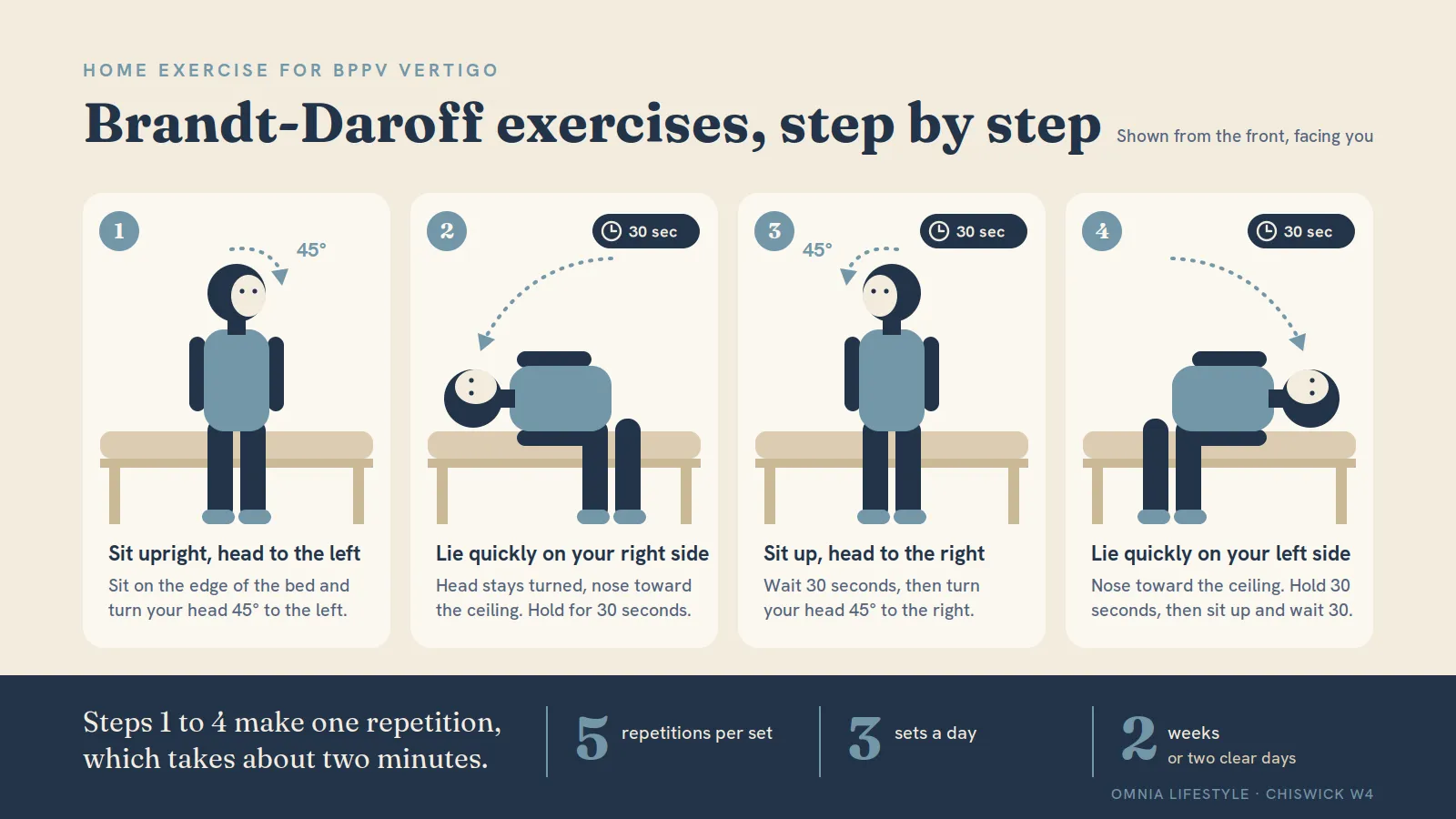


Brandt-Daroff exercises are a set of simple positional movements used to treat benign paroxysmal positional vertigo (BPPV), the most common cause of spinning dizziness triggered by head movement. They can be done at home, on the edge of a bed, without equipment. They are not the fastest treatment for BPPV, but they have a useful place, particularly for lingering symptoms and for people who cannot easily get to a clinician.
This guide explains how to do them correctly, how often, what to expect, how they compare with the Epley manoeuvre, and the warning signs that mean dizziness should be assessed urgently instead.
What Brandt-Daroff exercises are
BPPV happens when tiny calcium carbonate crystals, which normally sit in one part of the inner ear, come loose and drift into one of the semicircular canals. When you move your head, the loose crystals shift and send a false signal that you are spinning. Episodes are brief, usually under a minute, and are typically set off by rolling over in bed, looking up or bending down.
Brandt-Daroff exercises were described in 1980 by the neurologists Thomas Brandt and Robert Daroff. They involve moving repeatedly from sitting to lying on each side. The repeated movement is thought to help in two ways: by gradually dispersing the loose crystals, and by helping the brain become less sensitive to the false signal, a process called habituation.
How to do Brandt-Daroff exercises step by step
Sit on the edge of a bed, roughly in the middle, so that you have room to lie down on either side. The first few times, have someone nearby.
- Start sitting upright on the edge of the bed, feet on the floor.
- Turn your head about 45 degrees to the left.
- Lie down quickly on your right side, keeping your head turned, so that you are looking up toward the ceiling at an angle. Your legs can stay where they are or come up onto the bed.
- Stay there for 30 seconds, or until any dizziness has settled, whichever is longer.
- Sit back up and wait 30 seconds, looking straight ahead.
- Turn your head about 45 degrees to the right.
- Lie down quickly on your left side, head still turned, looking up toward the ceiling.
- Stay for 30 seconds, or until the dizziness settles.
- Sit back up and wait 30 seconds.
That is one repetition. It takes around two minutes.
How often to do them
The programme most commonly recommended is:
- 5 repetitions per set, which takes about 10 minutes
- 3 sets a day, usually morning, midday and evening
- For around 2 weeks, or until you have had two days in a row with no vertigo
If you have been given a different schedule by a clinician who has assessed you, follow that instead.
What to expect
Dizziness during the exercises is normal. The movements deliberately reproduce the position that triggers your vertigo, so expect a brief spinning sensation, particularly in the first few days. It should settle within about a minute of reaching each position. Some people also feel slightly sick or off balance for a short while afterwards.
Improvement is gradual. Many people notice the spinning becoming weaker and shorter over one to two weeks. If nothing has changed after two weeks of doing the exercises consistently, that is a reason to be assessed rather than to keep going.
Practical points that help:
- Do them on a bed, not the floor, and not just before driving or using stairs.
- Keep your eyes open. It is tempting to close them, but it tends to make the sensation worse.
- Move briskly into each position. A slow, cautious movement is less effective.
- Do the evening set shortly before bed, so that any lingering unsteadiness passes while you sleep.
Brandt-Daroff exercises or the Epley manoeuvre?
For the most common form of BPPV, which affects the posterior canal, the Epley manoeuvre is usually the better first choice. It is a repositioning manoeuvre: a specific sequence of head positions that guides the loose crystals out of the canal and back to where they belong. Studies comparing the two have consistently found that repositioning manoeuvres such as the Epley and Semont resolve symptoms faster and in a higher proportion of people, often within one to three sessions. Clinical guidelines reflect this and recommend repositioning as first-line treatment.
Brandt-Daroff exercises still have a place:
- For residual symptoms after a repositioning manoeuvre, when the strong spinning has gone but a mild sensitivity to movement remains.
- When it is not clear which ear is affected, because the exercises treat both sides.
- When you cannot get to a clinician quickly, or a repositioning manoeuvre is not suitable for you.
- For people whose BPPV recurs, as a self-management option agreed with their clinician.
We cover the repositioning approach in detail in our guide to the Epley manoeuvre for BPPV.
Why the diagnosis matters first
Brandt-Daroff exercises only work for BPPV. Other common causes of dizziness, including vestibular neuritis, vestibular migraine, Meniere's disease and low blood pressure on standing, do not respond to them and need different management. Our guide to how long vertigo lasts by cause explains how the patterns differ.
BPPV is confirmed with a positional test, most often the Dix-Hallpike test, in which a clinician moves you into the provoking position and watches for a characteristic flicker of the eyes called nystagmus. The test also shows which ear and which canal are involved, and that determines which manoeuvre will work. If your dizziness has never been assessed, this is the step worth taking before committing to two weeks of exercises.
Who should take care or avoid them
Speak to a GP or physiotherapist before starting if you have:
- Significant neck or back problems, or recent neck or spinal surgery
- A history of stroke, transient ischaemic attack or known narrowing of the arteries in the neck
- A detached retina or recent eye surgery
- Dizziness that has never been diagnosed
When dizziness needs urgent attention
Call 999 if dizziness or vertigo comes with any of the following:
- Sudden severe headache
- Double vision or loss of vision
- Slurred speech or difficulty finding words
- Drooping of one side of the face
- Weakness or numbness in an arm or leg
- Sudden difficulty walking or standing that is out of proportion to the dizziness
These can be signs of a stroke. BPPV does not cause any of them.
See your GP promptly if you have sudden hearing loss, ringing in one ear, vertigo that lasts for hours rather than seconds, or repeated falls.
Frequently asked questions
How long do Brandt-Daroff exercises take to work?
Most people who respond notice improvement within one to two weeks of doing them three times a day. If there is no change after two weeks, have the diagnosis checked.
Are Brandt-Daroff exercises supposed to make you dizzy?
Yes. Brief spinning during each position is expected and usually becomes weaker with each day. Dizziness that lasts for many minutes, or that comes with other symptoms, is not expected.
Can Brandt-Daroff exercises make vertigo worse?
Symptoms often feel slightly worse for the first few days because you are repeatedly triggering them. Occasionally the crystals move into a different canal, which changes the pattern of the vertigo. If your symptoms change character or clearly worsen, stop and get assessed.
Which side should I start on?
It does not matter, because each repetition covers both sides. Many people find it more comfortable to start on the side that provokes less dizziness.
Can I do them if I am not sure I have BPPV?
They are unlikely to harm, but they will not help if the cause is something else, and two weeks can be lost. A positional test takes a few minutes and settles the question.
Will BPPV come back?
It can. Recurrence is common over the following years. The good news is that it usually responds to the same treatment each time.
Vertigo assessment and treatment in Chiswick
Dizziness and balance problems are assessed at Omnia Lifestyle in Chiswick, W4, close to Turnham Green station, on bus routes 94, E3 and 272. Limited parking is available on request when booking. Assessment includes positional testing to confirm whether BPPV is the cause and which canal is involved, so that the right manoeuvre is used from the start.
Read more about balance and dizziness, explore vestibular assessment and rehabilitation, or book an assessment.
This article is general information, not medical advice. If you have any of the emergency warning signs listed above, seek immediate medical attention.



.jpg)
.jpg)