






Book at our Chiswick clinic
Blood Test
Bloating is one of the most common gut symptoms. The NHS says the most common reason is having a lot of gas in your gut, often linked to diet, swallowing air, constipation or irritable bowel syndrome (IBS). For most people it comes and goes and settles with changes to eating habits. When bloating keeps coming back, though, it is worth checking for medical causes that can be treated.
A few targeted tests can help, including a blood test for coeliac disease, a stool test for gut inflammation, a test for the stomach bacteria H. pylori and, for some women, a CA125 blood test. This guide explains which tests can help with bloating, which test to book first, what tests cannot tell you and when bloating needs urgent attention.
Test it in Chiswick: our Digestive Health Check blood test costs £99, with your result explained in person by a practitioner. No GP referral needed. Book this test or call 020 4515 0000. Prefer to test at home? A home finger-prick kit is also available, ask us when you enquire.
Quick answer
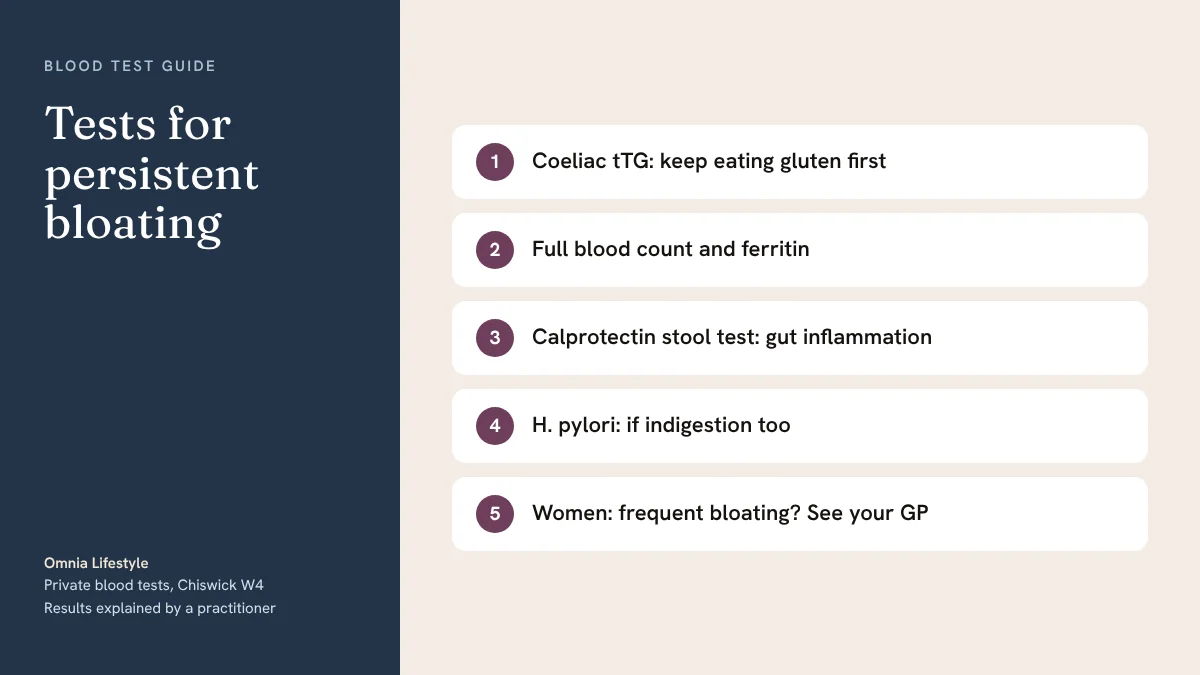
For persistent bloating, the most useful tests are coeliac antibodies (tTG IgA, with total IgA), a full blood count and ferritin to look for anaemia, a faecal calprotectin stool test to look for bowel inflammation, and an H. pylori test if you also have indigestion or upper tummy pain. You must still be eating gluten for the coeliac test to be accurate. Women with bloating that is persistent or happens often, particularly more than 12 times a month, should see their GP, who may check CA125 for ovarian cancer.
Blood tests that can help
Coeliac antibodies (tTG)
Coeliac disease is an autoimmune reaction to gluten. The NHS lists bloating and farting, diarrhoea, stomach aches, indigestion, constipation and tiredness among its symptoms. NICE recommends offering a coeliac blood test to anyone with persistent unexplained abdominal or gut symptoms, and to all adults with IBS symptoms. The first choice tests are IgA tissue transglutaminase (tTG) and total IgA, because people with low IgA can get a falsely negative tTG IgA result.
Important: the test only works if you are eating gluten. NICE advises eating some gluten in more than 1 meal every day for at least 6 weeks before testing. If you have already cut out gluten, speak to us or your GP before booking. Our Coeliac Antibody Check (£99) measures tTG IgA and tTG IgG, and you can add a total IgA test (£49). A positive result needs referral to a gut specialist for a biopsy to confirm the diagnosis, so please do not start a gluten-free diet until that has happened.
Full blood count and ferritin
A Full Blood Count (£59) and a Ferritin test (£49) look for anaemia and low iron stores. Unexplained iron deficiency alongside gut symptoms can point to coeliac disease or bleeding from the gut, and the NHS advises seeing a GP if you have indigestion and iron deficiency anaemia. NICE also lists a full blood count, ESR or CRP, and a coeliac test as the blood tests to do when IBS is suspected, to rule out other conditions. Read more in ferritin levels explained.
Faecal calprotectin (stool test)
Calprotectin is a protein released into the bowel when it is inflamed. It is measured in a small stool sample, not blood. NICE recommends it to help tell inflammatory bowel disease (such as Crohn's disease and ulcerative colitis) apart from IBS in adults with recent lower gut symptoms, when cancer is not suspected. A normal result makes inflammatory bowel disease less likely. Book the Calprotectin test (£119), or the qFIT and Calprotectin (£139), which adds a test for hidden blood in the stool.
H. pylori
H. pylori is a common stomach bacterium and a main cause of stomach ulcers. It is most relevant if your bloating comes with indigestion, burning or pain in the upper tummy, or feeling full quickly. NICE recommends testing with a breath test, a stool antigen test, or a laboratory blood test where it has been validated locally. A blood test detects antibodies, which can stay in the blood after an infection has cleared, so it cannot always tell past from current infection. For a stool or breath test, NICE advises stopping proton pump inhibitors (such as omeprazole) for 2 weeks first. We offer the H. pylori Antibody blood test (£79) and the H. pylori Stool Test (£89).
CA125 for women with persistent bloating
Ovarian cancer is uncommon, but its early symptoms can be mistaken for IBS. NICE advises that tests are carried out if a woman, especially if she is 50 or over, has any of these symptoms on a persistent or frequent basis, particularly more than 12 times a month:
- persistent swelling of the tummy, often described as bloating
- feeling full quickly and/or loss of appetite
- pelvic or tummy pain
- needing to pee more urgently or more often
NICE also advises testing in women aged 50 or over who have developed IBS-type symptoms in the last 12 months, because IBS rarely starts for the first time at this age. For women aged 40 or over, the first test is a CA125 blood test, now interpreted using age-related thresholds, followed by an ultrasound scan if it is raised. For women aged 39 or under, NICE says CA125 should not be used on its own and an urgent ultrasound should be considered instead. The guidance also applies to trans men and non-binary people with female reproductive organs.
If these symptoms apply to you, please see your GP, as the NHS pathway includes an ultrasound scan and fast referral if needed. A private CA125 test (£59) can be part of the conversation, but a normal result does not rule out ovarian cancer, and CA125 can also be raised by conditions other than cancer.
Which test should I book?
- A focused start: Digestive Health Check, £99. Coeliac tTG IgA and H. pylori antibodies in one blood sample. It does not include total IgA, which can be added.
- A broader picture: Nutritional and Digestive Health, £199. Coeliac antibodies and H. pylori plus a full blood count, ferritin and iron studies, vitamin B12, folate, vitamin D, zinc, magnesium, HbA1c and cholesterol, useful if bloating comes with tiredness or poor absorption.
- The fullest view: Digestive Health Extended, £299. A full blood count, liver function, ferritin, coeliac tTG IgA and H. pylori antibodies in blood, plus stool tests for calprotectin, H. pylori antigen and hidden blood (qFIT).
What blood tests cannot tell you
Many causes of bloating do not show up on a blood test. These include IBS, constipation, wind from certain foods, swallowing air, lactose intolerance and hormonal bloating around periods. NICE notes that a hydrogen breath test and stool tests for parasites are not needed to confirm IBS when a person meets the diagnostic criteria. A GP may need to examine your tummy, and some people need a scan or a camera test to find the cause.
Normal results are still helpful: they make coeliac disease, inflammatory bowel disease and anaemia less likely, and can support a diagnosis of IBS, which can then be managed with diet and other treatments.
When to see a GP urgently
See a GP if you feel bloated regularly, if changing your diet has not helped, or if you have bloating with unintentional weight loss or blood in your poo. Ask for an urgent GP appointment or call NHS 111 if you have bloating with:
- vomiting, diarrhoea or constipation
- a stomach ache
- a high temperature, or you feel hot, cold or shivery
- a swelling or lump in your tummy
- being unable to pee, poo or fart
Call 999 or go to A&E if you have a swollen stomach and a severe stomach ache that came on very suddenly, you are vomiting blood or your vomit looks like ground coffee, or you have severe difficulty breathing.
Frequently asked questions
What blood test checks for bloating?
There is no single bloating test. A coeliac antibody test, a full blood count and ferritin are the most useful blood tests, often with an H. pylori test. A calprotectin stool test checks for bowel inflammation.
Do I need to eat gluten before a coeliac blood test?
Yes. NICE advises eating some gluten in more than 1 meal every day for at least 6 weeks before the test. If you have stopped gluten, the result may be falsely negative.
Can a blood test detect IBS?
No. IBS is diagnosed from your symptoms once other conditions have been ruled out. Blood tests for coeliac disease, anaemia and inflammation help rule out other causes.
Should I have a CA125 test for bloating?
If you are a woman with bloating that is persistent or happens more than 12 times a month, especially if you are 50 or over, see your GP, who can arrange CA125 and an ultrasound scan where needed. CA125 is not accurate on its own in women under 40.
Is calprotectin a blood test?
No, calprotectin is measured in a small stool sample. We give you a collection kit and instructions when you book.
Bloating tests in Chiswick
Omnia Lifestyle is at 8 to 9 Bedford Corner, The Avenue, Chiswick, London W4 1LZ, a short walk from Turnham Green station (District line; Piccadilly line trains stop there early morning and late evening only) and served by buses 94, E3 and 272. Limited parking is available on request when you book. Every clinic test price includes your sample taken at the clinic, analysis at the Randox accredited laboratory, a practitioner review of your result with you, and a GP feedback report on request. You do not need a GP referral, and most results are back within a few working days.
Useful links: start with the Digestive Health Check or the Coeliac Antibody Check, browse all our gut health tests, see our women's health blood tests, or compare every blood test and price. Our guides to ferritin levels and CRP levels explain related results.
This article is general information, not medical advice. Discuss your results with your GP or practitioner.
Ready to book?
Blood Test




.jpg)
.jpg)
