






Book at our Chiswick clinic
Blood Test
C-reactive protein (CRP) is a protein made by the liver. Its level rises within hours when there is inflammation or infection anywhere in the body, which makes it one of the most widely used blood tests in the NHS.
CRP tells you that inflammation is present and roughly how strong it is, but not where it is or what is causing it. This guide explains normal, raised and very high CRP results, the difference between CRP and high-sensitivity CRP, how CRP compares with ESR, and the symptoms that need urgent help.
Test it in Chiswick: our C-Reactive Protein (CRP) blood test costs £49, with your result explained in person by a practitioner. No GP referral needed. Book this test or call 020 4515 0000. Prefer to test at home? A home finger-prick kit is also available, ask us when you enquire.
Quick answer
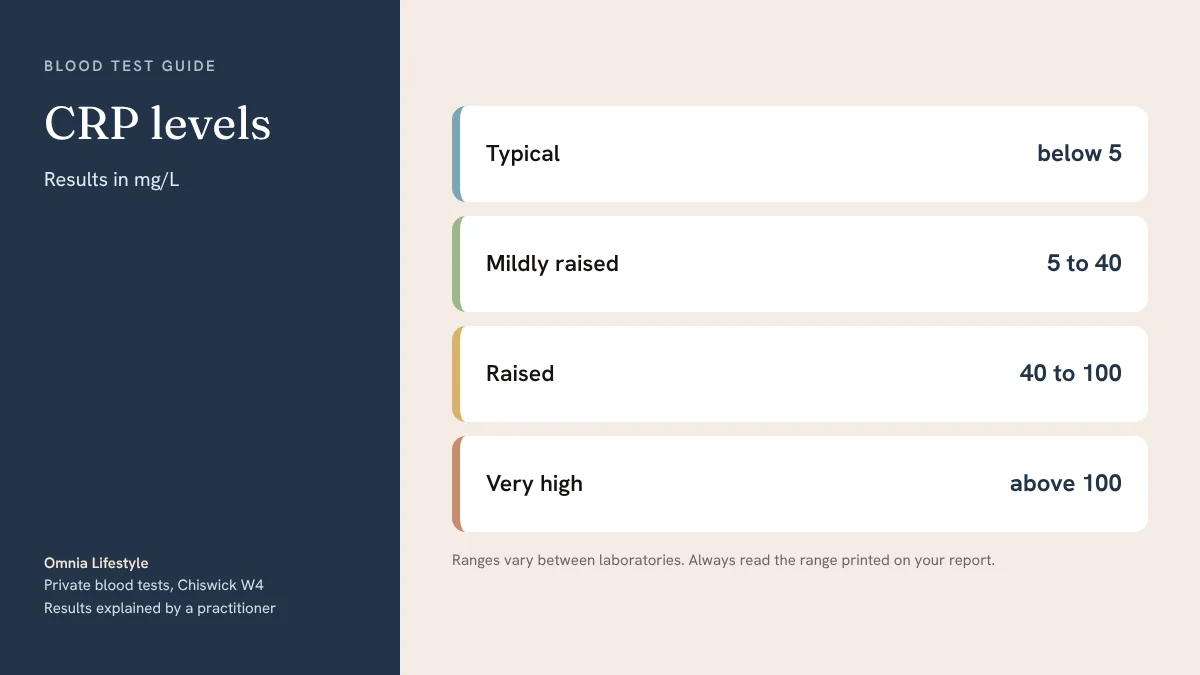
Most UK laboratories use a typical adult CRP of below 5 mg/L, but check the range on your report. One NHS laboratory explains that CRP of 10 to 40 mg/L is typical of mild inflammation and some viral infections, while 40 to 200 mg/L reflects acute inflammation or bacterial infection. Another notes that values above 100 mg/L suggest possible bacterial infection. CRP is not specific, so a result is always read alongside symptoms. For heart risk, a separate high-sensitivity CRP test is used.
What is CRP?
CRP is an acute phase protein, part of the body's rapid response to injury and infection. NHS laboratories note that it rises after bacterial infection, inflammation, trauma, surgery and heart attack, and falls again as the cause settles. Because it responds quickly, doctors use it both to spot inflammation and to monitor whether treatment is working.
What your CRP result means
- Typical (below 5 mg/L): no significant inflammation detected. A normal CRP does not rule out every condition: NHS guidance notes it can stay normal in some connective tissue diseases, such as lupus, and in myeloma.
- Mildly raised (about 5 to 40 mg/L): seen with mild inflammation, some viral infections, minor injuries and long-term conditions. NHS laboratories note that excess body fat can cause low-level rises, usually under 20 mg/L.
- Raised (about 40 to 100 mg/L): suggests acute inflammation or a bacterial infection and needs discussion with a doctor.
- Very high (above 100 mg/L): suggestive of possible bacterial infection or significant inflammation. If you feel unwell, seek medical advice the same day.
CRP and hs-CRP: what is the difference?
A standard CRP test is designed to measure inflammation from infection and illness. A high-sensitivity CRP (hs-CRP) test measures the same protein but can detect much lower levels, and is used as one marker of future heart and circulation risk.
One NHS laboratory uses these risk bands for hs-CRP:
- Below 1.0 mg/L: lower risk
- 1.0 to 3.0 mg/L: average risk
- Above 3.0 mg/L: higher risk
The same laboratory stresses that hs-CRP should not replace standard risk factors such as cholesterol and blood pressure, should not be tested during an infection or injury, and is best repeated about two weeks apart before drawing conclusions. Our cholesterol guide covers the main heart risk markers.
Common causes of a raised CRP
- Bacterial infections, such as chest, urine or skin infections, and some viral infections
- Inflammatory conditions such as rheumatoid arthritis and polymyalgia rheumatica
- Injury, burns or recent surgery
- A recent heart attack
- Excess body fat, which can cause a persistent mild rise
CRP compared with ESR
ESR (erythrocyte sedimentation rate) is an older, indirect test of inflammation. The two tests behave differently:
- Speed: CRP rises within hours and falls quickly as inflammation settles. ESR is slower to respond and may take about seven days to peak.
- Other influences: ESR is higher in women, increases with age and is affected by other blood factors. One NHS laboratory quotes an ESR range of 2 to 16 mm/hr for women and 2 to 10 mm/hr for men aged 16 to 60.
- Uses: NHS laboratories recommend CRP first in most situations. ESR remains useful for giant cell arteritis and for monitoring some conditions such as myeloma and connective tissue diseases. For polymyalgia rheumatica, both are usually checked.
Read more in our ESR levels guide.
Get urgent help
A CRP result never replaces how you feel. If you have a fever and feel very unwell, do not wait for a blood test. Call 999 or go to A&E if an adult:
- is breathing very fast
- is confused, has slurred speech or is not making sense
- has blue, pale or blotchy skin
- has a very high or very low temperature, feels hot or cold to the touch, or is shivery
- has a rash that does not fade when you press it
These can be signs of sepsis. If you are unsure, call NHS 111. If you get a very high CRP result and have symptoms of infection, contact your GP or NHS 111 the same day.
Who might consider a CRP test?
- People with ongoing joint pain, stiffness, tiredness or bowel symptoms who want a starting point for a GP conversation
- People with a known inflammatory condition who want to track it between appointments
- Anyone checking that inflammation has settled after an infection, as advised by their practitioner
Preparing for your CRP test
- Fasting: NHS laboratories list no special preparation for CRP. If it is part of a panel that needs fasting, follow the panel's instructions.
- Recent illness: tell us about any recent infection, injury or surgery, as these can raise CRP for a short time.
- hs-CRP for heart risk: wait until any infection has fully settled before testing.
How often to retest
NHS laboratories do not usually repeat CRP within 24 hours. To check that inflammation is settling, your practitioner may suggest a repeat after a few days or weeks. For hs-CRP, two results about two weeks apart give a more reliable picture.
Frequently asked questions
Is a CRP of 10 mg/L high?
It is above the typical range of below 5 mg/L. One NHS laboratory describes 10 to 40 mg/L as typical of mild inflammation and some viral infections. Your symptoms decide whether it needs follow-up.
Is a CRP of 50 serious?
A CRP of 50 mg/L sits in the range NHS laboratories link with acute inflammation or bacterial infection. Discuss it with a doctor promptly, and seek urgent help if you feel very unwell.
What CRP level is dangerous?
There is no single danger number. Values above 100 mg/L suggest possible bacterial infection, but how unwell you are matters most. Signs of sepsis need 999 whatever the result.
Should I have a CRP or an hs-CRP test?
Choose CRP to look for inflammation or infection. Choose hs-CRP as part of a heart risk check when you are well.
Is CRP or ESR better?
CRP responds faster and is the first choice in most situations. ESR still has a role for certain conditions, and the two are sometimes checked together.
CRP testing in Chiswick
Omnia Lifestyle is at 8 to 9 Bedford Corner, The Avenue, Chiswick, London W4 1LZ, a short walk from Turnham Green station on the District line (Piccadilly line trains stop there early morning and late evening only). Buses 94, E3 and 272 stop nearby, and limited parking is available on request when you book. Your sample is taken at the clinic and analysed at the Randox accredited laboratory. Every test price includes a practitioner review of your result with you and a GP feedback report on request. You do not need a GP referral, and most results are ready within a few working days.
Book the C-Reactive Protein (CRP) test on its own, or choose the Inflammation Check, which adds ESR and a full blood count. For heart risk, see the hs-CRP test or our autoimmune and inflammation tests. You can also compare every blood test and price, or read our guides to ESR levels and blood tests for joint pain.
This article is general information, not medical advice. Discuss your results with your GP or practitioner.
Ready to book?
Blood Test




.jpg)
.jpg)
