






Book at our Chiswick clinic
Blood Test
The erythrocyte sedimentation rate (ESR) is one of the oldest blood tests still in everyday use. It measures how far red blood cells settle to the bottom of a tall, thin tube in one hour. When there is inflammation in the body, certain proteins in the blood rise and make red cells clump together, so they fall faster and the ESR goes up.
ESR is a useful general signal that something is going on, but it cannot say what or where. This guide explains how ESR changes with age and sex, what a high result can mean, how it compares with CRP, and the warning signs of polymyalgia rheumatica and giant cell arteritis that need same-day attention.
Test it in Chiswick: our ESR blood test costs £39, with your result explained in person by a practitioner. No GP referral needed. Book this test or call 020 4515 0000.
Quick answer
ESR is reported in millimetres per hour (mm/hr). Healthy values rise with age and are higher in women than in men, so laboratories use age and sex specific ranges. One NHS laboratory uses upper limits of 10 mm/hr for men and 12 mm/hr for women aged 17 to 50, rising to 30 and 35 mm/hr over 70. A high ESR shows inflammation somewhere, not its cause: infections, autoimmune conditions, polymyalgia rheumatica, giant cell arteritis, anaemia, pregnancy and some cancers can all raise it. A new headache, jaw pain when chewing or changes in vision need same-day medical attention.
What ESR measures
ESR is a non-specific marker. It can rise with infection, inflammation, tissue damage and some cancers, but also with things that are not illnesses at all, such as getting older, pregnancy and anaemia. That is why a result is always read alongside your symptoms, an examination and other blood tests.
ESR and CRP
C-reactive protein (CRP) is another inflammation marker, made by the liver. CRP rises and falls within days, so it reflects what is happening now. ESR changes more slowly and is influenced by more factors, including age, sex and red cell count. Doctors often request both, because together they give a clearer picture. Our guide to CRP levels explains that test, and a CRP test (£49) is available on its own.
Normal ESR by age and sex
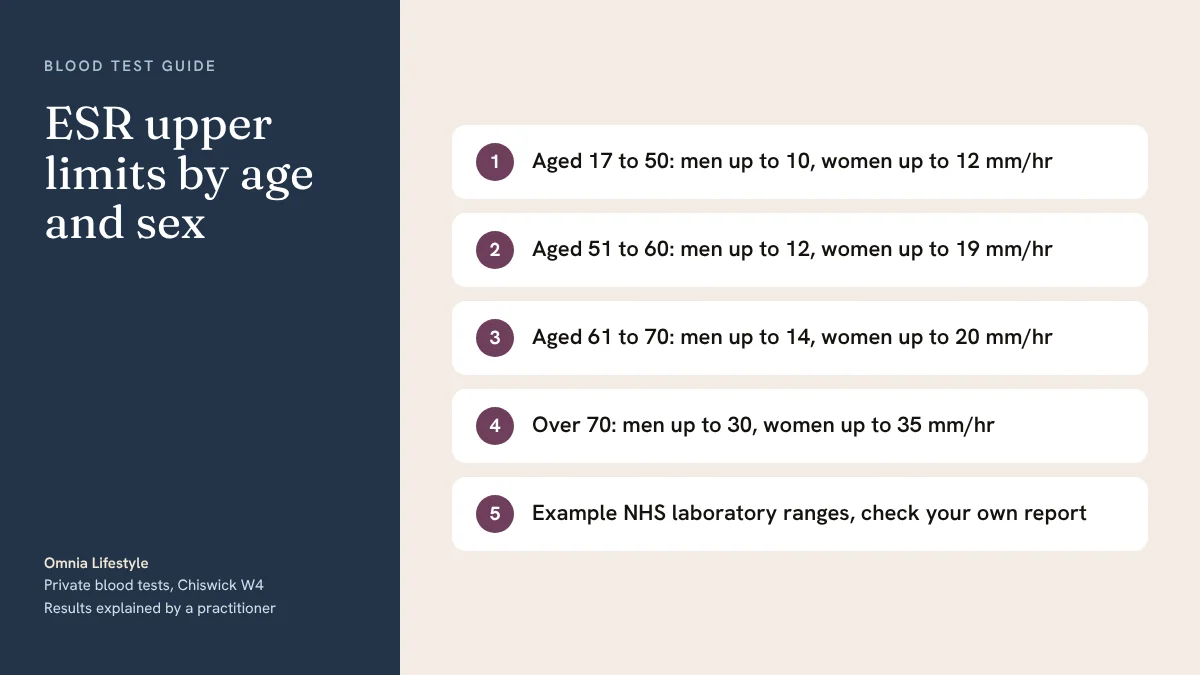
Each laboratory sets its own ranges. As an example, the laboratory at York and Scarborough Teaching Hospitals NHS Foundation Trust uses these upper limits:
- Aged 17 to 50: up to 10 mm/hr for men, up to 12 mm/hr for women
- Aged 51 to 60: up to 12 mm/hr for men, up to 19 mm/hr for women
- Aged 61 to 70: up to 14 mm/hr for men, up to 20 mm/hr for women
- Over 70: up to 30 mm/hr for men, up to 35 mm/hr for women
Other NHS laboratories group ages differently, so always compare your result with the range printed on your own report.
What your result means
- Within range for your age and sex: no sign of significant inflammation on this test. A normal ESR does not rule out every problem, so symptoms still matter.
- Mildly raised: common, and often due to a recent infection, anaemia, pregnancy or simply age. It is usually worth repeating once you are well and reading alongside CRP and a full blood count.
- Clearly raised: suggests active inflammation that needs explaining. Your practitioner will look at your symptoms and may suggest further tests or a GP review.
- Very high: can be seen with serious infection, giant cell arteritis, myeloma and some other conditions. This needs prompt medical review, especially if you feel unwell.
A low ESR is not usually a cause for concern.
Causes of a high ESR
- Infections: from chest and urine infections to more serious bone or heart valve infections.
- Autoimmune and inflammatory conditions: such as rheumatoid arthritis, lupus and inflammatory bowel disease.
- Polymyalgia rheumatica and giant cell arteritis: see below.
- Anaemia, pregnancy and kidney disease: these can raise ESR without active inflammation.
- Some cancers: including myeloma and lymphoma. This is a less common cause, and most raised results have another explanation.
- Age: ESR naturally drifts up over the years.
Polymyalgia rheumatica and giant cell arteritis
Polymyalgia rheumatica (PMR) is an inflammatory condition that causes pain and stiffness, usually in the shoulders, neck and hips. The NHS describes the main symptom as muscle stiffness in the morning that lasts longer than 45 minutes. Tiredness, loss of appetite, weight loss and low mood are also common. Most people diagnosed are over 65, and it is very rare under 50. ESR and CRP are usually raised.
Giant cell arteritis (GCA), also called temporal arteritis, is inflammation of blood vessels, especially around the temples. It can occur alongside PMR. Symptoms include a new, severe or frequent headache, tenderness of the scalp or temples, jaw pain when eating or talking, and vision problems such as double vision or sight loss. The NHS warns that it can lead to stroke and blindness if not treated quickly. It is treated with steroid medicine.
ESR is most useful as part of an urgent assessment for GCA. However, a blood test alone cannot confirm or rule it out. If you have possible GCA symptoms, do not wait for a private test result: get medical help the same day.
When to see your GP or get urgent help
Go to A&E or call 999 if you suddenly cannot see out of one or both eyes, if you have new double vision or other changes in your sight together with a new headache, scalp tenderness or jaw pain, or if you have signs of a stroke, such as a drooping face, weakness in one arm or slurred speech.
Get an urgent same-day GP appointment or call NHS 111 if you have a new or unusual headache, scalp or temple tenderness, or jaw pain when chewing or talking, especially if you also have shoulder or hip stiffness.
Book a GP appointment soon if you have morning stiffness in your shoulders or hips lasting more than 45 minutes, unexplained weight loss, night sweats, persistent fever, swollen joints, persistent bone pain, or a raised ESR without a clear reason.
Who should consider an ESR test
- People with joint pain, swelling or stiffness, as part of a wider check
- People with an inflammatory condition who want to track it between appointments, alongside their specialist care
- Anyone with tiredness, aches or feeling generally unwell, alongside CRP and a full blood count
For a broader view, our Rheumatology Check (£79) combines ESR with rheumatoid factor, anti-CCP antibodies and uric acid, and our autoimmune and inflammation blood tests page compares the options.
Preparing for the test
You do not need to fast for an ESR test. Tell your practitioner if you are pregnant, have had a recent infection or injury, or take steroids or anti-inflammatory medicines, as these can all affect the result. The sample needs to be tested within hours of being taken, which our clinic arranges for you.
How often to retest
If your ESR was mildly raised during or soon after an infection, a repeat once you have fully recovered usually shows whether it has settled. If you are being treated for PMR, GCA or another inflammatory condition, your GP or specialist will set a monitoring plan. If your result is in range and you feel well, there is no need for regular testing.
Frequently asked questions
Is an ESR of 30 high?
It depends on your age and sex. At the York NHS laboratory, 30 mm/hr is above the upper limit for adults up to 70, but within range for men and women over 70. Compare it with the range on your report and discuss it with your practitioner.
What is the difference between ESR and CRP?
Both measure inflammation. CRP changes quickly and reflects what is happening now, while ESR changes more slowly and is affected by age, sex and anaemia.
Can a high ESR mean cancer?
Occasionally, but most raised results are due to infection, inflammation, anaemia or age. A persistently raised ESR without a clear cause should be discussed with your GP.
Can ESR be normal in giant cell arteritis?
Yes, a normal result does not completely rule it out. Symptoms such as a new headache, jaw pain or vision changes need same-day medical assessment whatever your blood test shows.
Why is my ESR high when I feel well?
Age, being female, pregnancy, anaemia or a recent minor infection can all raise ESR. Your practitioner will read it alongside other results and may suggest repeating it.
ESR testing in Chiswick
We take your sample at our clinic at 8 to 9 Bedford Corner, The Avenue, Chiswick, London W4 1LZ. We are a short walk from Turnham Green station (District line, with Piccadilly line trains stopping there early morning and late evening only) and close to the 94, E3 and 272 bus routes. Limited parking is available on request when you book. Your sample is analysed at the Randox accredited laboratory, no GP referral is needed, and most results are ready within a few working days. A practitioner explains your result with you in person, and a GP feedback report is available on request.
Book the ESR blood test on its own, or choose the Inflammation Check (£79), which combines ESR with CRP, ferritin and a full blood count. You can also compare every blood test and price, read our guide to CRP levels, or see which blood tests help with joint pain.
This article is general information, not medical advice. Discuss your results with your GP or practitioner.
Ready to book?
Blood Test




.jpg)
.jpg)
