Book at our Chiswick clinic
Physiotherapy
Pain in the right shoulder is one of the most common reasons people see a physiotherapist. Because most people are right-handed, the right shoulder does more lifting, reaching and carrying, so overuse problems such as rotator cuff tendon pain often show up on this side first.
Right shoulder pain can also be referred from somewhere else, most often the neck, and occasionally the gallbladder, liver or diaphragm. This guide explains the common causes, what different types of right shoulder and arm pain can mean, when to worry and what helps.
Right shoulder pain in a few lines
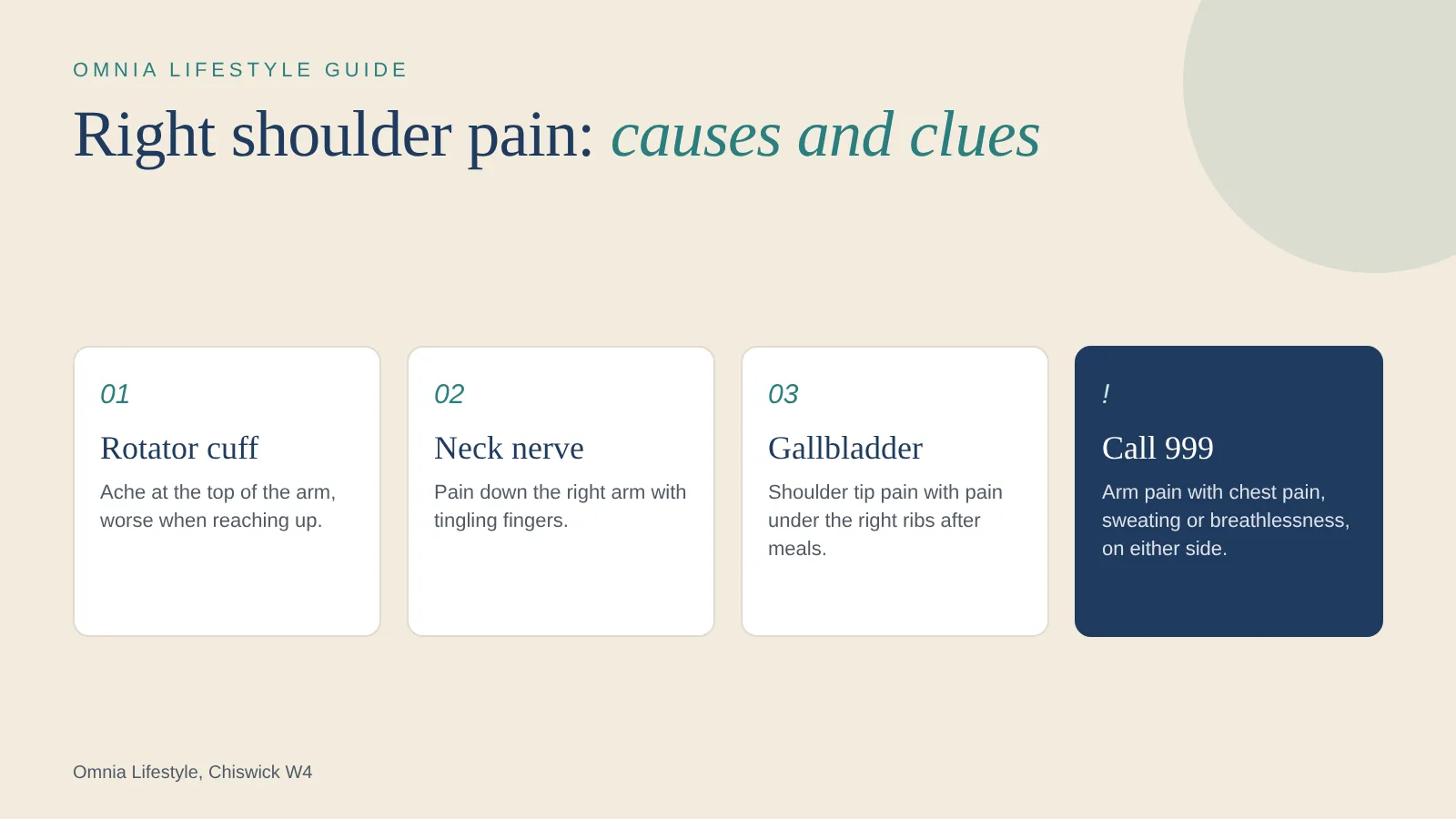
Most right shoulder pain comes from rotator cuff irritation, a muscle strain, frozen shoulder, arthritis or a trapped nerve in the neck, and usually eases with exercise. Right shoulder tip pain with pain under the right ribs, especially after fatty meals, can come from the gallbladder. Call 999 if shoulder or arm pain comes with chest pain, breathlessness, sweating or feeling sick, as heart attacks can affect the right arm.
Right shoulder pain: when to call 999
Heart attack pain is often linked with the left arm, but the British Heart Foundation notes that it can spread to either arm. Call 999 if pain in your right shoulder or arm comes with:
- Chest pain, pressure, tightness or heaviness
- Pain spreading to the neck, jaw, back or tummy
- Breathlessness, sweating, feeling sick or light-headed
- Sudden weakness or numbness in the right arm or face, slurred speech or confusion, which can be a stroke
- Sudden sharp pain when breathing with breathlessness or coughing up blood
Also go to A&E if your shoulder looks deformed after a fall, or you cannot move your arm at all.
Common causes of pain in the right shoulder
- Rotator cuff tendon pain and impingement: an ache on the outside of the upper arm, worse lifting the arm out to the side or overhead and when lying on your right side. Very common in people who use the right arm for work, sport or the gym.
- Muscle strain: pain across the top of the shoulder after lifting, carrying a child or bag on that side, or long hours using a mouse.
- Frozen shoulder: pain and steadily increasing stiffness, so that you cannot reach behind your back or above your head. A Nottinghamshire NHS patient leaflet notes that it mainly affects people aged 40 to 60 and is more common in women. See frozen shoulder.
- Arthritis: osteoarthritis of the shoulder or of the joint at the end of the collarbone, with a deep ache and stiffness.
- Trapped nerve in the neck: pain from the neck or shoulder blade into the right arm, often with pins and needles in the fingers.
- Calcific tendinopathy: calcium deposits in a rotator cuff tendon can cause right shoulder pain that comes on suddenly and is severe.
Right shoulder pain from the gallbladder and other organs
Your right shoulder shares nerve pathways with the diaphragm, so irritation under the right side of the diaphragm can be felt at the tip of the right shoulder or under the right shoulder blade. Possible sources include:
- Gallstones and gallbladder inflammation: pain in the upper right tummy, under the ribs, that can spread to the right shoulder or shoulder blade. Ireland's health service (HSE) notes that it is sometimes triggered by eating fatty food and usually lasts 1 to 5 hours, although it sometimes goes away after a few minutes.
- Liver problems: an ache under the right ribs that may be felt in the right shoulder.
- Lung and chest problems: pneumonia, pleurisy or a blood clot in the lung can cause sharp shoulder pain that is worse when breathing in.
- After keyhole surgery: gas used during abdominal surgery can cause shoulder tip pain.
Clues that pain is not coming from the shoulder: moving the arm does not change it, pressing the shoulder does not reproduce it, and it is linked to meals, breathing or feeling generally unwell. The NHS advises asking for an urgent GP appointment or calling NHS 111 if you have tummy pain that lasts longer than 30 minutes, and calling 999 or going to A&E if you have sudden, severe tummy pain, a very high temperature or feel hot, cold or shivery, or yellowing of your skin or the whites of your eyes. See also middle back pain for pain felt under the right shoulder blade.
Pain in the right shoulder and arm
Aching in the right arm and shoulder together is most often the rotator cuff, which typically causes pain at the top of the right arm rather than in the joint itself. Pain that travels from the right shoulder to the elbow or all the way to the hand points more towards the neck.
Right arm pain with tingling or numb fingers
Right arm pain with pins and needles or numbness in the fingers is usually a trapped nerve in the neck, or a nerve squeezed at the elbow or wrist, as in carpal tunnel syndrome. Shooting pains down the right arm that change when you move your neck strongly suggest the neck. See a GP or physiotherapist if it lasts more than a few weeks, and seek urgent help for weakness that is getting worse or numbness with a drooping face or slurred speech.
Right shoulder and hand pain
Pain in both the right shoulder and the hand can be one problem, such as a nerve root in the neck, or two separate ones, such as rotator cuff pain together with arthritis or a tendon problem in the hand. A physiotherapy assessment can tell these apart.
Right arm pain in women
The causes of right arm and shoulder pain in women are largely the same as in men, although frozen shoulder is more common in women, and carrying a child or bag on the right side is a frequent trigger. The British Heart Foundation notes that women sometimes have lesser-known heart attack symptoms rather than chest pain, and that the pain can spread to either arm, the neck, jaw or upper back, so do not ignore arm, jaw or back discomfort with breathlessness.
Sharp pain in the right shoulder or a dull ache?
Sharp pain on the right shoulder that catches when you lift or reach is usually rotator cuff or joint related. Right shoulder pain that comes on suddenly and severely without injury can be calcific tendinopathy. Sharp pain when breathing needs medical assessment.
A constant dull ache in the right shoulder is common with tendon problems, arthritis, muscle tension and frozen shoulder. A dull ache that does not change at all with movement, or comes with tummy symptoms, should be checked by a GP.
When to see a GP
- Pain has not improved after two weeks of home care
- It is very painful to move your arm or you cannot lift it
- The shoulder is hot, red or swollen, or you feel feverish
- Pain is linked to eating, breathing or comes with tummy pain
- You have pins and needles or numbness that does not go away
- You have unexplained weight loss or feel generally unwell
What helps right shoulder pain
- Keep moving gently within comfort, as a still shoulder stiffens
- Swap sides for carrying bags, children and shopping where you can
- Adjust your desk so the mouse is close and your right elbow rests near your side
- Use heat or ice for up to 20 minutes at a time
- Try painkillers such as paracetamol or ibuprofen if suitable for you
- Sleep on your back or left side with a pillow supporting the right arm
- Start gentle exercises from our shoulder impingement exercises guide
How Omnia treats right shoulder pain
At Omnia Lifestyle an HCPC-registered physiotherapist will first check for any signs that your right shoulder pain needs a GP review, then examine your neck and shoulder to find the source and agree a clear plan.
- Physiotherapy in Chiswick: 70-minute initial assessment and treatment for £99, follow-ups from £70. Recognised by AXA Health, Aviva, WPA and Vitality.
- Sports massage: from £65 for 30 minutes, for tight shoulder and neck muscles alongside an exercise plan.
- Acupuncture: £80 for a 60-minute session, which some people choose alongside exercise for long-standing neck and shoulder pain.
Questions people ask about right shoulder pain
Why does my right shoulder ache?
Usually because of rotator cuff irritation, muscle strain or posture, often from heavy use of the dominant arm. Less commonly the ache is referred from the neck or, with tummy symptoms, the gallbladder.
Can gallbladder pain feel like right shoulder pain?
Yes. Gallbladder pain can spread to the right shoulder or under the right shoulder blade, usually with pain under the right ribs, often after meals. It does not change with arm movement.
Can right shoulder pain be a heart attack?
It can. The British Heart Foundation notes that heart attack pain can spread to either arm. Call 999 if right shoulder or arm pain comes with chest pain, breathlessness, sweating or nausea.
Why does my right arm hurt from shoulder to elbow?
Pain from the shoulder to the elbow is a classic rotator cuff pattern. Pain that goes past the elbow into the hand with tingling more often comes from the neck.
How long does right shoulder pain last?
Strains often settle in a few weeks. The NHS says shoulder pain usually takes about two weeks of self-care to start easing, although full recovery can take six months or longer, and NHS inform notes that frozen shoulder can take over a year to resolve.
Booking a right shoulder assessment
For a right shoulder that aches when you reach, lift or lie on it, our physiotherapy team at 8 to 9 Bedford Corner, The Avenue, Chiswick W4 1LZ will examine the neck and shoulder together and agree a plan with you. Book online, or phone 020 4515 0000 to talk it through first.
Sources
- NHS: Shoulder pain
- Nottinghamshire Integrated Care System (Sherwood Forest Hospitals): Frozen shoulder, information for patients
- NHS inform: Frozen shoulder
- Whittington Health NHS Trust: Calcific tendinopathy
- HSE: Symptoms of gallstones
- NHS: Gallstones
- Gloucestershire Hospitals NHS Foundation Trust: Laparoscopic cholecystectomy
- British Heart Foundation: Signs and symptoms of heart attacks in women
This article is general information, not medical advice. If you have any of the warning signs listed above, call 999 or seek urgent medical attention.
Ready to book?
Physiotherapy