


Book at our Chiswick clinic
Manual Lymphatic Drainage
Lymphatic drainage massage at home is a gentle self-massage that encourages fluid to move through the lymphatic system. It uses very light, slow strokes that stretch the skin rather than press into the muscles, and it always starts by clearing the areas nearest the main lymph nodes before working on the swollen part. Done well, it takes about ten to twenty minutes and needs nothing more than your hands.
This guide explains how to do lymphatic drainage massage step by step, how to improve lymphatic drainage, who should not try it without medical advice and when swelling needs urgent care.
Quick answer
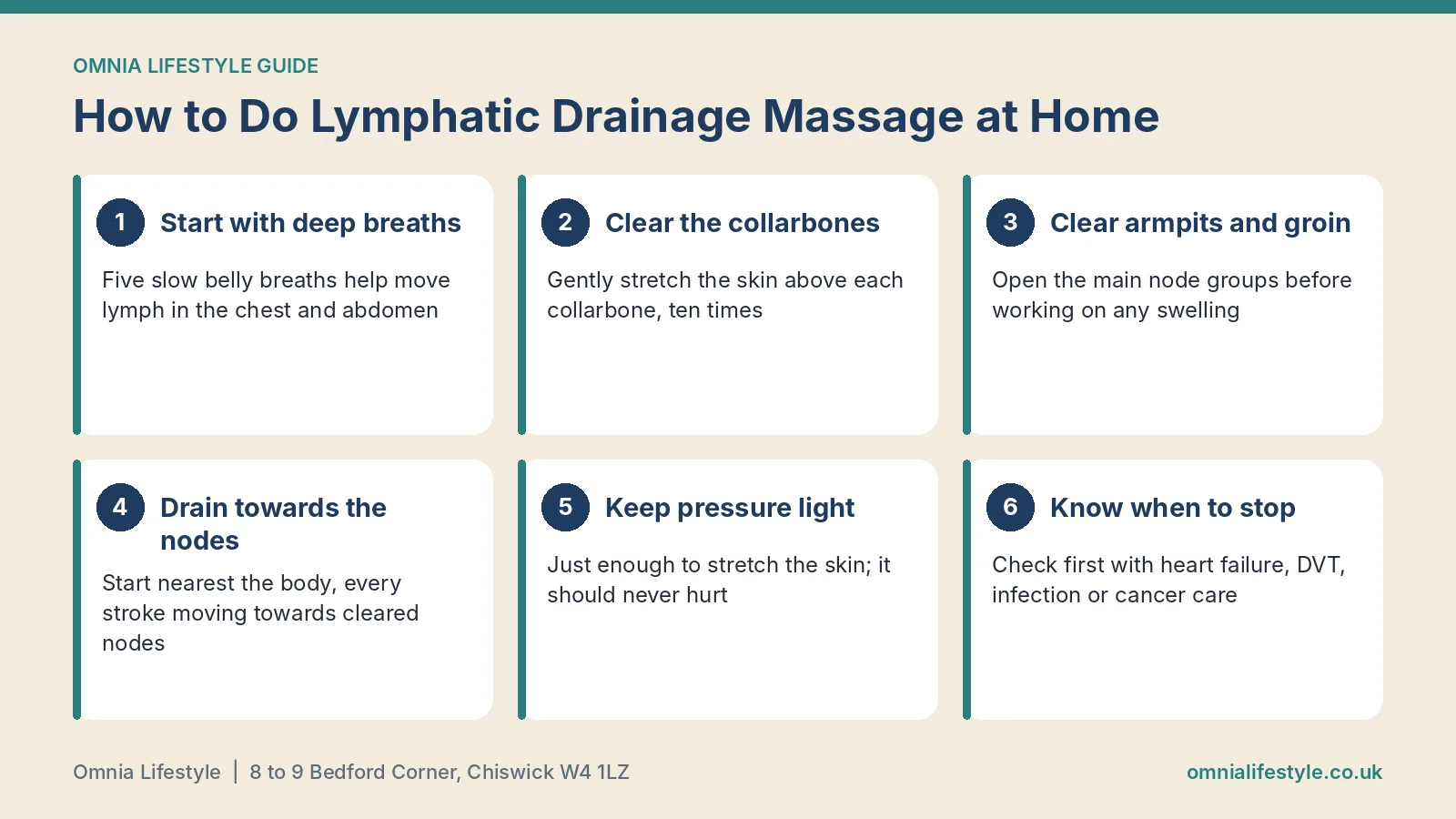
To do lymphatic drainage massage, use flat hands and very light pressure, just enough to stretch the skin, with slow, rhythmic strokes. Start with a few deep belly breaths, then clear the area above the collarbones, the armpits and the groin. Only then work on the swollen area, beginning at the part nearest your body and stroking towards the nearest group of lymph nodes. Spend ten to twenty minutes once a day. It should never hurt or leave redness.
How the lymphatic system drains
Your lymphatic system is a network of thin vessels and lymph nodes that returns excess fluid from the tissues to your bloodstream. It has no central pump. Lymph moves when your muscles contract, when you breathe deeply and when the skin is gently stretched.
Fluid drains towards clusters of lymph nodes, mainly:
- Above the collarbones, where lymph rejoins the blood
- In the armpits, draining the arms, chest and upper back
- In the groin, draining the legs, buttocks and lower abdomen
- Deep in the abdomen, which deep breathing helps to stimulate
Most of the small lymph vessels lie just under the skin. That is why lymphatic massage is so light: firm pressure flattens the vessels instead of helping them work.
How to do lymphatic drainage massage, step by step
Before you start self lymphatic drainage:
- Check it is safe for you. Read the section on who should not do it without medical advice first.
- Use bare skin and dry hands. Oil makes your hands slide instead of stretching the skin.
- Keep the pressure light. Think of the weight of a coin on your skin. You should see the skin move, but you should not feel the muscle underneath.
- Go slowly. Each stroke takes a second or two, repeated five to ten times in each spot.
- Follow the order. Clear first, then drain. Working on a swollen area before the nodes above it are cleared simply pushes fluid against a blockage.
This is the basic self lymph massage sequence. Steps 1 to 4 clear the pathways and are the same whichever area you want to treat.
1. Deep belly breathing
Place your hands on your stomach. Breathe in slowly through your nose so your belly rises, then breathe out slowly through your mouth. Repeat five times. Deep breathing helps move lymph through the large vessels in your chest and abdomen.
2. Clear above the collarbones
Rest your fingertips in the soft hollows just above each collarbone. Gently stretch the skin down and inwards towards the centre of your body, then release. Repeat ten times.
3. Clear the sides of the neck
Place your flat hands on each side of your neck, just below your ears. Gently stretch the skin down towards your collarbones and release. Repeat ten times, keeping the pressure very light.
4. Clear the armpits
Raise one arm and rest it on your head or a pillow. Place the flat fingers of your other hand in the hollow of your armpit and gently stretch the skin up into the armpit, then release. Repeat ten times on each side.
5. Clear the groin
Lie on your back with your knees bent. Place your flat hands in the crease at the top of each thigh and gently stretch the skin upwards towards your hip bones and release. Repeat ten times.
6. Work on the area you want to drain
Now follow the routine for the abdomen or legs below. Always start with the part nearest your body and work outwards, while every stroke still moves towards the nodes you have just cleared.
7. Finish with breathing
End with five more deep belly breaths, then have a glass of water and go for a short walk if you can.
Self lymph massage for the legs, abdomen and face
Self lymphatic drainage for the legs
Leg swelling drains towards the groin, so clear the groin first (step 5), then:
- Upper thigh: place both hands flat on the front and sides of your thigh. Stretch the skin gently upwards towards the groin and release. Move your hands down the thigh a little at a time, always stroking upwards. Repeat for one to two minutes.
- Behind the knee: with your fingers in the soft area at the back of the knee, make gentle upward stretches ten times.
- Lower leg: work from just below the knee down towards the ankle in sections, each stroke moving upwards towards the knee.
- Ankle and foot: use gentle circles around the ankle bones, stroking up towards the calf.
- Return upwards: finish with a few long, light strokes from the ankle all the way up to the groin.
Raising your legs afterwards and doing simple ankle pumps can help. Our lymphatic drainage exercises and stretches give a short routine to pair with this.
Lymphatic massage at home for the abdomen
Abdominal massage is often used for a feeling of bloating or heaviness, and to help the deeper lymph vessels. It is not suitable during pregnancy without advice from your midwife, or soon after abdominal surgery unless your surgical team has agreed it.
- Lie on your back with your knees bent and clear the groin and armpits first.
- Place your flat hands on your lower abdomen and make slow, gentle circles, following the direction of the large bowel: up the right side, across under the ribs and down the left side.
- Combine the strokes with deep breathing, pressing very lightly as you breathe out.
- Continue for two to three minutes, then rest.
Facial lymphatic drainage
The face drains down the sides of the neck towards the collarbones, so steps 2 and 3 above always come first. Then use very light strokes from the centre of the face outwards towards the ears, and down the neck. Our facial lymphatic drainage guide covers this in five steps, including how to use gua sha and rollers.
How to improve lymphatic drainage every day
Self-massage works best alongside habits that keep lymph moving:
- Move regularly: walking, swimming and cycling all use the muscle pump in your legs
- Break up long periods of sitting, especially on flights and long drives, with ankle circles and short walks
- Breathe deeply for a few minutes several times a day
- Raise swollen legs above the level of your hips when resting
- Look after your skin, keeping it clean and moisturised to lower the risk of infection
- Wear compression only if advised by a clinician who has measured you
There is no good evidence that detox drinks, supplements or fasting flush or clean your lymphatic system, and it does not need cleansing. You can read more about what the evidence shows about lymphatic drainage massage.
How to drain lymph nodes: what to know
Swollen glands in the neck, armpit or groin usually mean your body is fighting an infection, such as a cold, and they normally go down by themselves within about two weeks. Do not massage or press on swollen, tender lymph nodes. Lymphatic drainage moves fluid towards healthy nodes; it is not a treatment for swollen glands.
Who should not do it without medical advice
Lymphatic drainage moves fluid back towards your heart and circulation. Speak to your GP or specialist before trying it at home if you have:
- Heart failure or another heart condition that causes fluid build-up
- A suspected blood clot or DVT, or a clot that is still being treated
- An active infection or cellulitis, including red, hot or painful skin, or a high temperature
- Kidney problems, particularly if you have been told to limit fluids
- Active cancer treatment, or cancer that has not yet been treated
- Lymphoedema, which needs a plan from a trained lymphoedema therapist
- Recent surgery, where your surgical team should agree the timing
- Pregnancy, where your midwife or GP should check first
When swelling needs urgent care
Call 999 if you have:
- Sudden breathlessness, chest pain or coughing up blood, which can be a sign of a blood clot in the lung
- Swelling of the face, lips, tongue or throat with difficulty breathing or swallowing
Get urgent medical help the same day, from your GP or NHS 111, if you have:
- Swelling, pain, warmth or redness in one leg, especially the calf, which can be a sign of DVT
- Red, hot, painful or spreading skin, with or without a high temperature or feeling unwell, which can be cellulitis
- Swelling in both legs that comes with breathlessness, or breathlessness when lying flat
- Sudden swelling with no obvious cause
See your GP if:
- Swelling has lasted more than a few days and is not improving
- Swollen lymph nodes have not gone down within two weeks, feel hard or do not move when pressed
- You also have night sweats, unexplained weight loss or a high temperature
- Swelling has started after cancer treatment or surgery
Stop self-massage straight away if it causes pain, increases the swelling or makes your skin red.
When professional lymphatic drainage helps
Self-massage is useful for mild fluid retention and for keeping results going between sessions. Professional manual lymphatic drainage (MLD) may help more when swelling is persistent, follows surgery, or is part of lymphoedema. A trained therapist assesses the cause, checks it is safe to treat, uses precise techniques on areas that are hard to reach yourself, and teaches you a home routine suited to your body.
Some people combine MLD with compression therapy or device-based treatments. Omnia Lifestyle is the only clinic offering MLD, Body Ballancer and LPG Cellu M6 Infinity together, and our page on lymphatic drainage options in London explains how they compare.
Frequently asked questions
How often should I do self lymphatic drainage?
Once a day for ten to twenty minutes is a common routine. If a therapist has given you a plan, follow their advice.
How do I know if lymphatic massage at home is working?
You may notice the area feels lighter or softer, or that you need to pass urine more often afterwards. Changes are usually gradual, and swelling that does not improve should be checked.
Can I use a machine for lymph drainage at home?
Some home devices exist, but their quality varies. See our guide to which lymphatic drainage machines actually work before buying one.
Should lymphatic drainage self massage hurt?
No. The pressure should be very light and comfortable. Pain, redness or bruising means you are pressing too hard, or that something needs checking.
How do I stimulate my lymphatic system?
Regular movement, deep breathing, raising swollen limbs and gentle self-massage all help lymph flow.
Lymphatic drainage massage in Chiswick
Manual lymphatic drainage is offered at Omnia Lifestyle, 8 to 9 Bedford Corner, The Avenue, Chiswick W4 1LZ, close to Turnham Green station, on bus routes 94, E3 and 272. Limited parking is available on request when booking. Your therapist reviews your health history and swelling, treats the areas that need it and shows you a self lymphatic drainage routine to continue at home.
Read more about lymphatic drainage massage in Chiswick, lymphoedema and lymphatic drainage exercises, explore pressotherapy and compression therapy, or book a session.
This article is general information, not medical advice. If you have any of the warning signs listed above, seek medical attention.
Ready to book?
Manual Lymphatic Drainage


.jpg)
.jpg)