


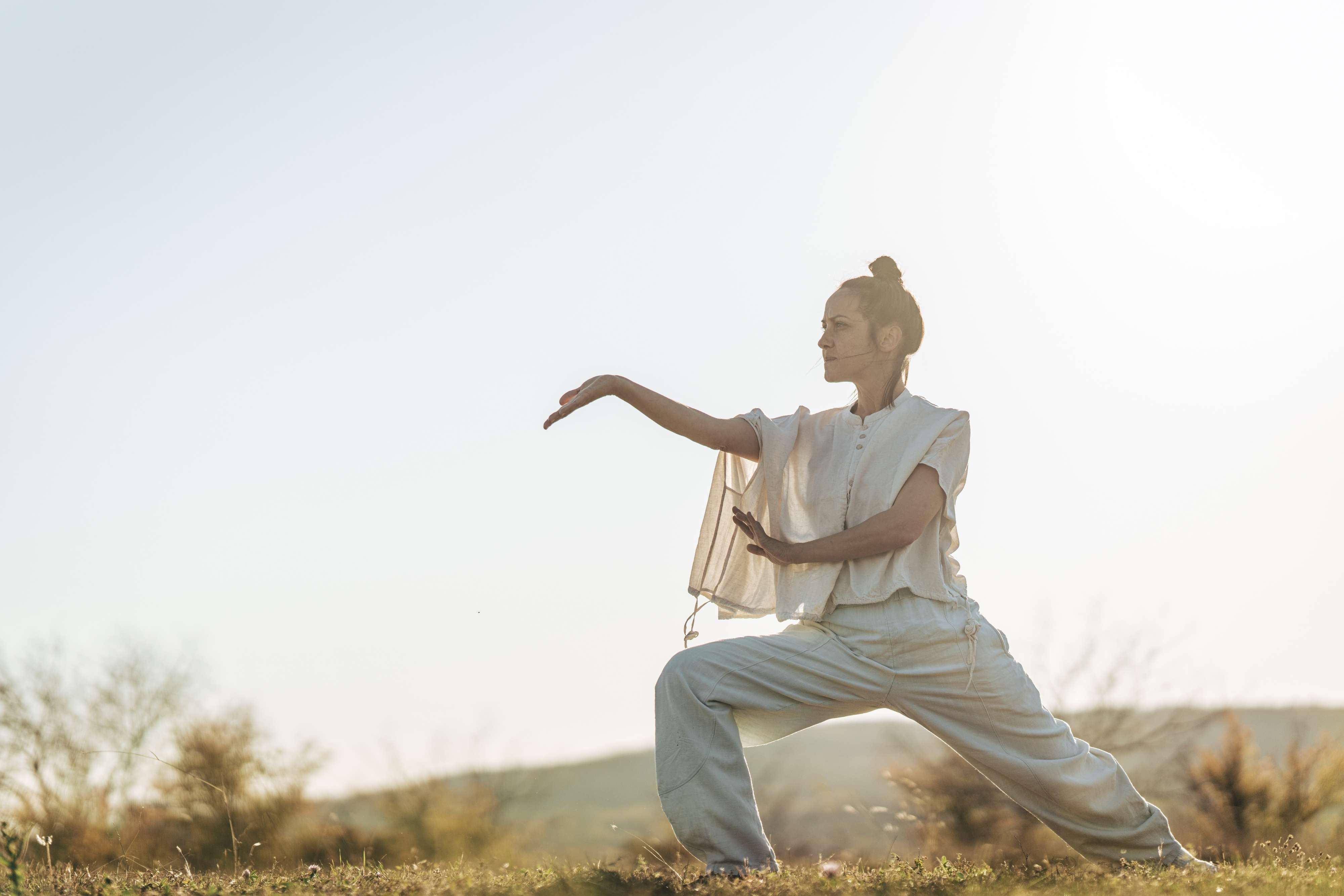


Tai chi looks simple from the outside: slow arms, soft knees, a calm face. Try it and you discover how much is going on underneath. Your legs work, your balance is tested with every weight shift, and your breathing slows without you trying.
This guide gives you eight beginner tai chi exercises you can practise at home in about ten minutes, with seated versions for each. They are the building blocks our teachers use in the first weeks of a class, and they are a good way to find out whether tai chi suits you before you join a group.
Before you start
- Wear loose clothing and flat shoes, or practise barefoot on a non-slip floor.
- Keep a chair nearby for balance, or do the seated versions.
- Move slowly. If you think you are going slowly enough, halve the speed.
- Stay within comfort. Tai chi should never hurt. Keep knees soft and over your toes, never twisted.
- Breathe through your nose if you can, and let the breath follow the movement rather than forcing it.
1. Standing posture
Stand with feet hip-width apart, toes pointing forward. Soften your knees slightly, let your tailbone drop, and imagine a thread lifting the crown of your head. Relax your shoulders and let your arms hang. Stand for one minute and notice where you hold tension.
Why it matters: every tai chi movement starts from this posture. Getting it right protects your knees and lower back.
Seated version: sit towards the front of a firm chair, feet flat, spine tall without leaning on the backrest.
2. Raising and lowering the arms
From standing posture, breathe in as you float both arms forward and up to shoulder height, wrists leading and fingers soft. Breathe out as you lower them slowly, bending the knees a little as the hands come down. Repeat eight times.
This is the opening movement of most tai chi forms. It links breath and movement and is the simplest way to feel the calming effect.
Seated version: the same arm movement, sitting tall.
3. Shifting weight side to side
Step your feet a little wider than hip-width. Slowly move your weight into your right leg until the left foot feels light, then move it back through the centre into the left leg. Keep your head level, as if balancing a book on it. Do ten slow shifts.
Why it matters: controlled weight transfer is the core of tai chi and the main reason it improves balance.
Seated version: shift your weight from one sitting bone to the other, keeping your head level.
4. Shifting weight forward and back
Step one foot forward, heel down, about a short stride's length. Slowly move your weight onto the front foot, front knee over the toes, then back onto the rear foot, letting the front toes lift slightly if comfortable. Do eight shifts, then change feet.
Seated version: press alternately through the balls of the feet and the heels, rocking gently.
5. Opening and closing the hands
Hold your hands in front of your chest, palms facing each other, as if holding a large ball. Breathe in as you slowly draw the hands apart, breathe out as you bring them back towards each other without touching. Repeat ten times and notice any warmth or tingling in the palms.
This qi gong exercise trains relaxed attention and is easy to do anywhere.
6. Turning the waist
Stand with feet hip-width apart and knees soft. Turn gently from the waist to the right and left, letting your arms swing loosely so the hands lightly tap the body. Keep the knees pointing forward; the turn comes from the waist and hips, not the knees. Continue for one minute.
Seated version: turn the upper body gently, arms relaxed, feet still.
7. Wave hands like clouds
From a slightly wide stance, raise your right hand to face height, palm facing you, and your left hand to hip height, palm down. Turn the waist slowly to the right, then lower the right hand and raise the left as you turn back to the left. The hands pass each other like slow, drifting clouds while your weight moves with the turn. Do six to eight each way.
This is one of the best-known tai chi movements and combines everything above: posture, weight shift, waist turn and coordinated hands.
8. Brush knee (simplified)
Step forward with your left foot, heel first. As your weight moves forward, your left hand sweeps down and across in front of the left knee, and your right hand pushes slowly forward at chest height. Draw back, change sides and repeat. Do four on each side.
Keep the stance short and the front knee over the toes. If balance is a concern, do this beside a chair or skip the step and practise the arm movement only.
A simple ten-minute routine
- Standing posture: 1 minute
- Raising and lowering the arms: 8 breaths
- Weight shifting side to side: 10 shifts
- Weight shifting forward and back: 8 each side
- Turning the waist: 1 minute
- Opening and closing the hands: 10 breaths
- Wave hands like clouds: 6 to 8 each way
- Brush knee: 4 each side
- Finish with standing posture and three slow breaths
Practise on three or four days a week. Ten minutes most days does more than one long session, and you should notice steadier balance and easier breathing within a few weeks.
When to learn with a teacher
Home practice is useful, but small details make a big difference in tai chi: where the knee points, how the weight sits, whether the shoulders are relaxed. A teacher who can see and correct you speeds up learning and keeps your joints safe, which is why most people start in a class and practise at home between sessions.
Speak to your GP before starting if you have had a recent fall, unexplained dizziness, recent surgery, or a heart condition that is not well controlled. If dizziness is part of the picture, our vestibular assessment can look for a treatable cause.
Frequently asked questions
Can I learn tai chi at home?
You can start at home with simple exercises like these, but learning a full form is far easier with a teacher who can correct your posture. Most people combine a weekly class with short home practice.
How long does it take to learn tai chi?
The basic movements can be learned in a few classes. Linking them into a form takes a few months, and refining it is a lifelong practice. Benefits for calm appear quickly; balance and strength changes usually take eight to twelve weeks of regular practice.
Is tai chi good exercise for older adults?
Yes. It is one of the most studied forms of exercise for older adults, particularly for balance and falls. Read is tai chi good for older adults for the evidence.
Does tai chi help with arthritis?
The evidence is strongest for knee osteoarthritis. See is tai chi good for arthritis.
What happens in a group class?
A warm-up with qi gong breathing, tai chi movements taught step by step, and a cool-down. See what happens in a tai chi class.
Tai chi group classes in Chiswick
Our group tai chi and qi gong classes are £15 a class, taught by a sixth-generation Wu-style lineage holder and a senior practitioner, with a seated option throughout. Beginners can join at any point. Classes are at Omnia Lifestyle, 8-9 Bedford Corner, The Avenue, Chiswick, London W4 1LZ, two minutes from Turnham Green station, on bus routes 94, E3 and 272, and an easy trip from Hammersmith, Acton, Kew and Ealing. Limited parking is available on request when booking.
Read more about tai chi and qi gong in Chiswick, see what tai chi classes cost in London, or ask about the next group class.
This article is general information, not medical advice. If you have a medical condition or a history of falls, speak to your GP before starting a new exercise practice.


.jpg)
.jpg)