


Book at our Chiswick clinic
Deep Tissue Massage
Almost everyone has felt them: tight, tender lumps in the top of the shoulders or between the shoulder blades that ache when you press them. Knots in shoulders and neck are extremely common, especially with desk work and stress. They are not dangerous, but they can be uncomfortable, cause headaches and keep coming back if nothing changes.
This guide explains what shoulder knots are, why they form, how they cause headaches, how to release them at home and with massage, and what to do when they won't go away.
Quick answer
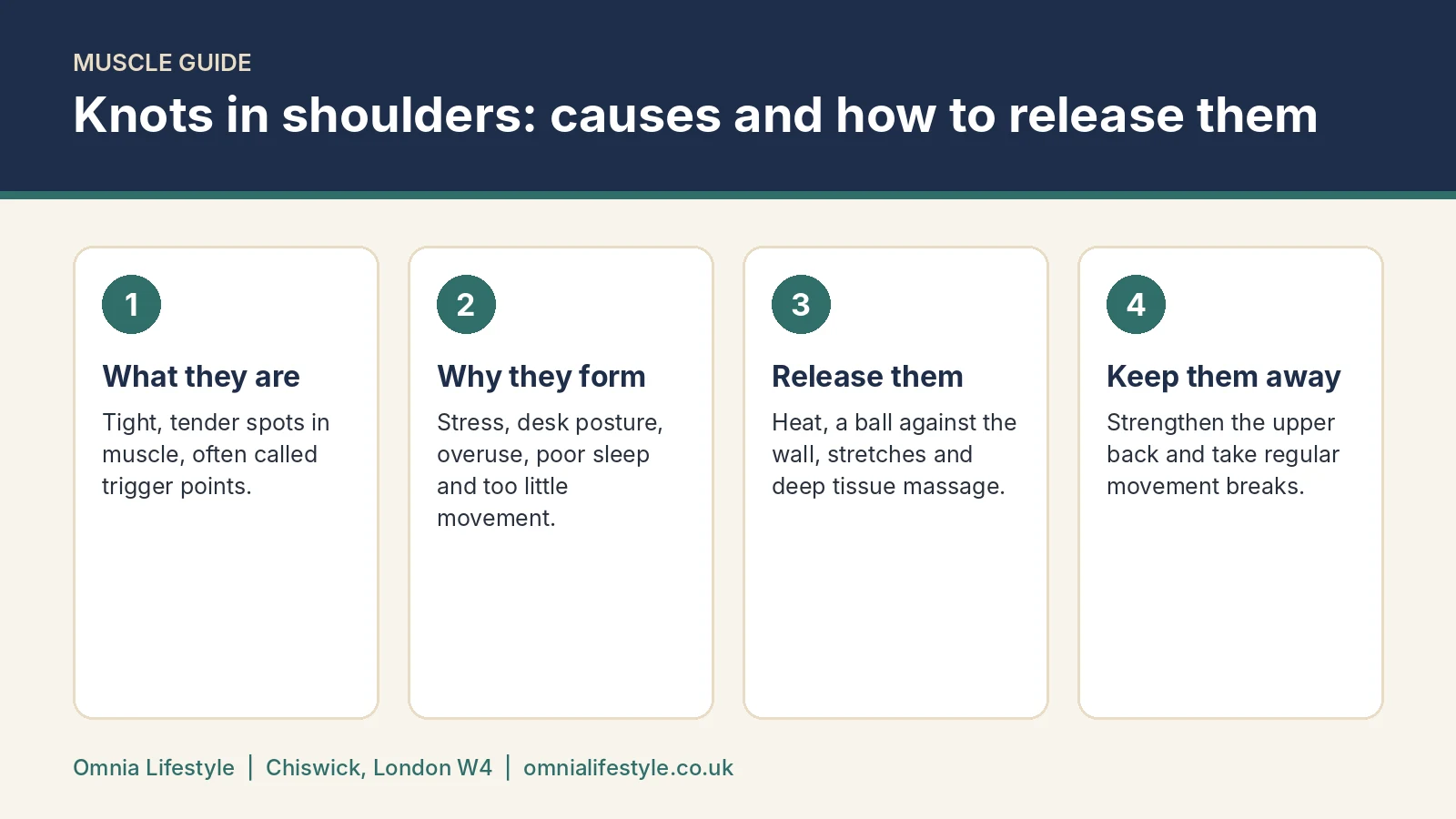
Knots in shoulders are tight, tender spots in muscle, often called myofascial trigger points. They usually form in the upper trapezius and the muscles between the shoulder blades, and are linked to stress, desk posture, overuse, poor sleep and too little movement. Heat, pressure with a massage ball, stretches, strengthening and deep tissue massage all help. Knots that keep coming back usually need a change in what is causing them, not just more massage.
What are knots in shoulders?
A muscle knot is an area of muscle that feels tight, ropey or lumpy and is tender to press. Pressing it may also send pain to another area, such as the head or arm. Therapists call these myofascial trigger points. Scientists still debate exactly what is happening in the tissue, but the experience is very real, and they respond well to the approaches below.
Why knots form: common causes
- Stress. Raised shoulders and clenched muscles are a natural stress response.
- Desk and phone posture. Hours with the head forward overload the upper back and neck muscles.
- Overuse. Carrying heavy bags on one shoulder, repetitive work or a new training load.
- Poor sleep and an unsupportive pillow.
- Too little movement. Muscles that stay in one position for hours become stiff and sore.
- Weak upper back muscles that tire quickly and stay tense.
Knots in shoulders and neck
Knots often run from the top of the shoulders up into the neck, along the upper trapezius and levator scapulae muscles. They can make it uncomfortable to turn your head and may cause a stiff neck in the morning. See how to relieve neck pain.
Knots in shoulders causing headaches
Trigger points in the upper trapezius and the small muscles at the base of the skull commonly refer pain into the head, causing tension-type headaches that wrap around the back of the head, the temples or behind the eyes. Releasing these muscles and reducing tension often eases these headaches. See how to relieve a tension headache. A sudden, severe or unusual headache needs medical attention.
Knots in shoulders and upper back
Knots between the shoulder blades are common in people who sit for long periods. They often go hand in hand with stiffness in the upper back. See upper back pain between the shoulder blades.
How to get rid of knots in shoulders at home
- Heat. A warm shower, bath or heat pack for 15 to 20 minutes relaxes tight muscle.
- Ball release. Place a tennis or massage ball between your upper back and a wall. Lean into it and hold on a tender spot for 30 to 60 seconds, breathing slowly, until it eases. Avoid the spine and do not press on anything that causes sharp or tingling pain.
- Upper trapezius stretch. Sit tall, hold the edge of the chair with your right hand and gently tilt your left ear towards your left shoulder. Hold for 30 seconds, then swap sides.
- Levator scapulae stretch. Turn your head 45 degrees to one side, look down towards your armpit and gently assist with your hand. Hold for 30 seconds each side.
- Shoulder rolls and shrugs. Roll your shoulders up, back and down 10 times to get blood flowing.
- Strengthen. Band rows and pull-aparts build endurance so the muscles tire less. See posture exercises.
Knots in shoulders during massage
During a deep tissue massage, your therapist uses slow, sustained pressure on the knot. It often feels tender at first, sometimes with a referred ache elsewhere, and then softens. Pressure should feel like a satisfying discomfort, not sharp pain, so tell your therapist if it is too much. Some soreness for a day or two after massage is normal. See deep tissue massage for desk neck and shoulder pain.
Knots in shoulders that won't go away
Constant knots in the shoulders usually mean the cause is still there: ongoing stress, long hours at a desk, poor sleep or weakness in the upper back. Massage gives relief, but lasting change comes from regular movement breaks, strengthening, a better workstation and managing stress. If knots persist despite this, or come with pain, numbness or weakness down the arm, a physiotherapist can check whether a neck problem is involved.
When to see a doctor
- Pain, numbness, tingling or weakness spreading down the arm
- A lump that is hard, growing or not tender
- Neck or shoulder pain with fever or feeling unwell
- Shoulder or arm pain with chest pain or breathlessness, which needs a 999 call
Frequently asked questions
Can you massage out a knot?
Massage can ease a knot quickly, but it often returns unless the cause is addressed. Combining massage with stretches and strengthening works best.
How long do shoulder knots last?
A knot from a one-off strain can settle in days. Knots caused by ongoing stress or posture can keep returning until the cause changes.
Should I use heat or ice on a knot?
Heat is usually better for muscle knots, as it helps the muscle relax.
Can dehydration cause muscle knots?
There is little evidence for this. Stress, posture and lack of movement are much more common causes.
Deep tissue massage for shoulder knots in Chiswick
Deep tissue massage and physiotherapist-led MSK therapy are available at Omnia Lifestyle, 8 to 9 Bedford Corner, The Avenue, Chiswick W4 1LZ, close to Turnham Green station, on bus routes 94, E3 and 272. Limited parking is available on request when booking. Deep tissue massage is £65 for 30 minutes or £90 for 60 minutes.
Explore deep tissue massage, manual therapy in London and MSK therapy, or book an appointment.
This article is general information, not medical advice. If you have any of the warning signs listed above, seek medical attention.
Ready to book?
Deep Tissue Massage


.jpg)
.jpg)