



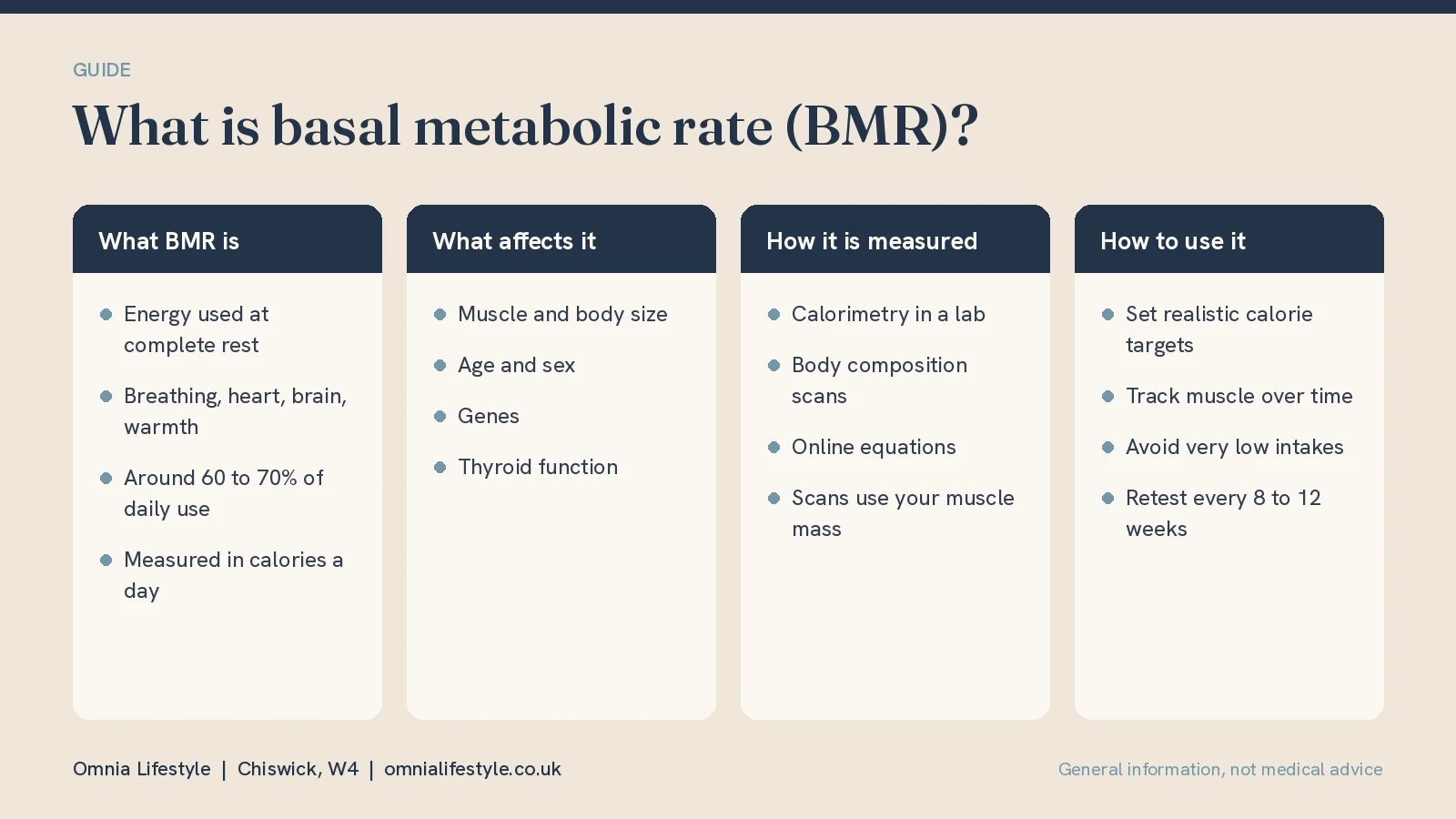


Your basal metabolic rate, or BMR, is the number of calories your body uses at complete rest to keep you alive. Knowing it gives you a realistic starting point for weight management, nutrition and training, rather than relying on guesswork or generic calorie targets.
This guide explains what BMR is, what affects it, how it is measured, and how to use the number sensibly.
What BMR is
Even when you are lying still, your body uses energy to breathe, pump blood, keep your brain working, repair tissues and stay warm. That energy is your basal metabolic rate. For most people it accounts for around 60 to 70 percent of all the calories they use in a day.
BMR, RMR and daily energy use
- BMR (basal metabolic rate): energy used at complete rest, measured under strict conditions.
- RMR (resting metabolic rate): a slightly less strict measure of energy used at rest. In practice the two are very similar and often used interchangeably.
- Total daily energy expenditure: your BMR plus the energy used digesting food and moving, including exercise and everyday activity.
What affects your BMR
- Muscle mass: muscle uses more energy than fat, even at rest.
- Body size: larger bodies use more energy.
- Age: BMR stays fairly stable through most of adulthood and declines more noticeably later in life, partly because of muscle loss.
- Sex: men usually have a higher BMR because they tend to carry more muscle.
- Genes: some variation between people is inherited.
- Thyroid function: an underactive thyroid lowers BMR and an overactive thyroid raises it.
- Dieting: prolonged very low calorie diets can reduce energy use.
What is a normal BMR?
There is no single normal figure, because BMR depends on size, muscle, age and sex. As a rough guide, many women fall somewhere between about 1,200 and 1,600 calories a day and many men between about 1,500 and 1,900, but individual results vary widely.
How BMR is measured
- Indirect calorimetry: measures oxygen use and carbon dioxide output. It is the most accurate method but is mainly used in research and specialist settings.
- Body composition scans: devices such as InBody measure your muscle and fat mass and estimate BMR from them. Because they account for muscle, they are usually more personalised than online calculators.
- Online equations: formulas based on height, weight, age and sex give a reasonable estimate but cannot tell muscle from fat.
How to use your BMR
- Set realistic targets: your daily calorie needs are higher than your BMR, because you also move and digest food.
- Avoid very low intakes: eating far below your needs for long periods tends to cost muscle and makes weight regain more likely.
- Track muscle, not just weight: if BMR stays stable or rises while you lose weight, you are protecting muscle.
- Retest every 8 to 12 weeks to see how training and nutrition are changing your body.
How to raise your BMR
The most reliable way is to build muscle through strength training two or three times a week, with enough protein at each meal. Good sleep and avoiding crash diets also help protect it.
When to see a GP
See your GP if you have unexplained weight changes, feel cold and tired all the time, or notice dry skin, thinning hair or a racing heart. These can point to a thyroid problem.
Frequently asked questions
Is a low BMR bad?
Not necessarily. A lower BMR is normal for smaller people and those with less muscle. It simply means your daily energy needs are lower.
Should I eat my BMR in calories?
Your BMR is not a target to eat to. Most people need more than their BMR each day because of activity and digestion.
How accurate are BMR calculators?
They give a reasonable estimate for many people but can be off for those with more or less muscle than average. A body composition scan is usually more personalised.
Does BMR change as you lose weight?
Yes. As body size falls, BMR usually falls a little. Strength training helps limit the drop by protecting muscle.
BMR testing in Chiswick
Omnia Lifestyle offers InBody body composition scans, which measure muscle and fat and estimate your BMR, at our clinic in Chiswick, W4, close to Turnham Green station, on bus routes 94, E3 and 272. Limited parking is available on request when booking.
Read more about slow metabolism and weight management, see how to speed up your metabolism, explore InBody scans and fitness and nutrition, or book an appointment.
This article is general information, not medical advice. If you have any of the warning signs listed above, see your GP.



.jpg)
.jpg)