






Book at our Chiswick clinic
Blood Test
TSH, or thyroid stimulating hormone, is made by the pituitary gland at the base of the brain. It tells your thyroid how hard to work. Because TSH reacts to even small changes in thyroid hormone, it is the first blood test most UK doctors use to check how the thyroid is working.
This guide focuses on the TSH number itself: the typical adult range, what a high or low result can mean, the thresholds NICE uses before suggesting treatment, and how TSH behaves in pregnancy, in later life and when you take levothyroxine. For free T4, free T3 and thyroid antibodies, see our full guide to thyroid function test results.
Test it in Chiswick: our TSH blood test costs £39, with your result explained in person by a practitioner. No GP referral needed. Book this test or call 020 4515 0000. Prefer to test at home? A home finger-prick kit is also available, ask us when you enquire, or see our home kit options.
Quick answer
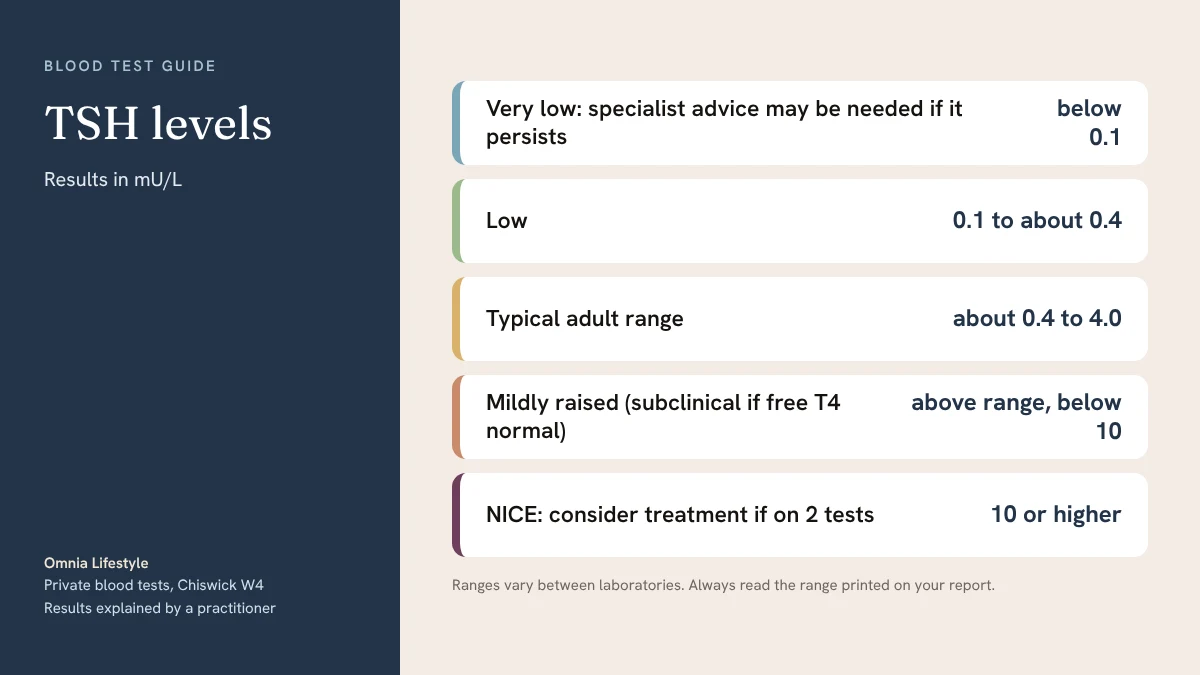
A typical adult TSH range is about 0.4 to 4.0 mU/L, although each laboratory sets its own range (one NHS laboratory uses 0.27 to 4.2 mU/L). A high TSH usually means the thyroid is underactive. A low TSH usually means it is overactive, or that a levothyroxine dose is a little too high. NICE suggests considering treatment when TSH is 10 mU/L or higher on 2 tests 3 months apart, even if free T4 is normal. Mildly raised results are usually repeated before any decision is made.
What is TSH?
TSH works like a thermostat signal. When thyroid hormone levels fall, the pituitary releases more TSH to push the thyroid harder, so TSH goes up. When thyroid hormone levels are too high, the pituitary turns TSH down. So a high TSH points to an underactive thyroid and a low TSH to an overactive one.
TSH is reported in mU/L, sometimes written mIU/L. When it is outside the range, free T4 (and sometimes free T3) is checked to show how much thyroid hormone is in your blood.
What your TSH result means
Always read the range printed on your own report, as each laboratory sets its own. As a guide:
- Low (below about 0.3 to 0.4 mU/L): may suggest an overactive thyroid or too high a dose of levothyroxine. Less often it reflects a pituitary problem or a recent serious illness. Free T4 and free T3 help tell these apart.
- Within range (about 0.4 to 4.0 mU/L): your thyroid is very likely to be working normally.
- Mildly raised (above the range but below 10 mU/L): with a normal free T4, this is called subclinical hypothyroidism. It is common and can settle, so it is usually repeated.
- 10 mU/L or higher: more likely to mean the thyroid is struggling. With a low free T4, this is an underactive thyroid (overt hypothyroidism).
High TSH
Subclinical hypothyroidism
Subclinical hypothyroidism means TSH is above the range while free T4 is still normal. NICE guideline NG145 suggests:
- considering levothyroxine for adults whose TSH is 10 mU/L or higher on 2 separate occasions 3 months apart
- considering a 6-month trial of levothyroxine for adults under 65 who have symptoms and a TSH above the range but below 10 mU/L on 2 occasions 3 months apart
- if treatment is not started, checking TSH and free T4 once a year when there are signs of underlying thyroid disease, such as raised thyroid antibodies or previous thyroid surgery, and every 2 to 3 years otherwise
Overt hypothyroidism
A raised TSH together with a low free T4 means the thyroid is underactive. This is often caused by the immune system attacking the thyroid, which is why thyroid antibodies are commonly checked. The NHS lists symptoms such as extreme tiredness, feeling cold, weight gain, constipation, low mood, dry skin or hair, a croaky voice and irregular or heavy periods. Treatment is usually a daily levothyroxine tablet. Read more about underactive thyroid symptoms.
Low TSH
The British Thyroid Foundation (BTF) explains that a low TSH with a high free T4 suggests an overactive thyroid (hyperthyroidism) that needs treatment. A low TSH with normal free T4 and free T3 is called subclinical hyperthyroidism. For adults with untreated subclinical hyperthyroidism, NICE suggests checking TSH every 6 months, and seeking specialist advice if TSH is below 0.1 mU/L on 2 occasions at least 3 months apart and there are signs of thyroid disease or symptoms of an overactive thyroid.
A low TSH with a low free T4 is a different pattern. The BTF notes it can come from the pituitary gland not working properly, or from a significant illness that does not involve the thyroid. If you take levothyroxine, a low TSH often means the dose needs a review, as the BTF advises keeping TSH within the range during treatment. See also overactive thyroid symptoms.
TSH on levothyroxine
- Timing after a dose change: TSH takes weeks to settle. NHS medicines monitoring guidance suggests checking TSH from 6 weeks after starting or changing the dose, and one NHS formulary advises waiting 8 weeks, so a test about 6 to 8 weeks after a change is typical.
- Until stable: NICE suggests checking TSH every 3 months until it has stabilised, then once a year. NICE also notes that TSH can take up to 6 months to return to the range.
- What counts as stable: NHS monitoring guidance describes 2 similar results within the range, 3 months apart.
- On the day: tell us what time you took your last dose so your result can be read in context.
TSH in pregnancy
TSH ranges are different in pregnancy. The BTF explains that pregnancy ranges should ideally come from healthy pregnant women in the same population, so trimester-specific ranges vary between laboratories and there is no single set of numbers. A pregnancy result should not be judged against the standard adult range alone.
If you already take levothyroxine, BTF guidance aims for a TSH below 2.5 mU/L before conception and during pregnancy. It advises a thyroid test as soon as pregnancy is confirmed, ideally by 7 to 9 weeks, then every 4 to 6 weeks until 20 weeks and again at 28 weeks. The dose usually needs to rise as soon as a pregnancy test is positive, so contact your GP or midwife straight away and follow their plan. Our guide to blood tests before pregnancy covers planning ahead.
TSH and age
The BTF notes that TSH levels increase in people aged 70 and over, and that this is not always linked to poorer health. Standard ranges were worked out mainly in younger people, so a slightly raised TSH in later life may not mean the same thing. Studies have found little clear benefit from treating a mildly raised TSH in older people. When treatment is needed, NICE suggests a lower starting dose of 25 to 50 micrograms a day for adults aged 65 and over. Babies and young children have their own reference ranges.
When to see your GP or get urgent help
- See your GP if you have symptoms of an underactive or overactive thyroid, a new lump or swelling in your neck, or a TSH outside the range.
- Ask for an urgent GP appointment or contact NHS 111 if you have had palpitations with chest pain, breathlessness or fainting that have now stopped.
- Call 999 or go to A&E if you have palpitations that do not go away, or palpitations with chest pain, breathlessness or fainting, if neck swelling makes it hard to breathe or swallow, or if someone with a thyroid condition becomes very drowsy, confused or suddenly much more unwell.
Who should consider a TSH test?
- People with ongoing tiredness, weight change, low mood or changes to periods
- People taking levothyroxine who want to check their dose between GP reviews
- Anyone with a family history of thyroid or autoimmune disease
Preparing for your test
You do not usually need to fast for a TSH test. Biotin, found in many hair, skin and nail supplements, can interfere with some laboratory tests, and the BTF lists it among the supplements that can affect thyroid results. One NHS laboratory advises waiting at least 8 hours after a biotin dose above 5 mg before a blood sample, so tell us if you take it. Let us know about levothyroxine or other thyroid medicines, and if you are pregnant.
How often to retest
A mildly raised TSH is usually repeated after about 3 months. The NICE schedules for levothyroxine and untreated subclinical results are set out above.
Frequently asked questions
Is a TSH of 5 high?
It is slightly above many laboratory ranges. If your free T4 is normal, this is subclinical hypothyroidism, and NICE guidance is to repeat the test after about 3 months before deciding on treatment.
Is a TSH of 0.1 too low?
Yes, it is below most ranges. It may mean an overactive thyroid or too high a levothyroxine dose. Free T4 and free T3 show which, and NICE suggests specialist advice if TSH stays below 0.1 mU/L on 2 tests at least 3 months apart with signs of thyroid disease or symptoms.
What is a normal TSH level for a woman?
Adult women and men share the same TSH range, usually about 0.4 to 4.0 mU/L. Pregnancy is the main exception, when ranges are different and set by each laboratory.
Can a high TSH go back to normal?
A mildly abnormal TSH can return to the range on a repeat test, which is why NICE asks for 2 results 3 months apart before treating subclinical hypothyroidism.
TSH testing in Chiswick
We take your blood sample at our clinic at 8 to 9 Bedford Corner, The Avenue, Chiswick, London W4 1LZ, a short walk from Turnham Green station on the District line (Piccadilly line trains stop there early morning and late evening only), and on the 94, E3 and 272 bus routes. Limited parking is available on request when you book. Your sample is analysed at the Randox accredited laboratory, most results are back within a few working days, and a practitioner talks you through what your result means. No GP referral is needed, and we can send a GP feedback report on request.
Book a single TSH blood test, or choose our £59 Thyroid panel, which adds free T4, free T3 and thyroid antibodies. You can also compare every blood test and price, read our thyroid function test results guide, or see whether you need to fast before a blood test. If you would like support alongside your GP care, see our thyroid care at Omnia.
This article is general information, not medical advice. Discuss your results with your GP or practitioner.
Ready to book?
Blood Test




.jpg)
.jpg)
