

Book at our Chiswick clinic
LPG Endermologie
You have lost weight or had a baby, and something soft is still there. Is it loose skin that needs firming, or fat that will shift with time? The two can look alike, but what helps is different, and spending money on the wrong approach is frustrating. This guide gives you simple ways to tell loose skin vs fat, and explains what to do next.
Want an honest answer in person? Your first LPG Endermologie visit is a 60-minute Discovery Session for £99, including a consultation and a full treatment. Book online or call 020 4515 0000.
Quick answer
Loose skin feels thin and soft, folds easily and stays after weight loss, while fat feels thicker and shrinks as body weight falls. Many areas have both. At Omnia Lifestyle in Chiswick W4, a consultation and optional Styku 3D scan can help, and LPG Endermologie can firm mild looseness, although it is not a fat reduction treatment.
Fat versus loose skin: what is the difference?
Skin is a thin layer held firm by collagen and elastin. Fat sits underneath it. Once skin has been stretched for a long time it may not fully recoil, which leaves spare skin over a smaller body. Our guide to tightening loose skin after weight loss explains why this happens.
| Check | Mostly loose skin | Mostly fat |
|---|---|---|
| Thickness of a pinch | Thin, close to two layers of skin | Thick and full between your fingers |
| Feel | Soft, sometimes crinkled or crepey | Soft to firm, with volume under the skin |
| Lean forward | Hangs or folds easily | Moves as one mass |
| Lie on your back | Spreads flat or falls to the side | Stays as volume |
| After months at a stable weight | Stays much the same | Depends on eating and activity |
| As you lose more weight | Can look looser | Reduces |
These are rough home checks, not a measurement. Many stomachs, arms and thighs have some of both.
How can you tell at home?
- Pinch gently. Take a fold between finger and thumb. A thin fold points to skin. A thick one points to fat.
- Tense the muscle. If tensing your stomach or arm makes the area firmer but thin skin still sits on top, the spare layer is probably skin.
- Change position. Lean forward, then lie down. Loose skin shifts easily with gravity.
- Look at the texture. Fine crinkles suggest crepey skin. Dimples suggest cellulite.
- Check your timeline. If your weight has been stable for some months and the area has stopped changing, skin is the more likely answer.
Loose skin vs fat on the stomach
The stomach is where people ask this question most. Three things can be going on at once: spare skin, fat under it, and tummy muscles that have stretched. If a bulge appears down the middle when you sit up, it may be separation of the tummy muscles. NHS Borders advises asking for help if the gap is wider than two fingerbreadths with visible doming. Physiotherapy is the first step, not a skin treatment.
A fold of skin that hangs over your waistband is a different matter. That usually needs a surgical opinion. Our guide to loose skin after weight loss explains how we assess this, and skin tightening in London covers the treatments we offer.
Could it be something else?
- Fluid. Swelling that changes through the day, or leaves a dent when pressed, is not fat or skin. See your GP.
- Lipoedema. Painful, heavy legs that bruise easily may be lipoedema. See lipoedema vs cellulite.
- A lump. Any new lump, or a swollen stomach that does not settle, needs checking by a GP.
What helps loose skin?
Mild looseness can improve with time once your weight is stable, especially alongside strength work that fills out the area. For more, treatments that work on the skin itself, such as LPG Endermologie, radiofrequency or focused ultrasound, can firm mild to moderate looseness. They firm and smooth skin but they do not remove it. Our guide to how to tighten loose skin covers each option in detail.
What helps fat?
Eating and activity remain the main tools, including strength work on at least two days a week and regular aerobic exercise, as the NHS recommends. You cannot choose where your body reduces fat first: in a study of upper-body resistance training, MRI scans showed fat under the skin changing generally, not only where the muscles were worked. If you have concerns about weight, your GP is a good place to start. LPG Endermologie is not a fat reduction treatment, and we do not promise fat reduction. For shape-focused goals, see body contouring in London.
How can a Discovery Session help?
The £99 Discovery Session lasts 60 minutes and includes a consultation and a full treatment. Your therapist looks at the area with you and will tell you honestly whether it is likely to respond. A Styku 3D scan is available if you want a baseline of shape and circumference, and you can see how an InBody scan measures muscle, fat and water.
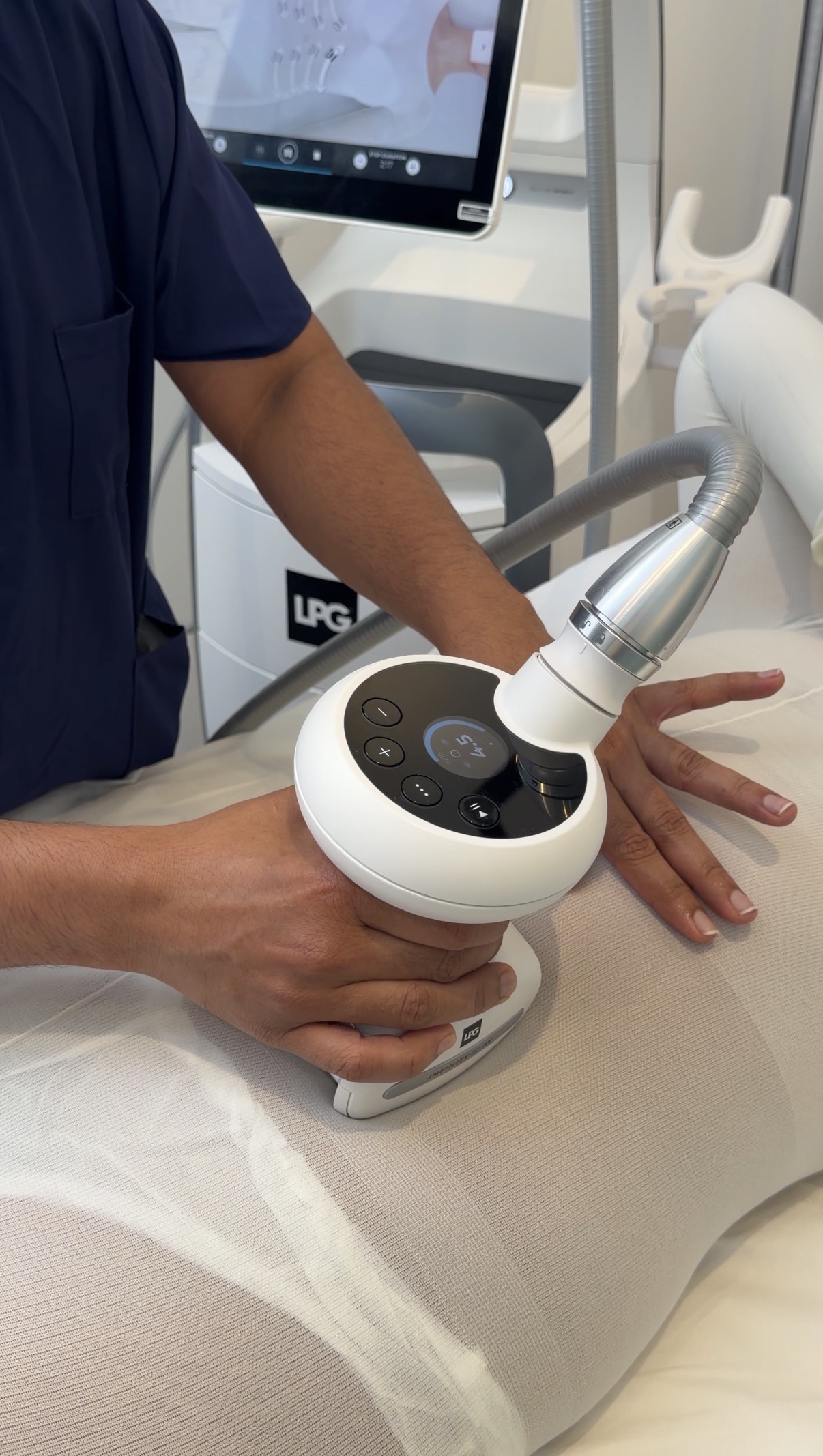
We use the Cellu M6 Infinity, with motorised rollers and controlled suction, and no needles, heat or downtime. Most people notice change after 6 to 8 sessions, followed by a weekly course then monthly maintenance. Results vary, and no treatment is permanent. LPG Systems' BeScored study from 2024 reported that 92% of participants noticed firmer skin. That is manufacturer data, and evidence for LPG overall is mixed.
When is surgery the better option?
If skin hangs in folds, causes rashes or soreness, or gets in the way of exercise or clothing, non-surgical treatment will not be enough. Surgery is the only way to remove skin. The Royal College of Surgeons and BAPRAS patient guide says weight should be stable for 12 months before body contouring is considered on the NHS, which is sensible timing whichever route you take. See loose skin removal surgery cost in the UK for prices and NHS funding.
Who is LPG Endermologie not for?
- LPG Endermologie is not used on the abdomen in pregnancy.
- It is not suitable with active cancer, an infection, phlebitis or a blood clot, open wounds or inflamed skin.
- If you have a circulatory or blood disorder, recent surgery, a pacemaker or an implanted device, get advice from your doctor or surgeon first.
- It is not a way to reduce body fat, and it will not remove hanging skin.
Frequently asked questions
Does loose skin look like fat?
It can, especially on the stomach, where a soft fold may look like fat under clothing. Pinching is the simplest first check: loose skin is thin, while fat is thicker.
Can you have loose skin and fat in the same place?
Yes, and it is common. As you reduce fat, spare skin may become more obvious, so it often helps to reach a stable weight first.
How long should I wait after losing weight?
Skin can keep changing for months. Wait until your weight has been stable before judging how much looseness remains.
Does exercise get rid of loose skin?
It does not shrink skin, but building muscle fills out the area and improves shape.
Can a scan tell loose skin from fat?
A scan measures shape or body composition. It does not grade loose skin, but a repeat scan can show whether the area is changing.
Loose skin and body shape advice in Chiswick
Omnia Lifestyle is at 8 to 9 Bedford Corner, The Avenue, Chiswick W4 1LZ, close to Turnham Green station, on bus routes 94, E3 and 272. Limited parking is available on request when booking. LPG sessions run Monday to Saturday.
Book LPG Endermologie in Chiswick: Discovery Session £99 for 60 minutes, including consultation and treatment, then follow-up sessions from £70. You pay after your treatment. Book online or call 020 4515 0000.
Sources
- Royal College of Surgeons and BAPRAS: Body contouring surgery patient guide
- NHS: Physical activity guidelines for adults aged 19 to 64
- Kostek MA et al. Study of subcutaneous fat after upper-body resistance training. Medicine and Science in Sports and Exercise, 2007
- NHS Borders: Separation of the abdominal muscles in pregnancy and beyond
- LPG Systems: BeScored study, 2024 (manufacturer data)
- Kołodziejczak A, Adamiak J, Rotsztejn H. Narrative review of endermologie. Applied Sciences, 2025
Last updated 4 November 2026. This article is general information, not medical advice.
Ready to book?
LPG Endermologie