





Frozen shoulder, known medically as adhesive capsulitis, is a condition in which the capsule surrounding the shoulder joint becomes inflamed, thickened and tight. The result is a shoulder that is first very painful and then very stiff, often for many months. It almost always gets better, but it is slow, and the right exercises at the right stage make a real difference to how much movement you keep and how quickly you recover it.
This guide sets out the exercises commonly used for frozen shoulder, how to match them to the stage you are in, how hard to push, and the signs that mean your shoulder should be assessed rather than exercised.
The three stages of frozen shoulder
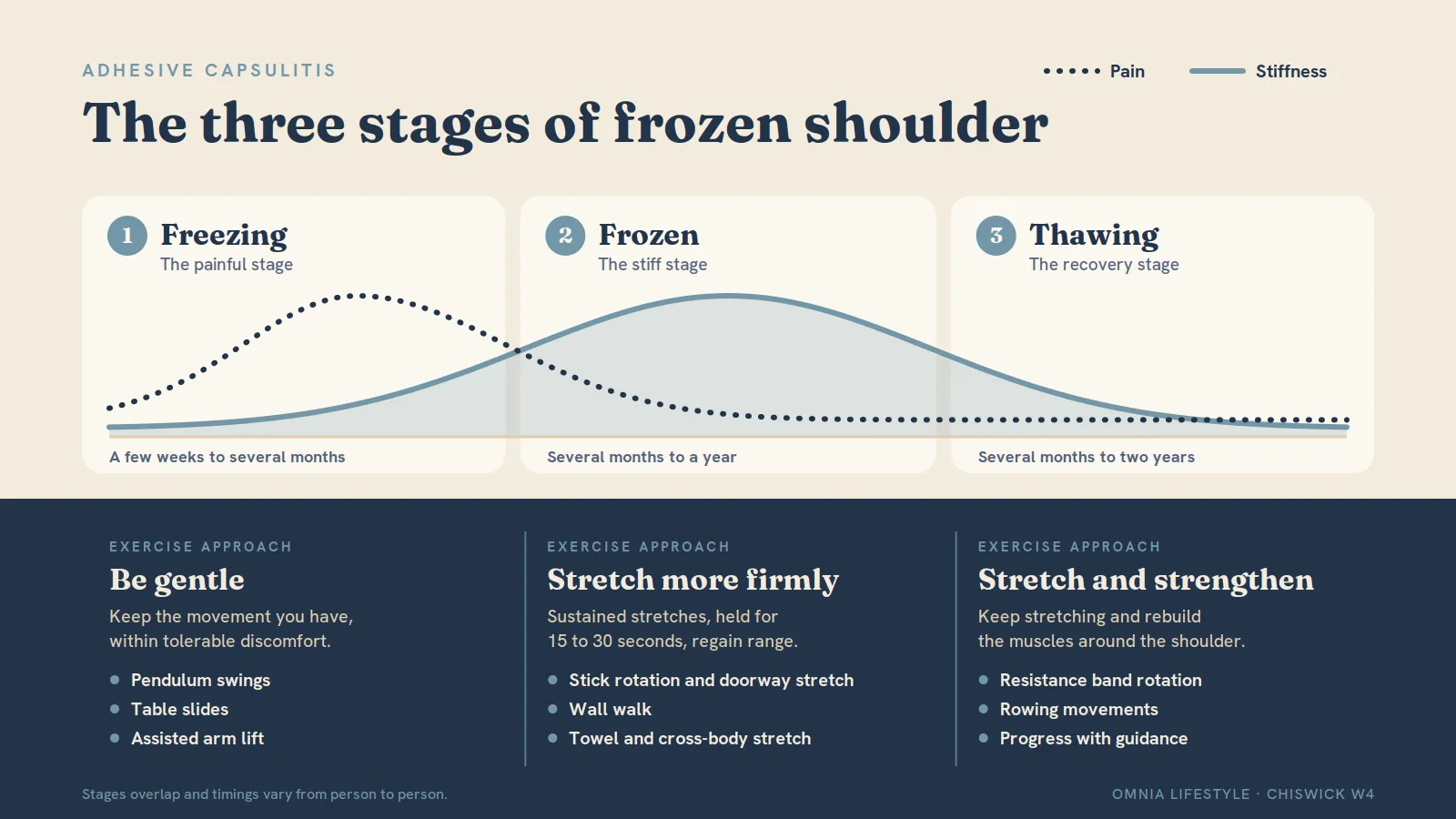
Frozen shoulder typically moves through three overlapping stages. Knowing which one you are in matters, because exercise that suits one stage can aggravate another.
- Freezing (painful) stage. Pain builds gradually, is often worse at night, and movement starts to reduce. This stage commonly lasts from a few weeks to several months.
- Frozen (stiff) stage. Pain eases, but stiffness is at its worst. Reaching overhead, behind your back or out to the side is markedly limited. This can last several months to a year.
- Thawing (recovery) stage. Movement gradually returns. This can take a further several months to two years.
Frozen shoulder is most common between the ages of 40 and 60, affects women slightly more often than men, and is considerably more common in people with diabetes or thyroid conditions. It can also follow a period of keeping the arm still after an injury or surgery.
How hard to push: the rule that matters most
In the painful stage, be gentle. The capsule is inflamed, and forceful stretching tends to increase pain and can prolong this stage. The aim is to keep the movement you have, within tolerable discomfort, not to win movement back.
In the stiff and thawing stages, stretch more firmly. Once the constant pain and night pain have settled, the capsule responds to sustained stretching, and this is when range of movement is regained.
A practical guide: a stretching sensation or mild ache during an exercise that settles within about half an hour is acceptable. Sharp pain, or pain that lingers for hours or disturbs your sleep that night, means you pushed too far and should ease back.
Little and often works best. Two or three short sessions a day are more effective than one long one. Warming the shoulder first, with a warm shower or a heat pack for 10 minutes, makes stretching more comfortable.
Exercises for the painful stage
Pendulum swings
Lean forward with your good arm supported on a table and let the affected arm hang down, relaxed. Use a gentle sway of your body to let the arm swing in small circles, about the size of a dinner plate, then forwards and backwards, then side to side. Continue for one to two minutes. The arm should stay passive; the movement comes from your body.
Table slides
Sit at a table with your hand resting on a cloth or towel. Slide your hand forwards along the table by leaning your body forward, letting the shoulder flex gently, then return. Repeat 10 times. This gives assisted movement without the shoulder having to lift the weight of the arm.
Assisted arm lift lying down
Lie on your back. Hold the wrist of the affected arm with your good hand, or hold a stick in both hands, and use the good arm to lift the affected arm up and back over your head as far as is comfortable. Hold for a few seconds and lower. Repeat 10 times.
Exercises for the stiff and thawing stages
Continue the exercises above, then add the following. Hold each stretch for 15 to 30 seconds and repeat three to five times.
Outward rotation with a stick
Lie on your back with your elbows bent to 90 degrees and tucked into your sides, holding a stick or umbrella in both hands. Use the good arm to push the stick so that the hand of the affected arm moves outwards, away from your body, keeping the elbow against your side. Outward rotation is usually the most restricted movement in frozen shoulder, so this is one of the most valuable stretches.
Doorway rotation stretch
Stand in a doorway with the elbow of the affected arm bent to 90 degrees and the hand resting on the door frame. Keeping the elbow at your side, gently turn your body away from the arm until you feel a stretch at the front of the shoulder.
Wall walk
Stand facing a wall at about three-quarters of an arm's length. Walk your fingers up the wall as high as you comfortably can, letting your fingers do the work rather than your shoulder muscles. Hold at the top, then walk back down. Repeat standing side-on to the wall to work on lifting the arm out to the side.
Towel stretch behind the back
Hold one end of a towel behind your back with the affected arm, and the other end over your opposite shoulder with your good hand. Use the good arm to gently pull the towel upwards, drawing the affected hand up your back. This works on the hand-behind-back movement that is needed for dressing.
Cross-body stretch
Use your good hand to lift the affected arm at the elbow and bring it across your chest, applying gentle pressure until you feel a stretch at the back of the shoulder.
Strengthening in the thawing stage
As movement returns, the muscles around the shoulder need rebuilding after months of reduced use. Resistance band exercises for outward and inward rotation with the elbow at your side, and rowing movements to work the muscles around the shoulder blade, are the usual starting point. These are best progressed with guidance, since the right load depends on how much movement and control you have regained.
What to avoid
- Forcing through sharp pain in the painful stage. It does not speed recovery and often sets it back.
- Keeping the arm completely still or in a sling. Immobility makes stiffness worse. Use the arm for normal daily activities within comfort.
- Sudden, jerky movements and heavy overhead lifting while the shoulder is painful.
- Giving up on the exercises because progress is slow. Improvement in frozen shoulder is measured over weeks and months, not days.
Other treatments that may be offered
Exercise is one part of managing frozen shoulder. Depending on the stage and severity, other options include pain relief advised by your GP or pharmacist, a corticosteroid injection, which can be particularly helpful for pain in the early stage, and hydrodilatation, in which fluid is injected to stretch the capsule. Surgery, such as manipulation under anaesthetic or keyhole capsular release, is reserved for a small number of cases that do not improve.
Physiotherapy typically combines hands-on joint mobilisation with a home exercise programme matched to your stage, and adjusts both as the shoulder changes.
When to have your shoulder assessed
Call 999 if shoulder or arm pain comes with chest pain or tightness, breathlessness, sweating or nausea. This can be a sign of a heart attack.
Seek urgent medical advice if:
- The shoulder is hot, red and swollen, or you feel feverish and unwell
- The pain followed a fall or injury, or the shoulder looks misshapen
- You suddenly cannot lift the arm at all
See your GP or a physiotherapist if:
- Shoulder pain and stiffness have lasted more than a few weeks
- Night pain is regularly disturbing your sleep
- You are not sure whether the problem is frozen shoulder. Rotator cuff problems and arthritis can look similar but need a different approach
- You have diabetes, as frozen shoulder can be more persistent and benefits from early management
Frequently asked questions
How long does frozen shoulder last?
Commonly between one and three years from start to finish, although this varies widely. Most people regain good function, though some are left with a small loss of movement that rarely causes problems.
Should I exercise a frozen shoulder through pain?
Through mild stretching discomfort, yes. Through sharp or lasting pain, no. In the early painful stage, gentle movement within comfort is the aim.
Can frozen shoulder come back?
It rarely returns in the same shoulder. A proportion of people do go on to develop it in the other shoulder, sometimes years later.
Is heat or ice better for frozen shoulder?
Heat before stretching usually helps the shoulder move more comfortably. Some people find ice useful for pain relief after exercise. Neither changes the course of the condition.
What is the best sleeping position?
Most people are more comfortable lying on their back or on the unaffected side, with a pillow supporting the affected arm so that it does not drop across the body.
Does massage help frozen shoulder?
Massage can ease the muscle tension that builds up around a stiff, painful shoulder, which can make exercise more comfortable. It does not stretch the joint capsule itself, so it complements the exercises rather than replacing them.
Frozen shoulder assessment and treatment in Chiswick
Frozen shoulder and other shoulder problems are assessed and treated at Omnia Lifestyle in Chiswick, W4, close to Turnham Green station, on bus routes 94, E3 and 272. Limited parking is available on request when booking. Assessment confirms whether frozen shoulder is the cause, identifies which stage you are in, and sets an exercise programme at the right intensity for that stage.
Read more about frozen shoulder and neck and shoulder pain, explore physiotherapy, or book an assessment.
This article is general information, not medical advice. If you have any of the warning signs listed above, seek medical attention.



.jpg)
.jpg)