






Book at our Chiswick clinic
Blood Test
Cortisol is a steroid hormone made by the adrenal glands, which sit on top of the kidneys. It helps control blood sugar, blood pressure, salt and water balance and the immune response, and it rises when your body is under stress. That is why it is often called the stress hormone.
Because cortisol changes so much through the day, the time of your blood test matters as much as the number. This guide explains what a 9am cortisol result means, what low and high readings can point to, why a single blood test cannot diagnose Cushing's syndrome or Addison's disease, and which symptoms need urgent help.
Test it in Chiswick: our Stress Hormone Check blood test costs £79, with your result explained in person by a practitioner. No GP referral needed. Book this test or call 020 4515 0000. Prefer to test at home? A home finger-prick kit is also available, ask us when you enquire.
Quick answer
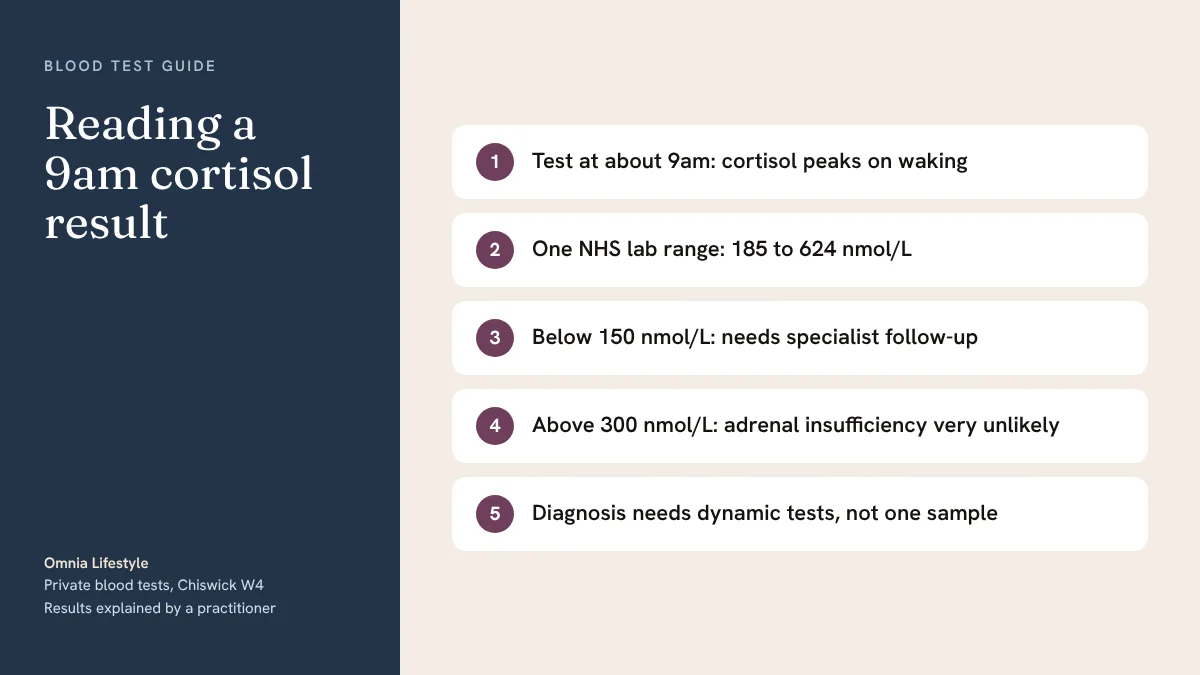
Cortisol is highest when you wake and falls through the day, so blood cortisol is usually checked at about 9am. Ranges vary between laboratories: one NHS laboratory quotes 185 to 624 nmol/L for a 9am sample. NICE guidance says a 9am cortisol below 150 nmol/L may mean adrenal insufficiency and needs specialist follow-up, 150 to 300 nmol/L is uncertain, and above 300 nmol/L makes it very unlikely. A single result cannot diagnose Cushing's syndrome or Addison's disease. Always read the range printed on your own report.
What is cortisol?
Cortisol belongs to a group of hormones called glucocorticoids. Almost every cell in the body has receptors for it, so it has many jobs: it helps release energy, keeps blood sugar steady, damps down inflammation, supports blood pressure and helps the body respond to illness, injury and stress.
Your brain controls cortisol through a feedback loop. The hypothalamus and pituitary gland release signals (including a hormone called ACTH) that tell the adrenal glands to make cortisol. When cortisol rises, those signals switch off. Problems anywhere in this loop, in the brain, the pituitary or the adrenal glands, can make cortisol too high or too low.
The daily cortisol rhythm and why 9am matters
Cortisol follows a daily (diurnal) rhythm. It is generally highest in the morning around the time you wake up and falls through the afternoon and evening. In people who work nights the pattern can be reversed. On top of this rhythm, extra cortisol is released whenever the body is under physical or emotional stress.
This is why NHS laboratories base their cortisol ranges on a morning sample, usually taken between 8am and 10am. One NHS laboratory describes a random cortisol taken at another time of day as uninterpretable, because a normal afternoon level can look low against a morning range.
What your 9am cortisol result means
Laboratories use different methods and cut-offs, so treat the figures below as a guide and always check the range on your report.
- Low (below 150 nmol/L): NICE guidance (NG243) says a 9am level below 150 nmol/L may indicate adrenal insufficiency, meaning the adrenal glands may not be making enough cortisol. It does not confirm a diagnosis, but it should be discussed promptly with a GP, who may arrange specialist tests.
- Uncertain (150 to 300 nmol/L): NICE describes the chance of adrenal insufficiency in this middle zone as uncertain, and the result may be normal. It is interpreted alongside your symptoms and may be repeated or followed by a synacthen test.
- Within range: one NHS laboratory quotes 185 to 624 nmol/L for a 9am sample. NICE guidance treats a 9am cortisol above 300 nmol/L as making adrenal insufficiency very unlikely, although oral oestrogen and acute illness can affect the result.
- High (above the laboratory upper limit): often reflects stress, illness, pregnancy or oestrogen-containing medicines such as the combined pill, which raise measured cortisol. A persistently high level with symptoms needs further testing, not a diagnosis from one sample.
Why one blood test cannot diagnose Cushing's or Addison's
A single cortisol reading is a snapshot. Specialists confirm adrenal conditions with dynamic tests, which check how cortisol responds when the system is stimulated or suppressed.
Suspected low cortisol (Addison's disease and adrenal insufficiency)
If a GP suspects Addison's disease, they refer you to an endocrinologist (a hormone specialist). The key test is the synacthen test, where blood is taken before and after an injection of Synacthen to see how well the adrenal glands respond.
Suspected high cortisol (Cushing's syndrome)
NHS laboratory guidance states that a random cortisol is not an effective screening tool for Cushing's syndrome. First-line tests include an overnight dexamethasone suppression test, 24-hour urine cortisol collections, or late-night saliva cortisol. The most common cause of Cushing's syndrome is long-term use of high-dose steroid medicines such as prednisolone.
Symptoms linked with low or high cortisol
Possible signs of low cortisol
- Extreme tiredness, muscle weakness and cramps
- Feeling dizzy or light-headed when standing up
- Loss of appetite, weight loss, tummy pain or feeling sick
- Cravings for salty food
- Patches of skin that are darker than the skin around them
Possible signs of high cortisol
- Weight gain around the face, neck, upper back and tummy, with thinner arms and legs
- A red, rounded face, easy bruising and purple stretch marks
- Muscle weakness in the upper arms and thighs
- High blood pressure, low sex drive, mood changes, and irregular or stopped periods
Many of these symptoms are common and have other causes, which is why a result is the start of a conversation, not an answer on its own.
Get urgent help: signs of an adrenal crisis
An adrenal crisis is a medical emergency in which cortisol is dangerously low. It can be triggered by infection, injury or surgery, especially in people with Addison's disease or who take steroid medicines. Call 999 if someone with known or suspected adrenal problems suddenly gets worse, or has:
- a fast heart rate, or feels very dizzy or light-headed, especially on standing
- severe tummy pain or pain in the side, or is being sick
- muscle weakness, pain or spasms, or a headache that does not go away
- drowsiness, irritability or confusion
- a seizure (fit) or loss of consciousness
The NHS advises calling 999 even if an emergency steroid injection has already been given. For symptoms that are worrying but not an emergency, see your GP or call NHS 111. If you take steroid tablets, do not stop them suddenly without medical advice.
Who might consider a cortisol test?
- People with ongoing tiredness, dizziness on standing or unexplained weight loss who want a starting point for a GP conversation
- People with features that could suggest high cortisol, such as new stretch marks, easy bruising and central weight gain
- Anyone curious about stress hormones who understands that one result is a snapshot, not a stress score
Our Stress Hormone Check measures cortisol together with DHEA-S, another adrenal hormone, which gives a little more context.
Preparing for your cortisol test
- Timing: book an early appointment, as close to 9am as possible. A sample taken later in the day is hard to interpret.
- Steroid medicines: tell us if you use prednisolone, hydrocortisone or steroid inhalers. NHS laboratories note that cortisol results taken during steroid treatment may be uninterpretable.
- Oestrogen: the combined pill, some HRT and pregnancy raise measured cortisol, so mention them.
- Night shifts: tell us if you work nights, as your rhythm may be reversed.
- Supplements: mention high-dose biotin, which can interfere with some hormone tests.
- Fasting: NHS laboratories list no special requirements for cortisol on its own.
How often to retest
There is no routine schedule for cortisol. If a result is borderline, a repeat 9am sample or a referral for dynamic testing is usually the next step, guided by your GP or practitioner. If you retest privately, keep the timing the same so results can be compared fairly.
Frequently asked questions
Is a cortisol of 100 nmol/L low?
At 9am, yes, a level around 100 nmol/L is low. NICE guidance says a 9am result below 150 nmol/L may indicate adrenal insufficiency and should lead to referral to an endocrinologist. Later in the day the same number can be normal, which is why timing matters.
What is a normal 9am cortisol level?
It depends on the laboratory method. One NHS laboratory quotes 185 to 624 nmol/L for a 9am sample. Your report will show the range used for your test.
Can stress cause a high cortisol result?
Yes. The body releases extra cortisol under physical or emotional stress, including illness. A single high reading does not mean you have Cushing's syndrome, which needs specialist dynamic tests.
Does the contraceptive pill affect cortisol?
Yes. Oestrogen-containing medicines raise the amount of cortisol measured in blood, so laboratories interpret results differently for people taking them. Tell your practitioner before your test.
Why does my cortisol test need to be in the morning?
Cortisol peaks around waking and falls through the day. Reference ranges are based on morning samples, so an afternoon result cannot be compared against them reliably.
Cortisol testing in Chiswick
Omnia Lifestyle is at 8 to 9 Bedford Corner, The Avenue, Chiswick, London W4 1LZ, a short walk from Turnham Green station on the District line (Piccadilly line trains stop there early morning and late evening only). Buses 94, E3 and 272 stop nearby, and limited parking is available on request when you book. Your sample is taken at the clinic and analysed at the Randox accredited laboratory. Every test price includes a practitioner review of your result with you and a GP feedback report on request. You do not need a GP referral, and most results are ready within a few working days.
Book the Stress Hormone Check for cortisol and DHEA-S together, or add the separate DHEA-S test. For a wider hormone picture, the Hormone and Thyroid Panel Plus includes cortisol, DHEA-S and thyroid markers. You can also compare every blood test and price, or read our guides to DHEA-S levels and thyroid function test results.
This article is general information, not medical advice. Discuss your results with your GP or practitioner.
Ready to book?
Blood Test




.jpg)
.jpg)
