






Book at our Chiswick clinic
Blood Test
DHEA (dehydroepiandrosterone) is one of the most common steroid hormones in the body. It is made mainly by the outer layer of the adrenal glands, with small amounts from the ovaries, testes and brain. Most of it circulates as DHEA sulphate, or DHEA-S, which is more stable and is the form usually measured in a blood test.
DHEA-S acts mainly as a building block for other hormones, including testosterone and oestrogen. This guide explains how DHEA-S changes with age, what high and low results can mean, how it relates to PCOS and the adrenal glands, and why DHEA supplements need caution.
Test it in Chiswick: our DHEA-S blood test costs £49, with your result explained in person by a practitioner. No GP referral needed. Book this test or call 020 4515 0000. Prefer to test at home? A home finger-prick kit is also available, ask us when you enquire.
Quick answer
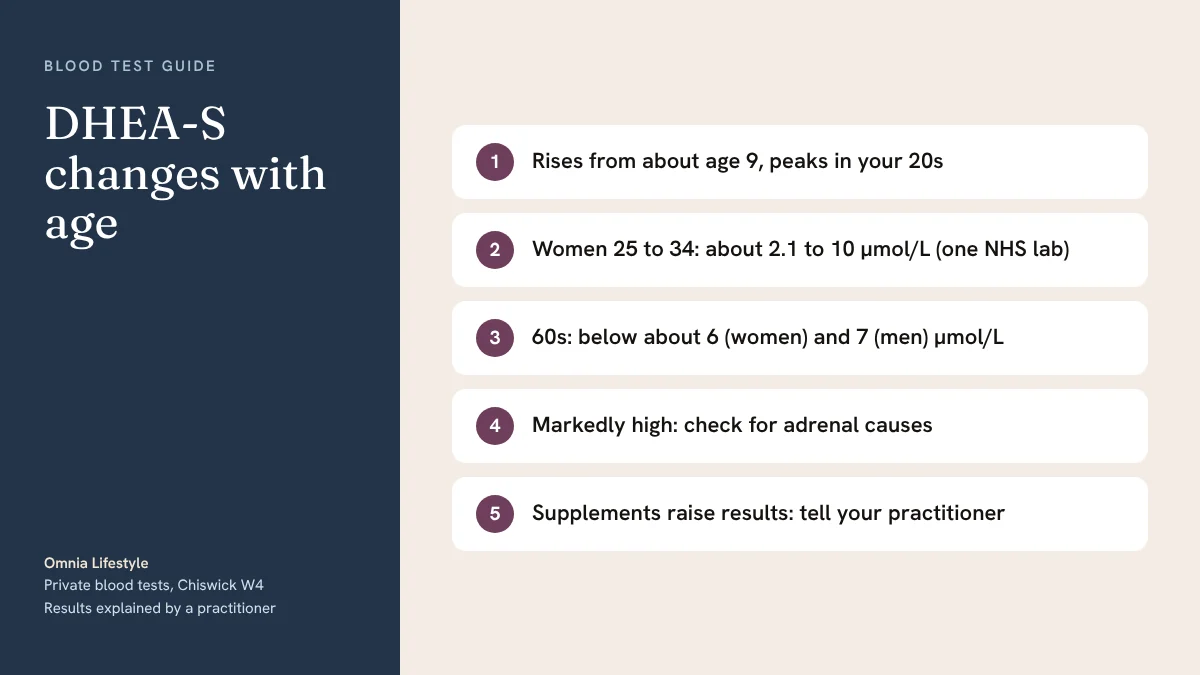
There is no single normal DHEA-S level: ranges depend on age and sex, and they vary between laboratories. Levels rise from about age 9 or 10, peak in your 20s and fall gradually after that. As one NHS example, a laboratory quotes 2.1 to 10 µmol/L for women aged 25 to 34 and 2.9 to 12 µmol/L for men, falling to below 6 and 7 µmol/L in the 60s. High DHEA-S can be linked with PCOS, congenital adrenal hyperplasia or, rarely, an adrenal tumour. Low levels are most often part of normal ageing.
What is DHEA-S?
DHEA is a precursor hormone. On its own it has fairly weak effects, but tissues convert it into androgens (such as testosterone) and oestrogens. In women it is an important source of oestrogen after the menopause, when the ovaries stop producing it.
Like cortisol, DHEA production is controlled by the brain. The hypothalamus and pituitary gland release a hormone called ACTH, which tells the adrenal glands to make DHEA. Because nearly all DHEA-S comes from the adrenal glands, it is a useful marker of adrenal androgen production, which is why it is often measured with testosterone when someone has signs of excess androgens.
How DHEA-S changes with age
DHEA production increases from around nine or ten years of age, peaks during the 20s and then gradually decreases into old age. NHS laboratories therefore publish ranges in age bands. One NHS laboratory, for example, quotes:
- Up to 24 years: women 2.7 to 11 µmol/L, men 3.6 to 13 µmol/L
- 35 to 49 years: women 1.3 to 8.5 µmol/L, men 1.7 to 10 µmol/L
- 50 to 59 years: women 1.0 to 7.0 µmol/L, men 1.0 to 8.0 µmol/L
- 60 to 69 years: women below 6.0 µmol/L, men below 7.0 µmol/L
Other laboratories use different methods and age bands, so compare your result with the range on your own report.
What your DHEA-S result means
- Below the range for your age: often reflects normal age-related decline. Less commonly it can reflect reduced adrenal or pituitary activity, so your practitioner may look at it alongside cortisol and your symptoms. In women, low DHEA has been associated with low libido and reduced bone strength.
- Within the range for your age: adrenal androgen production looks as expected. If you have symptoms such as excess hair growth, other hormones such as testosterone and SHBG may explain more.
- Mildly raised: can be seen in PCOS, where the extra androgens come mainly from the ovaries, so DHEA-S is usually normal or only slightly high. DHEA supplements also raise the result.
- Markedly raised: needs prompt medical review. NHS laboratories list adrenal overproduction from congenital adrenal hyperplasia (CAH), Cushing's syndrome or, rarely, an adrenal tumour among the causes.
DHEA-S, PCOS and the adrenal glands
PCOS (the NHS now calls it PMOS, polyendocrine metabolic ovarian syndrome) can cause irregular periods, excess hair growth, acne, oily skin and weight gain. Testosterone, SHBG and the free androgen index are the main blood markers, while DHEA-S helps show whether the adrenal glands are contributing. A DHEA-S that is much higher than expected points away from PCOS and towards an adrenal cause, which is why it is measured when a woman has a significantly raised testosterone.
The Society for Endocrinology notes that women with PCOS and hirsutism, and children with CAH, tend to have higher DHEA levels, and that levels may also be raised in adrenal cancer, which is rare.
Symptoms that can go with abnormal DHEA-S
DHEA-S does not cause symptoms by itself. Symptoms come from the hormones it feeds into, or from the underlying condition:
- Higher androgen effects: excess facial or body hair, acne, scalp hair thinning and irregular periods
- Lower levels: often no symptoms, though low DHEA in women has been associated with lower libido
When to see your GP
See your GP promptly if you notice:
- excess hair growth that develops quickly over weeks or months, rather than slowly over years
- a deepening voice, increased muscle bulk or clitoral enlargement (signs of virilisation)
- periods that stop without explanation
- signs of early puberty in a child
If someone has symptoms of very low cortisol, such as severe dizziness, vomiting, confusion or collapse, call 999, as this can be an adrenal crisis. Our cortisol guide lists the warning signs.
A note of caution on DHEA supplements
DHEA is sometimes sold as an anti-ageing or bodybuilding supplement. The Society for Endocrinology states that the idea of DHEA as an elixir of youth is not supported by current evidence, that serious side effects have been reported, and that DHEA is banned by the World Anti-Doping Agency. It also advises that commercially available DHEA supplements are not recommended for women with low levels because of concern about possible side effects.
If you already take DHEA, tell your practitioner before testing, because it will raise your result. Do not start a hormone supplement on the basis of a single blood test.
Who might consider a DHEA-S test?
- Women with excess hair growth, acne or irregular periods, usually alongside testosterone and SHBG
- People looking into adrenal health together with a morning cortisol
- Anyone taking or considering DHEA who wants a baseline to discuss with a doctor
Preparing for your DHEA-S test
- Cycle timing: some NHS laboratories ask for samples from women in the early part of the cycle (follicular phase). Note the date of your last period.
- Medicines and supplements: tell us about DHEA, hormone treatments, steroid medicines and high-dose biotin.
- With cortisol: if you test cortisol at the same time, book an early appointment close to 9am.
How often to retest
DHEA-S does not need regular checking in most people. Your practitioner may suggest a repeat test if a result is raised, if symptoms change, or to see the effect of a treatment your doctor has started.
Frequently asked questions
Is a DHEA-S of 2 µmol/L low?
It depends on your age and sex. For a woman in her 50s, 2 µmol/L sits within one NHS laboratory's range of 1.0 to 7.0 µmol/L. For a woman in her early 20s, the same result would be near or below the lower limit.
Is DHEA-S the same as DHEA?
DHEA-S is the sulphated form of DHEA. Most DHEA circulates in this form, which is more stable in blood, so DHEA-S is the usual test.
Is DHEA-S high in PCOS?
Usually it is normal or only slightly raised, because the extra androgens in PCOS come mainly from the ovaries. A markedly raised DHEA-S needs further investigation.
Why does DHEA-S fall with age?
Adrenal production of DHEA peaks in the 20s and declines gradually through adult life. A lower level in later life is expected and is reflected in age-adjusted ranges.
Should I take DHEA if my level is low?
Not without medical advice. The Society for Endocrinology does not recommend commercially available DHEA supplements because of possible side effects.
DHEA-S testing in Chiswick
Omnia Lifestyle is at 8 to 9 Bedford Corner, The Avenue, Chiswick, London W4 1LZ, a short walk from Turnham Green station on the District line (Piccadilly line trains stop there early morning and late evening only). Buses 94, E3 and 272 stop nearby, and limited parking is available on request when you book. Your sample is taken at the clinic and analysed at the Randox accredited laboratory. Every test price includes a practitioner review of your result with you and a GP feedback report on request. You do not need a GP referral, and most results are ready within a few working days.
Book the DHEA-S test, or choose the Stress Hormone Check for DHEA-S and cortisol together. If excess hair growth or acne is the concern, the Free Androgen Index test adds testosterone and SHBG. You can also compare every blood test and price, or read our guides to cortisol levels and testosterone levels in women.
This article is general information, not medical advice. Discuss your results with your GP or practitioner.
Ready to book?
Blood Test




.jpg)
.jpg)
