






Book at our Chiswick clinic
Blood Test
Platelets are tiny cell fragments in your blood that help it clot. When you cut yourself, platelets gather at the wound and plug the gap while a clot forms. Your platelet count is measured as part of a full blood count (FBC), and it is one of the first things doctors check if you bruise or bleed easily.
This guide explains what high and low platelet counts mean, the typical adult range, common causes and the bleeding and clotting warning signs that need urgent help. Ranges vary between laboratories, so always read your result against the range printed on your own report.
Test it in Chiswick: our Full Blood Count blood test costs £59, with your result explained in person by a practitioner. No GP referral needed. Book this test or call 020 4515 0000.
Quick answer
A typical adult platelet count is about 150 to 400 x10⁹/L, although NHS laboratories vary, with some using 140 to 450. A count below 150 is called thrombocytopenia. Counts between 100 and 150 without symptoms do not usually increase bleeding risk, and bleeding is uncommon unless the count falls below about 30. A count above 450 is called thrombocytosis and is most often a reaction to iron deficiency, infection, inflammation or recent surgery.
What are platelets?
Platelets are made in the bone marrow and are constantly replaced. They work together with clotting proteins in the blood. Too few platelets can lead to bruising and bleeding, while too many can, in some situations, increase the risk of clots.
Your report shows the platelet count as a number followed by x10⁹/L, which means billions of platelets per litre of blood. Some reports also include the mean platelet volume, the average size of your platelets.
What your platelet count means
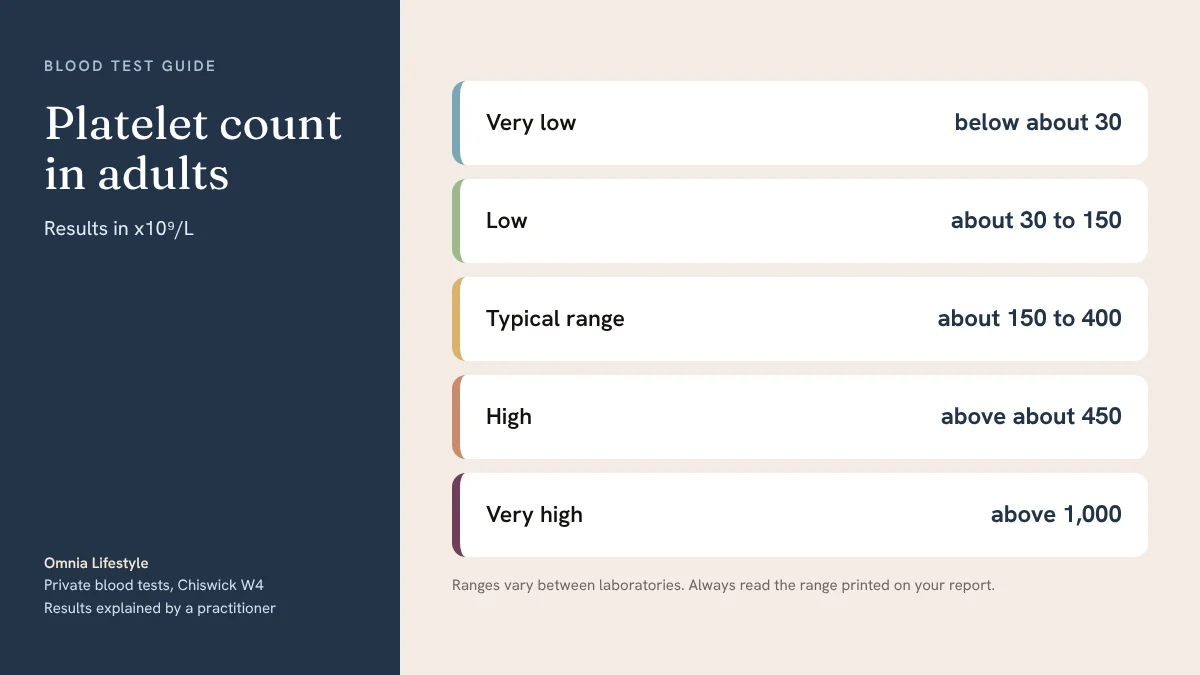
- Very low: below about 30 x10⁹/L. Bleeding and bruising become more likely, and below about 10 x10⁹/L there is a small risk of serious internal bleeding. Counts this low need prompt medical review.
- Low (thrombocytopenia): below about 150 x10⁹/L. NHS guidance for GPs notes that counts between 100 and 150 without symptoms carry no increased bleeding risk and can usually be monitored. Counts below 100 x10⁹/L should be discussed with a GP, and counts below 50 x10⁹/L promptly, as NHS guidance for GPs advises urgent referral at that level.
- Within range: about 150 to 400 x10⁹/L in most adults, with some laboratories using 140 to 450.
- High (thrombocytosis): above about 450 x10⁹/L. Most raised counts are a reaction to something else and settle once the cause is treated.
- Very high: above 1,000 x10⁹/L. NHS guidance for GPs advises referral to a haematologist (a blood specialist).
A low result is not always real
Sometimes platelets clump together in the sample tube, so the analyser counts fewer than are really in your blood. This is called pseudothrombocytopenia. If your count is unexpectedly low and you have no symptoms, the laboratory may look at the sample under a microscope or ask for a repeat sample in a different type of tube.
Common causes of a low platelet count
- Immune thrombocytopenia (ITP): the immune system destroys platelets.
- Alcohol and liver disease: heavy drinking and liver conditions can both lower the count.
- Medicines: a number of prescribed medicines can affect platelets.
- Vitamin B12 or folate deficiency: both are needed to make blood cells. See our guide to folate levels.
- Viral infections: including HIV and hepatitis B or C.
- Bone marrow conditions: less commonly, where the marrow does not make enough blood cells.
Common causes of a high platelet count
- Iron deficiency anaemia: one of the most common reasons. Our guide to haemoglobin levels explains more.
- Infection and inflammation: platelets rise as part of the body's response.
- After surgery: counts often rise for a while after an operation.
- Reduced spleen function: after removal of the spleen, or with conditions that affect it, such as coeliac disease.
- Bone marrow conditions: less commonly, the marrow makes too many platelets, as in a group of conditions called myeloproliferative disorders.
- Other conditions: occasionally a raised count is linked to an underlying cancer, which is why GPs look for the cause when a high count persists without a clear reason.
Symptoms of a low platelet count
Many people with a mildly low count have no symptoms. When symptoms do appear, they can include:
- bruising easily
- a rash of tiny red or purple pinprick spots, called petechiae
- nosebleeds or bleeding gums
- dark blood blisters in the mouth
- heavy periods
- tiredness
A high platelet count often causes no symptoms and is usually found on a routine blood test.
When to get urgent help
Call NHS 111 or go to A&E if you know or suspect your platelets are low and you have:
- a nosebleed lasting more than 30 minutes
- black stools or blood in your stools
- blood in your urine
- a heavy blow to the head
- other heavy bleeding or a sudden increase in bruising
Call 999 or go to A&E if you have:
- a severe headache with drowsiness, vomiting or loss of vision
- a rash that does not fade when you press it and you feel unwell
- signs of a blood clot, such as a painful, swollen leg with breathlessness, chest pain or coughing up blood
- signs of a stroke, such as a drooping face, weak arm or slurred speech
Do not stop any prescribed medicine, such as a blood thinner, because of a test result without first speaking to your GP or prescriber.
What to do about your result
A platelet result outside the range starts a conversation with your practitioner or GP rather than giving a diagnosis. A mildly abnormal result in someone who feels well is usually repeated first, as counts can change with a recent infection or inflammation. For a raised count, NHS guidance for GPs suggests checking iron levels and inflammation markers, then repeating the count after about six weeks if no cause is found.
If you bruise or bleed easily but your platelet count is normal, your practitioner may suggest a Clotting Screen, which looks at how well your clotting proteins are working.
Who should consider a platelet count test
- People who bruise easily, have frequent nosebleeds or bleeding gums.
- Women with very heavy periods.
- Anyone due to have a procedure who wants a baseline check.
- People who drink heavily or have a liver condition.
- Anyone wanting a general health check.
Preparing for the test
A full blood count needs no special preparation and you do not need to fast. If you are having other tests from the same sample that need fasting, follow the instructions you are given when you book. Tell us about any medicines you take, especially blood thinners, and any recent infection or operation.
How often to retest
If your count was only slightly outside the range, a repeat test after a few weeks is often enough to see whether it has settled. NHS guidance for GPs suggests an annual check for people with a stable count between 100 and 150 x10⁹/L and no symptoms. If your count has been abnormal for a known reason, your GP or specialist will set a monitoring plan.
Frequently asked questions
Is a platelet count of 140 low?
It is slightly below the most common lower limit of 150, but some NHS laboratories use 140 as their lower limit. On its own, without symptoms, a count like this does not usually increase bleeding risk.
Is a platelet count of 450 high?
It is at the upper edge of the range. Above 450 x10⁹/L is described as thrombocytosis. The most common reasons are iron deficiency, a recent infection or inflammation, so these are usually checked first.
What platelet count is dangerous?
Bleeding is uncommon unless the count falls below about 30 x10⁹/L, and below about 10 x10⁹/L there is a small risk of serious bleeding. Very high counts above 1,000 x10⁹/L also need specialist review.
Can low iron cause high platelets?
Yes. Iron deficiency is one of the most common causes of a raised platelet count, and the count usually settles once iron levels are restored.
Can alcohol lower platelets?
Yes. Heavy drinking can lower the platelet count directly, and alcohol-related liver disease can lower it further.
Platelet testing in Chiswick
We offer the Full Blood Count, which measures your platelets alongside your red cells, haemoglobin and white cells at Omnia Lifestyle, 8 to 9 Bedford Corner, The Avenue, Chiswick, London W4 1LZ. We are a short walk from Turnham Green station on the District line (Piccadilly line trains stop there early in the morning and late in the evening only), and buses 94, E3 and 272 stop nearby. Limited parking is available on request when you book. Your sample is taken at the clinic and analysed at the Randox accredited laboratory, and most results are ready within a few working days. You do not need a GP referral. A practitioner goes through your result with you in person, and a GP feedback report is available on request.
Find out more about our Full Blood Count, or look at clotting in more detail with our Clotting Screen. You can also compare every blood test and price, or read our guides to haemoglobin levels and white blood cell counts.
This article is general information, not medical advice. Discuss your results with your GP or practitioner.
Ready to book?
Blood Test




.jpg)
.jpg)
