






Book at our Chiswick clinic
Blood Test
White blood cells are the cells of your immune system. They travel in your blood and help your body fight infection, deal with inflammation and repair damaged tissue. Your white cell count is measured as part of a full blood count (FBC), and the result usually comes with a breakdown of the five main types of white cell.
This guide explains what a high or low white blood cell count means, the typical adult ranges, the most common causes and the warning signs that need urgent care. Ranges vary between laboratories, so always read your result against the range printed on your own report.
Test it in Chiswick: our Full Blood Count blood test costs £59, with your result explained in person by a practitioner. No GP referral needed. Book this test or call 020 4515 0000.
Quick answer
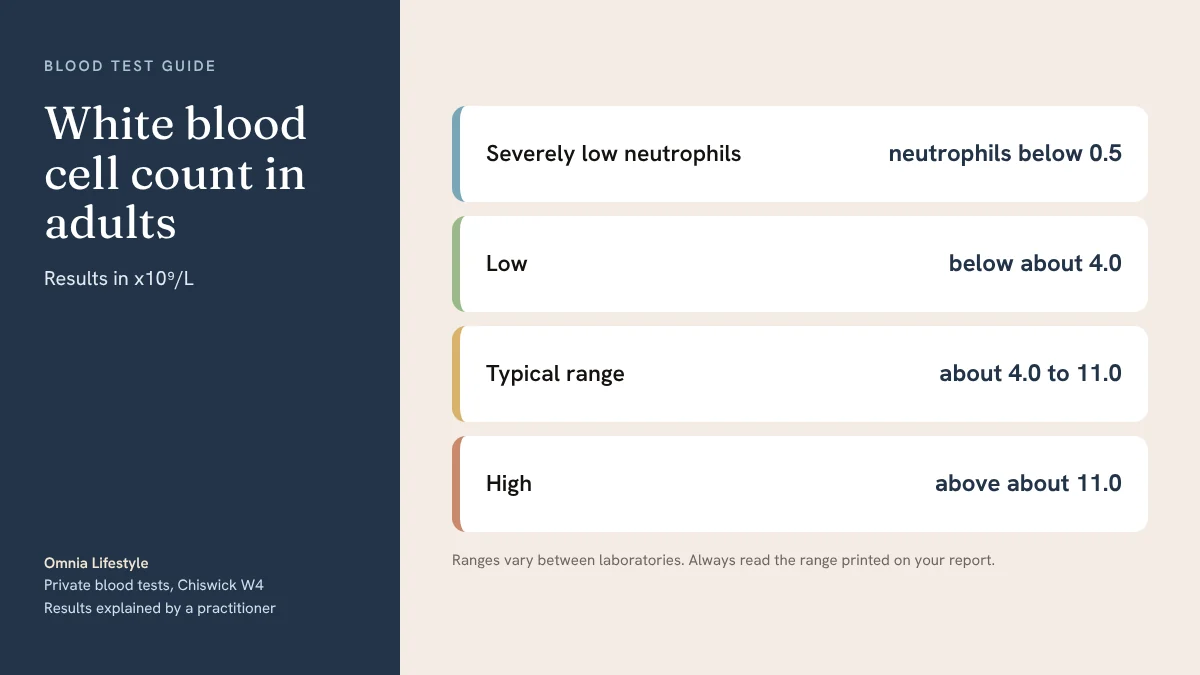
A typical adult white blood cell count is about 4.0 to 11.0 x10⁹/L, although some NHS laboratories use slightly different limits, such as 3.6 to 11.0. A high count is most often caused by infection, inflammation, smoking, steroid medicines or pregnancy. A low count is often linked to a recent viral infection, some medicines or low vitamin B12 or folate. If you are having chemotherapy and develop a high temperature, contact your cancer care team straight away, as this can be an emergency.
What is a white blood cell count?
Your report shows white cells as a number followed by x10⁹/L, which means billions of cells per litre of blood. Alongside the total, most reports list the five main types, often called the differential:
- Neutrophils: the most common type and the first line of defence against bacterial infection.
- Lymphocytes: these include the B cells and T cells that fight viruses and make antibodies.
- Monocytes: these clear away germs and damaged cells.
- Eosinophils: involved in allergic reactions and in fighting parasites.
- Basophils: the least common type, also involved in allergic reactions.
As an example of a UK laboratory range, one NHS trust uses these adult ranges: neutrophils 1.8 to 7.5, lymphocytes 1.0 to 4.0, monocytes 0.2 to 0.8, eosinophils 0.1 to 0.4 and basophils 0.02 to 0.10, all in x10⁹/L. Your own laboratory may use slightly different figures.
What your white blood cell count means
- Low (leucopenia): a total count below the lower limit on your report, usually about 4.0 x10⁹/L. A low count is most important when neutrophils are low.
- Within range: about 4.0 to 11.0 x10⁹/L in most adults.
- High (leucocytosis): a total count above the upper limit, usually about 11.0 x10⁹/L. Your practitioner will look at which type of white cell is raised.
Low neutrophils (neutropenia)
NHS guidance for GPs defines neutropenia as a neutrophil count below 1.8 x10⁹/L. Mildly low counts are common and often recover once a viral infection has passed. GPs look more closely at counts that stay below 1.0 x10⁹/L, and a count below 0.5 x10⁹/L is considered severe because the risk of serious infection is higher.
Some people of African-Caribbean or Middle Eastern family background naturally have a lower neutrophil count, often between 1.0 and 1.8 x10⁹/L. This is known as Duffy null associated neutrophil count and is usually harmless. Let your practitioner know your family background so your result can be read correctly.
High neutrophils or lymphocytes
NHS guidance for GPs describes a neutrophil count above 8.5 x10⁹/L as raised and a lymphocyte count above 5 x10⁹/L as a lymphocytosis. Mild rises usually reflect infection, inflammation or smoking and are simply monitored. Very high counts, or rises that persist without a clear reason, are referred to a haematologist (a blood specialist) for further tests.
Common causes of a high white blood cell count
- Infection: bacterial infections usually raise neutrophils, while viral infections such as glandular fever can raise lymphocytes.
- Inflammation: for example from long-term inflammatory conditions such as rheumatoid arthritis.
- Medicines: steroid tablets commonly raise the neutrophil count.
- Smoking: can raise both neutrophils and lymphocytes.
- Pregnancy: the neutrophil count naturally rises.
- Blood conditions: less commonly, a persistently raised count can be a sign of a blood disorder such as chronic lymphocytic leukaemia, which is why unexplained high counts are followed up.
Common causes of a low white blood cell count
- Viral infections: a recent cold, flu or other virus can lower the count for a while. Ongoing infections such as HIV and hepatitis B or C can also lower it.
- Medicines: including chemotherapy and some other prescribed medicines.
- Vitamin B12 or folate deficiency: both are needed to make healthy blood cells.
- Autoimmune conditions: where the immune system attacks the body's own cells.
- Bone marrow conditions: less commonly, for example myeloma.
Symptoms to look out for
A high or low white cell count does not usually cause symptoms by itself. The symptoms come from the underlying cause. See your GP if you have:
- infections that keep coming back, are unusually severe or are slow to clear
- fevers or night sweats without an obvious cause
- unexplained weight loss
- swollen glands in the neck, armpit or groin that do not go down
- unusual bruising or bleeding, or tiredness that does not improve
When to get urgent help
If you are having chemotherapy or other cancer treatment and you develop a temperature above 38°C, or feel hot, cold, shivery or generally unwell, contact your cancer care team's 24-hour helpline immediately. NICE guidance treats a fever with a neutrophil count of 0.5 x10⁹/L or lower in someone having cancer treatment as neutropenic sepsis, which needs hospital assessment straight away.
Call 999 or go to A&E if you cannot reach your care team, or if you or someone else has possible signs of sepsis, such as:
- confusion, slurred speech or not making sense
- very fast breathing
- blue, pale or blotchy skin
- a rash that does not fade when you press it
- a very high or very low temperature, feeling hot or cold to the touch, or shivering
If you feel unwell and are not sure what to do, call NHS 111.
What to do about your result
A white cell result outside the range starts a conversation with your practitioner or GP rather than giving a diagnosis. If you were unwell when the sample was taken, the simplest next step is often a repeat test once you have recovered. Your practitioner may also suggest checking inflammation markers such as CRP, or vitamin B12 and folate if your neutrophils are low.
Who should consider a white blood cell count test
- People who seem to catch every infection going, or whose infections are slow to clear.
- Anyone recovering from a viral illness who still feels unwell.
- People taking medicines that can affect the blood count.
- Anyone who wants a general health check, since the full blood count is a useful baseline.
Preparing for the test
A full blood count needs no special preparation and you do not need to fast. If you are having other tests from the same sample that need fasting, follow the instructions you are given when you book. Tell us about any recent infection, vaccination, steroid medicine or other prescribed medicines, as these can all affect the result.
How often to retest
If your count was only slightly outside the range and you had a recent infection, a repeat test a few weeks after you have recovered is often enough. NHS guidance for GPs suggests repeating a very low neutrophil count within about a week. People on medicines that affect the blood count usually follow a monitoring schedule set by their prescriber.
Frequently asked questions
Is a white blood cell count of 12 high?
Yes, 12 x10⁹/L is slightly above the typical upper limit of about 11.0. Mild rises like this are often caused by an infection, inflammation, smoking or steroid medicines, and the count often settles once the cause has passed.
Is a white blood cell count of 3.5 too low?
It is slightly below most laboratory ranges. What matters most is the neutrophil count. A mildly low result after a recent virus often recovers, so a repeat test is a sensible next step.
Can stress or exercise change my white cell count?
Your white cell count can change from day to day with illness and other factors. If you exercised hard or were unwell before your test, mention this to your practitioner, who may suggest a repeat test.
Does a high white blood cell count mean cancer?
Usually not. Most raised counts are caused by infection, inflammation, smoking or medicines. A blood cancer is a much less common cause, which is why persistently high counts without a clear reason are investigated.
What is a dangerous neutrophil level?
A neutrophil count below 0.5 x10⁹/L is considered severe. If you have a low count and develop a fever, especially during chemotherapy, get medical help immediately.
White blood cell testing in Chiswick
We offer the Full Blood Count, which measures your total white cell count and all five types of white cell, as well as your red cells and platelets at Omnia Lifestyle, 8 to 9 Bedford Corner, The Avenue, Chiswick, London W4 1LZ. We are a short walk from Turnham Green station on the District line (Piccadilly line trains stop there early in the morning and late in the evening only), and buses 94, E3 and 272 stop nearby. Limited parking is available on request when you book. Your sample is taken at the clinic and analysed at the Randox accredited laboratory, and most results are ready within a few working days. You do not need a GP referral. A practitioner goes through your result with you in person, and a GP feedback report is available on request.
Find out more about our Full Blood Count, or add inflammation markers with our Inflammation Check, which includes a full blood count with CRP, ESR and ferritin. You can also compare every blood test and price, or read our guides to CRP levels and blood tests for frequent infections.
This article is general information, not medical advice. Discuss your results with your GP or practitioner.
Ready to book?
Blood Test




.jpg)
.jpg)
