






Book at our Chiswick clinic
Blood Test
Magnesium is a mineral your body uses to turn food into energy, keep muscles and nerves working, support a steady heart rhythm and help the parathyroid glands look after your bones. Most of your magnesium is stored in bone and inside cells, and only a small share circulates in the blood.
A magnesium blood test is often requested when someone has cramps, twitching or palpitations, or takes a medicine known to lower magnesium. This guide explains the usual range, what low and high results can mean, the difference between serum and red cell magnesium, the most common causes of low magnesium, and when to get help.
Test it in Chiswick: our Magnesium blood test costs £39, with your result explained in person by a practitioner. No GP referral needed. Book this test or call 020 4515 0000. Prefer to test at home? A home finger-prick kit is also available, ask us when you enquire.
Quick answer
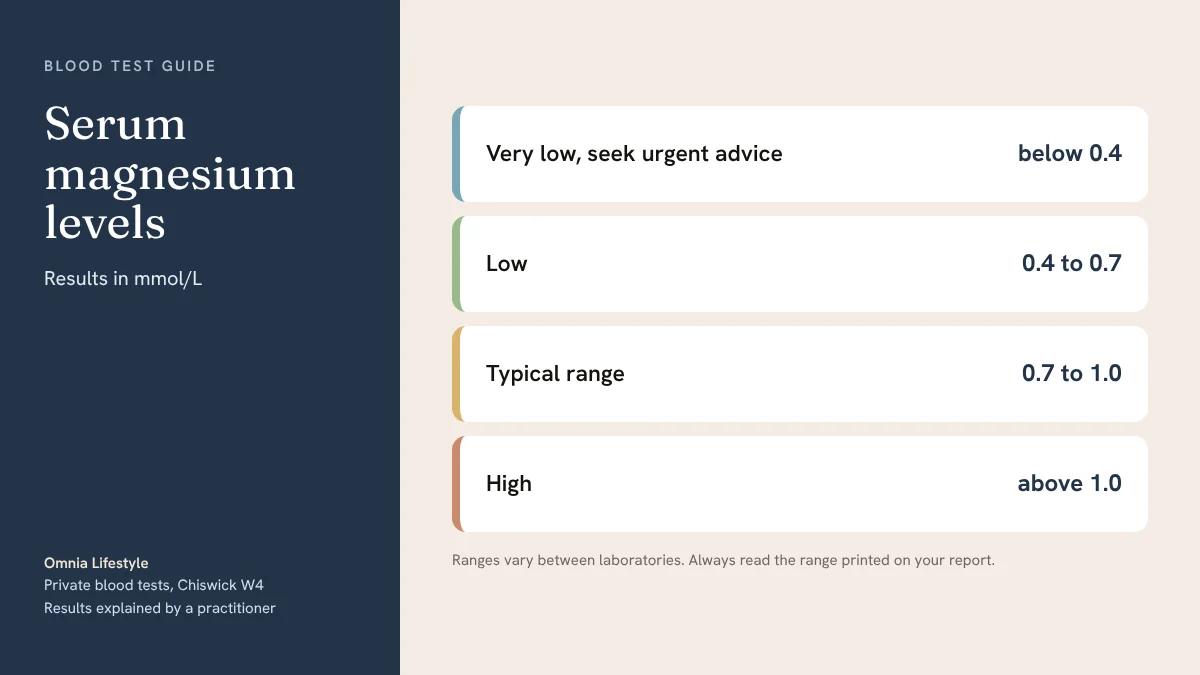
Most UK laboratories use an adult serum magnesium range of 0.7 to 1.0 mmol/L. A result below 0.7 mmol/L is usually called low magnesium (hypomagnesaemia). Many people with a mildly low level have no symptoms. Cramps, twitching, tremor, tingling, weakness and an irregular heartbeat become more likely as the level falls, especially below about 0.4 mmol/L, where NHS guidance suggests considering urgent hospital treatment. Common causes include long-term proton pump inhibitors (PPIs), diuretics, alcohol and ongoing diarrhoea. Ranges vary between laboratories, so always read the range printed on your report.
What a magnesium blood test measures
The standard test measures serum magnesium, the amount in the liquid part of your blood. Your body works hard to keep this level steady, drawing on stores in bone and cells when intake falls. This means a low blood result usually points to a genuine shortfall that is worth discussing, while a normal result does not completely rule out lower stores.
Serum magnesium or red cell magnesium?
Our Magnesium test (£39) measures serum magnesium. This is the test used in NHS hospitals and GP surgeries, and the one UK guidance on low magnesium is based on. Our Red Cell Magnesium test (£159) measures the magnesium held inside red blood cells. Some people choose it when serum magnesium is normal but symptoms continue, because it may give a view of magnesium inside cells.
Red cell magnesium is not used routinely in NHS practice, ranges differ more between laboratories, and it does not replace serum magnesium when a doctor needs to act on a result. For most people, serum magnesium is the right first test. Your practitioner can help you decide whether a red cell test would add anything in your situation.
What your result means
- Very low (below 0.4 mmol/L): NHS guidance advises considering emergency admission for magnesium given through a drip at this level, or at any level below the range if you have symptoms. Seek same-day medical advice.
- Low (0.4 to 0.7 mmol/L): often mild and without symptoms. It is usually managed by finding and treating the cause and, where advised, oral magnesium. Potassium and calcium are usually checked too, because low magnesium can pull them down.
- Within range (0.7 to 1.0 mmol/L): your blood level is where it is expected to be. If symptoms continue, other causes are worth exploring with your practitioner.
- High (above 1.0 mmol/L): uncommon. It is usually linked to reduced kidney function or to large amounts of magnesium from laxatives, antacids or supplements, and should be discussed with your GP.
These are typical adult values. Ranges vary between laboratories, so compare your result with the range printed on your own report.
Low magnesium symptoms
Most people with mildly low magnesium feel nothing at all. NHS guidance notes that symptoms are uncommon until the level falls below about 0.4 mmol/L, and that how quickly it falls matters as much as the number itself. When symptoms do appear, they can include:
- muscle cramps, twitching, tremor or spasms
- tingling or numbness
- tiredness and weakness
- feeling sick or losing your appetite
- unsteadiness, dizziness or confusion
- palpitations or an irregular heartbeat
Some of these symptoms come from the knock-on fall in potassium and calcium. Very low magnesium can cause seizures, which is a medical emergency.
Common causes of low magnesium
- Proton pump inhibitors (PPIs): medicines such as omeprazole and lansoprazole, used for indigestion and reflux. The MHRA has warned that long-term use can cause low magnesium, with most reported cases after a year of treatment, and advises doctors to consider checking magnesium before and periodically during prolonged treatment.
- Diuretics (water tablets): loop and thiazide diuretics increase magnesium loss through the kidneys. Taking a diuretic and a PPI together raises the risk further.
- Alcohol: regular heavy drinking reduces magnesium intake and increases losses.
- Losses from the gut: long-lasting diarrhoea, vomiting, malabsorption and overuse of laxatives.
- Other medicines: including some antibiotics, chemotherapy and immunosuppressant drugs.
- Low intake: very restrictive diets or a poor appetite. The NHS says adults aged 19 to 64 need about 300 mg a day (men) or 270 mg a day (women), which most people get from a varied diet including spinach, nuts and wholemeal bread.
What to do about a low result
A low result starts a conversation rather than giving a diagnosis. Your practitioner will look at your symptoms, medicines, alcohol intake and digestive health, and may suggest checking potassium, calcium and kidney function as well. Do not stop a prescribed PPI or diuretic without speaking to your GP first, as there are often safer ways to adjust treatment.
If a supplement is suggested, the NHS advises that 400 mg or less a day of magnesium from supplements is unlikely to cause harm, while higher doses taken for a short time can cause diarrhoea. If you have kidney disease, only take magnesium on medical advice.
When to see your GP or get urgent help
Call 999 or go to A&E if you or someone else has a seizure, collapses, has chest pain, or has a fast, pounding or irregular heartbeat with dizziness, fainting or breathlessness.
Get same-day advice from your GP or NHS 111 if your magnesium is below 0.4 mmol/L, or if you have a low result with symptoms such as marked muscle spasms, new confusion or palpitations.
Book a routine GP appointment if you have a mildly low result, persistent cramps or twitching, or you have taken a PPI or diuretic for a long time and have never had your magnesium checked.
Who should consider a magnesium test
- People who have taken a PPI for a long time, especially alongside a diuretic or digoxin
- People with ongoing diarrhoea, a malabsorption condition or a history of heavy drinking
- Anyone with unexplained cramps, twitching, tremor or palpitations
- People who have had a low potassium or calcium result
Preparing for the test
You do not need to fast for a magnesium blood test, and you can drink water as normal. Tell your practitioner about any magnesium supplements, laxatives, antacids and prescribed medicines, as these all help explain your result. Bring a list of your medicines and any previous results if you have them.
How often to retest
If a low result is being treated, your GP will usually recheck the level to make sure it has recovered and will advise on timing. If you take a PPI or diuretic long term, ask whether a periodic magnesium check makes sense for you, as the MHRA suggests. If your result is in range and you have no ongoing risk factors, there is usually no need for regular testing.
Frequently asked questions
Is a magnesium level of 0.65 mmol/L low?
Yes, slightly. It sits just below the usual lower limit of 0.7 mmol/L used by many UK laboratories. A mildly low level often causes no symptoms, but it is worth looking for a cause, such as a PPI, a diuretic or a digestive problem, and repeating the test.
Can a normal blood test miss low magnesium?
It can. Only a small share of your magnesium is in the blood, and the body keeps the blood level steady for as long as it can. If symptoms continue with a normal result, your practitioner will consider other causes and whether any further testing would help.
Can omeprazole cause low magnesium?
Yes. Omeprazole and other PPIs can lower magnesium when taken long term, usually after a year or more. Keep taking your medicine, but ask your GP whether your magnesium should be checked.
Is high magnesium dangerous?
High magnesium is uncommon and is usually linked to kidney problems or taking large amounts of magnesium-containing products. A raised result should be discussed with your GP, who may check your kidney function.
Do I need to fast for a magnesium blood test?
No. You can eat and drink normally before the test.
Magnesium testing in Chiswick
We take your sample at our clinic at 8 to 9 Bedford Corner, The Avenue, Chiswick, London W4 1LZ. We are a short walk from Turnham Green station (District line, with Piccadilly line trains stopping there early morning and late evening only) and close to the 94, E3 and 272 bus routes. Limited parking is available on request when you book. Your sample is analysed at the Randox accredited laboratory, no GP referral is needed, and most results are ready within a few working days. A practitioner explains your result with you in person, and a GP feedback report is available on request.
Book the Magnesium blood test on its own, or choose the Vitamins and Minerals Check (£99), which adds calcium, iron studies, vitamin D, vitamin B12, folate and zinc. You can also compare every blood test and price, read our guide to blood tests for muscle cramps, or learn how calcium levels are read.
This article is general information, not medical advice. Discuss your results with your GP or practitioner.
Ready to book?
Blood Test




.jpg)
.jpg)
