






Book at our Chiswick clinic
Blood Test
Calcium is best known for building strong bones and teeth, but the small amount in your blood matters just as much. It helps muscles contract, nerves send signals and the heart keep a steady rhythm. Parathyroid hormone (PTH) and vitamin D keep blood calcium within a narrow range.
When calcium drifts too high or too low, it is usually a sign that something in this control system needs attention. This guide explains what adjusted calcium means, the usual range, the main causes of high and low results, the symptoms to look out for and when a result needs urgent review.
Test it in Chiswick: our Adjusted Calcium blood test costs £49, with your result explained in person by a practitioner. No GP referral needed. Book this test or call 020 4515 0000. Prefer to test at home? A home finger-prick kit is also available, ask us when you enquire.
Quick answer
Adjusted calcium is your total blood calcium corrected for albumin, the main protein that carries calcium. Most UK laboratories use an adult range of 2.2 to 2.6 mmol/L. NICE advises checking PTH when adjusted calcium is 2.6 mmol/L or above twice, and the commonest causes of high calcium are primary hyperparathyroidism and cancer. Low calcium is often linked to vitamin D deficiency. An adjusted calcium above 3.0 mmol/L, or any abnormal result with symptoms such as confusion, vomiting or muscle spasms, needs same-day medical review. Ranges vary between laboratories, so check the range on your report.
What is adjusted calcium?
In the blood, a large share of calcium travels attached to proteins, mainly albumin, while the rest is free. If your albumin is low or high, your total calcium can look abnormal even when the free, active calcium is fine. Adjusted calcium (sometimes called corrected calcium) is a calculation that estimates what your total calcium would be if your albumin were normal, which is why it is the figure doctors usually act on.
Our Adjusted Calcium test reports albumin, total calcium and adjusted calcium together, so your practitioner can see the full picture.
What your result means
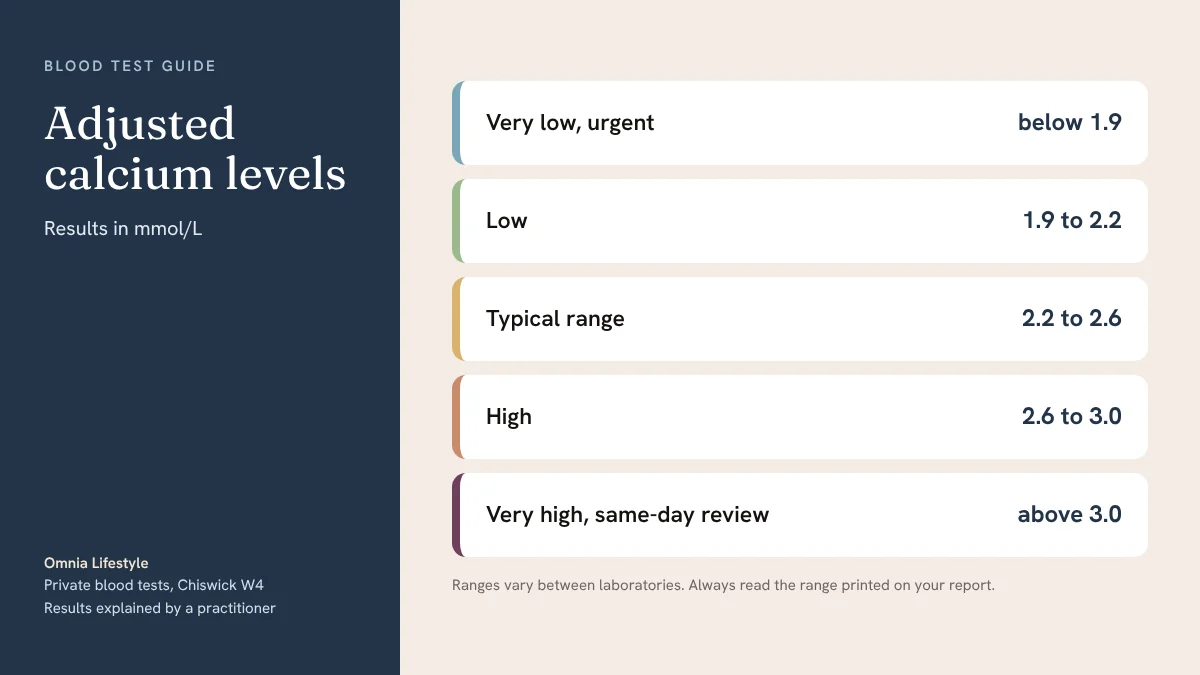
- Very low (below 1.9 mmol/L): the Society for Endocrinology treats this, or a low level with symptoms, as an emergency. Seek urgent medical help.
- Low (below 2.2 mmol/L): often mild and without symptoms. It needs a repeat test and a look at vitamin D, magnesium, kidney function and PTH.
- Within range (2.2 to 2.6 mmol/L): your calcium is where it is expected to be.
- High (2.6 to 3.0 mmol/L): often causes few or no symptoms. NICE advises checking PTH if calcium is 2.6 mmol/L or above on two separate occasions. Book a GP appointment.
- Very high (above 3.0 mmol/L): UK guidance says prompt treatment is usually needed, so this should be reviewed by a doctor the same day. Above 3.5 mmol/L is a medical emergency.
These are typical adult values. Ranges vary between laboratories, so compare your result with the range printed on your own report.
Causes of high calcium
NHS guidance notes that primary hyperparathyroidism and cancer together account for about 90% of cases of high calcium.
- Primary hyperparathyroidism: one or more of the four small parathyroid glands in the neck makes too much PTH, most often because of a non-cancerous growth (adenoma). It is more common in women and is often found by chance on a routine blood test.
- Cancer: some cancers release a hormone-like protein that raises calcium, and others spread to bone. This is more likely when calcium is very high or rises quickly, and when PTH is low.
- Medicines and supplements: including thiazide diuretics, lithium and taking too much vitamin D or calcium.
- Other causes: dehydration, kidney failure, long periods of immobility, conditions such as sarcoidosis, and an inherited condition called familial hypocalciuric hypercalcaemia.
Symptoms of high calcium
Many people with mildly high calcium feel well. When symptoms appear, they can include feeling very thirsty, passing urine often, constipation, tiredness, muscle weakness, feeling sick, tummy pain, low mood, bone pain and kidney stones. Very high levels can cause confusion, drowsiness and heart rhythm problems.
Causes of low calcium
- Vitamin D deficiency: without enough vitamin D, the gut absorbs less calcium. This is common in the UK, especially in winter. Our guide to vitamin D levels explains more.
- Low magnesium: the parathyroid glands need magnesium to release PTH properly.
- Underactive parathyroid glands (hypoparathyroidism): for example after thyroid or parathyroid surgery.
- Kidney disease: the kidneys activate vitamin D and help balance calcium and phosphate.
- Some medicines: including certain treatments for osteoporosis.
Symptoms of low calcium include tingling around the mouth and in the fingers, muscle cramps and spasms in the hands and feet, and, when very low, seizures or an irregular heartbeat.
What to do about an abnormal result
A single abnormal result starts a conversation rather than giving a diagnosis. Calcium can shift slightly with dehydration, recent illness or how the sample was taken, so a repeat test is usually the first step for a mildly abnormal result. Your practitioner may suggest checking PTH and vitamin D at the same time, which together show whether the parathyroid glands are responding as they should.
Our Bone Health Check (£119) includes adjusted calcium, PTH, vitamin D, phosphate and alkaline phosphatase. A Parathyroid Hormone (PTH) test (£119) and a Vitamin D test (£59) are also available on their own. If your calcium is high, do not start vitamin D or calcium supplements without medical advice.
When to see your GP or get urgent help
Call 999 or go to A&E if someone has a seizure, collapses, becomes very confused or drowsy, has severe muscle spasms or tightness in the throat that affects breathing, or has chest pain or a very irregular heartbeat.
Get same-day medical advice from your GP or NHS 111 if your adjusted calcium is above 3.0 mmol/L, or if you have a high or low result with symptoms such as vomiting, severe thirst, dehydration, new confusion or tingling around the mouth.
Book a routine GP appointment if your result is mildly high or low and you feel well, or if you have kidney stones, fragility fractures or osteoporosis and have not had your calcium checked.
Who should consider a calcium test
- People with kidney stones, osteoporosis or a fracture after a minor fall
- Anyone with constant thirst, passing urine often or long-standing constipation without a clear cause
- People with known vitamin D deficiency or a restrictive diet
- People who have had thyroid or parathyroid surgery
- People taking lithium or a thiazide diuretic, or high-dose vitamin D
Preparing for the test
You do not usually need to fast for a calcium test, and you can drink water as normal, which also avoids dehydration affecting the result. Tell your practitioner about any calcium or vitamin D supplements and prescribed medicines. If you are also having PTH or other hormone tests and take high-dose biotin, which is common in hair and nail supplements, mention it, as biotin can affect some hormone tests.
How often to retest
If your result is mildly high, NICE advises repeating it, and PTH is measured if calcium is 2.6 mmol/L or above on two separate occasions. If you are being treated for vitamin D deficiency or a parathyroid problem, your GP or specialist will set a monitoring plan. If your result is in range and you have no risk factors, regular testing is not usually needed.
Frequently asked questions
Is a calcium level of 2.7 mmol/L high?
Yes. An adjusted calcium of 2.7 mmol/L is above the usual range and above the 2.6 mmol/L level at which NICE advises checking PTH if it is found on two occasions. It is usually not urgent if you feel well, but it should be repeated and discussed with your GP, who may check PTH.
What is the difference between total and adjusted calcium?
Total calcium includes calcium bound to albumin. Adjusted calcium corrects for your albumin level, so it gives a fairer picture when albumin is low or high.
Can low vitamin D cause low calcium?
Yes. Vitamin D helps you absorb calcium from food. Low vitamin D can lead to low calcium and can also cause the parathyroid glands to work harder to keep calcium up.
Can dehydration raise calcium?
Dehydration can push calcium up a little and can make high calcium worse. Severe dehydration with high calcium needs urgent medical care.
Do I need to fast for a calcium blood test?
Usually not. Drink water as normal unless you are having other tests that need fasting.
Calcium testing in Chiswick
We take your sample at our clinic at 8 to 9 Bedford Corner, The Avenue, Chiswick, London W4 1LZ. We are a short walk from Turnham Green station (District line, with Piccadilly line trains stopping there early morning and late evening only) and close to the 94, E3 and 272 bus routes. Limited parking is available on request when you book. Your sample is analysed at the Randox accredited laboratory, no GP referral is needed, and most results are ready within a few working days. A practitioner explains your result with you in person, and a GP feedback report is available on request.
Book the Adjusted Calcium blood test, or choose the Bone Health Check for calcium, PTH and vitamin D together. You can also compare every blood test and price, read our guide to vitamin D levels, or learn about magnesium levels.
This article is general information, not medical advice. Discuss your results with your GP or practitioner.
Ready to book?
Blood Test




.jpg)
.jpg)
