






Book at our Chiswick clinic
Blood Test
A liver function test, often shortened to LFT, is a group of blood markers that shows how your liver is coping. Some of the markers are enzymes that leak into the blood when liver cells or bile ducts are irritated. Others, such as albumin and bilirubin, show how well the liver is doing its everyday jobs of making protein and clearing waste.
Liver results are often slightly outside the range in people who feel completely well, and most mild changes have a simple explanation. This guide explains each marker, the patterns clinicians look for, the most common causes and what usually happens next.
Test it in Chiswick: our Liver Function Check blood test costs £49, with your result explained in person by a practitioner. No GP referral needed. Book this test or call 020 4515 0000. Prefer to test at home? A home finger-prick kit is also available, ask us when you enquire.
Quick answer
A liver function test usually includes ALT, AST, ALP, GGT, bilirubin and albumin, and many NHS panels add total protein. One NHS laboratory uses these adult ranges: ALT below 50 U/L in men and below 35 U/L in women, ALP 30 to 130 U/L, bilirubin below 21 µmol/L and albumin 35 to 50 g/L. Ranges vary between laboratories, so always read the range on your report. A mildly raised ALT is most often linked to fatty liver, alcohol or medicines, and a result outside the range is usually repeated before anything else is decided.
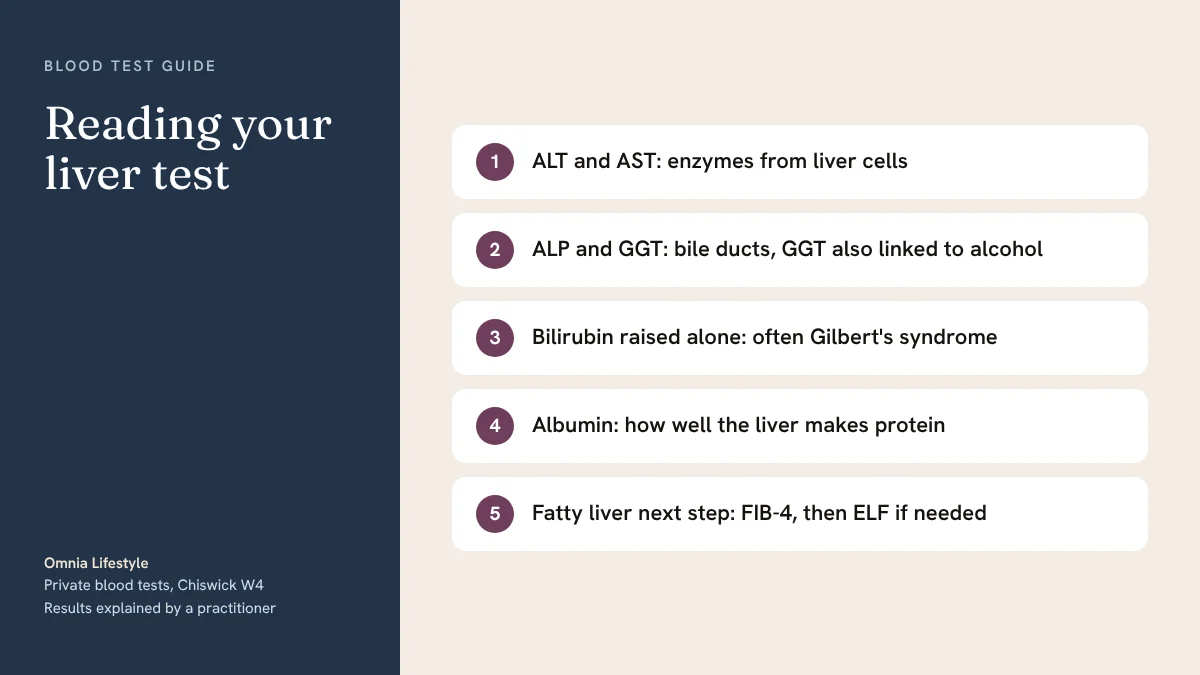
What each liver marker means
ALT (alanine aminotransferase)
ALT is an enzyme found mainly inside liver cells. When those cells are irritated or inflamed, more ALT escapes into the blood. It is the marker most often raised in fatty liver disease. Other common causes include alcohol, prescribed medicines, over-the-counter and herbal remedies, and long-term hepatitis B or C infection.
AST (aspartate aminotransferase)
AST is also found in liver cells, but it is present in muscle too, so hard exercise or a muscle injury can push it up. Clinicians read AST alongside ALT, and the two are combined with your age and platelet count to calculate the FIB-4 score, which estimates the risk of liver scarring.
ALP (alkaline phosphatase)
ALP comes from the bile ducts and from bone. A raised ALP together with a raised GGT points towards the liver or bile ducts, for example gallstones. A raised ALP with a normal GGT is more likely to come from bone, and your GP may check your vitamin D.
GGT (gamma-glutamyltransferase)
GGT is a sensitive sign that the liver is under some strain, but it does not tell you why. NHS guidance notes that a raised GGT on its own can suggest alcohol excess or fatty liver, although it is neither a perfect test for alcohol nor proof of heavy drinking. One NHS laboratory uses 10 to 71 IU/L for men and 6 to 42 IU/L for women.
Bilirubin
Bilirubin is a yellow pigment made when old red blood cells are broken down. The liver processes it and clears it into bile. A high level can cause jaundice, which is yellowing of the skin or the whites of the eyes. A mildly raised bilirubin with every other marker normal is very often due to Gilbert's syndrome.
Albumin and total protein
Albumin is the main protein made by the liver, so it reflects how well the liver has been working over weeks rather than days. NHS guidance uses a low albumin, together with a high bilirubin and low platelets, as a prompt to look for more advanced liver disease. Total protein is albumin plus the other blood proteins, called globulins, which include antibodies; one NHS laboratory uses 60 to 80 g/L. Our Liver Function Check reports albumin, while total protein is not part of this panel.
What your result means
- Within range: your liver markers look as expected. This is reassuring, but NICE advises that routine liver blood tests should not be used to rule out fatty liver, so a normal result does not exclude it if you have risk factors.
- Mildly raised: a small rise in ALT, AST or GGT is common. It is usually rechecked after alcohol, medicines, supplements and recent exercise have been considered.
- Markedly raised, or with jaundice: needs prompt medical review, and sooner if you feel unwell.
- Low albumin or raised bilirubin with other changes: worth discussing with your GP, who may check your platelets and clotting to look for more advanced liver disease.
Common result patterns
Raised ALT with fatty liver
Fatty liver, now also called metabolic dysfunction-associated steatotic liver disease (MASLD), is one of the most common reasons for a raised ALT. The NHS says it is more likely if you carry weight around your waist, have type 2 diabetes, high blood pressure or high cholesterol, or are over 50. Most people only have the first stage, a simple build-up of fat, which can improve with weight loss and more activity.
Isolated raised GGT with alcohol
When GGT is the only marker out of range, alcohol is a common explanation, particularly if the mean cell volume (MCV) on a full blood count is also raised. Fatty liver is the other frequent cause. NHS guidance suggests stopping alcohol for at least 4 weeks before GGT is repeated. Where the liver is already damaged, GGT may fall more slowly.
Raised bilirubin alone: Gilbert's syndrome
Gilbert's syndrome is a common inherited condition in which the liver processes bilirubin more slowly. Bilirubin can rise after over-exercising, poor sleep, alcohol or not drinking enough fluids, and some people notice mild jaundice that comes and goes. The NHS says it does not damage the liver or affect life expectancy. NHS laboratory guidance suggests Gilbert's when bilirubin is below 70 µmol/L and albumin, clotting, full blood count and the other liver markers are normal.
Raised ALP and GGT together
This pattern points towards the bile ducts, for example a gallstone or inflammation of the ducts. It usually leads to further blood tests and an ultrasound scan.
What usually happens next
- A repeat test. A mildly abnormal result is usually rechecked after 1 to 3 months, once alcohol, medicines and supplements have been reviewed.
- A liver screen. If results stay raised, your GP may arrange a liver screen. This commonly includes hepatitis B and C tests, ferritin and iron studies, autoimmune antibodies and immunoglobulins, a coeliac test, thyroid function, blood sugar and cholesterol, often with a liver ultrasound.
- Checking for scarring in fatty liver. NICE guideline NG49 recommends offering people with fatty liver a test for advanced liver fibrosis and suggests the enhanced liver fibrosis (ELF) blood test, where a score of 10.51 or above indicates advanced fibrosis. Many NHS pathways start with the simpler FIB-4 score: below 1.3 (below 2.0 if you are over 65) is low risk, 1.3 to 3.25 is intermediate and leads on to an ELF test, and above 3.25 usually means referral to a liver specialist. Low scores are typically repeated every 2 to 3 years.
Symptoms that can go with liver problems
Most liver conditions cause no symptoms in the early stages, which is why blood tests are so useful. Later symptoms can include tiredness and weakness, loss of appetite, itchy skin, feeling sick, darker urine, paler stools and yellowing of the skin or eyes.
When to see your GP or get urgent help
- Ask for an urgent GP appointment or contact NHS 111 if your skin or the whites of your eyes turn yellow, especially with darker urine or paler stools.
- Call 999 or go to A&E if you are vomiting blood and feel faint, dizzy, confused or generally unwell, or you also have black stools. If you have vomited blood but it has stopped and you have no other symptoms, ask for an urgent GP appointment or contact NHS 111.
- See your GP if a liver marker stays raised on a repeat test, or if your report flags a result as very high.
Who should consider a liver test
- You drink alcohol regularly and want to know how your liver is coping.
- You carry extra weight around your waist, or have type 2 diabetes, high blood pressure or high cholesterol.
- You take long-term medicines, or herbal or bodybuilding supplements.
- You have had a raised result before and want to check progress.
Preparing for the test and retesting
You do not usually need to fast for a liver function test on its own, although fasting may be needed if you add cholesterol or glucose tests. Tell us about any medicines, herbal remedies and supplements, and about your recent alcohol intake. If a result is raised, a repeat after 1 to 3 months is a common next step, and your GP or practitioner will advise how often to check after that.
Frequently asked questions
Is an ALT of 60 high?
It is above the upper limit many UK laboratories use, which is around 50 U/L for men and 35 U/L for women, but it is a mild rise. It is usually repeated after reviewing alcohol, weight, medicines and recent exercise.
How long should I stop alcohol before repeating GGT?
NHS guidance suggests at least 4 weeks without alcohol before GGT is measured again, so you can see whether alcohol was the cause.
Is Gilbert's syndrome serious?
No. The NHS says it does not damage the liver or shorten life expectancy. Tell doctors you have it, as it can explain a raised bilirubin on future tests.
Can a normal liver test rule out fatty liver?
Not reliably. NICE advises against using routine liver blood tests to rule out fatty liver, so your GP may suggest a scan or a fibrosis score if you have risk factors.
Liver testing in Chiswick
We take your sample at our clinic at 8 to 9 Bedford Corner, The Avenue, Chiswick, London W4 1LZ. We are a short walk from Turnham Green station (District line, with Piccadilly line trains stopping there early morning and late evening only) and close to the 94, E3 and 272 bus routes. Limited parking is available on request when you book. Your sample is analysed at the Randox accredited laboratory, no GP referral is needed, and most results are ready within a few working days. A practitioner explains your result with you in person, and a GP feedback report is available on request.
Book the Liver Function Check, or ask about the Liver Fibrosis Score (FIB-4) test at £99 if you have fatty liver. You can also compare every blood test and price, read our guide to triglyceride levels, or see blood test results explained.
This article is general information, not medical advice. Discuss your results with your GP or practitioner.
Ready to book?
Blood Test




.jpg)
.jpg)
