






Book at our Chiswick clinic
Blood Test
Triglycerides are the most common type of fat in your blood. Your body uses them for energy, and stores any it does not need in fat cells. They come from the food you eat and are also made by your liver. A triglyceride result is usually reported as part of a cholesterol (lipid) blood test.
High triglycerides are linked with heart and circulation disease, and very high levels can cause inflammation of the pancreas. This guide explains the healthy levels used in the NHS, what raises triglycerides, how to bring them down, and when a result needs prompt medical advice.
Test it in Chiswick: our Cholesterol Profile blood test costs £49, with your result explained in person by a practitioner. No GP referral needed. Book this test or call 020 4515 0000. Prefer to test at home? A home finger-prick kit is also available, ask us when you enquire.
Quick answer
NHS guidance gives a healthy triglyceride level as below 1.7 mmol/L on a fasting test and below 2.3 mmol/L on a non-fasting test. HEART UK suggests aiming for a non-fasting level below 2.0 mmol/L. NICE (NG238) says that between 4.5 and 9.9 mmol/L, heart risk may be underestimated by standard risk tools. Between 10 and 20 mmol/L, the test should be repeated fasting and specialist advice sought if it stays above 10. Above 20 mmol/L (not caused by alcohol or poorly controlled diabetes) needs urgent specialist review, because the risk of pancreatitis rises.
What are triglycerides?
After a meal, fat from your food is packaged into particles and carried in the blood as triglycerides. Your liver also makes triglycerides, particularly from extra calories, sugar and alcohol. This is why your level is higher after eating, and why a fasting test gives a lower number than a non-fasting one.
Triglycerides are different from cholesterol, but the two are closely linked. To understand the rest of your lipid profile, read our guide to cholesterol levels explained.
What your triglyceride result means
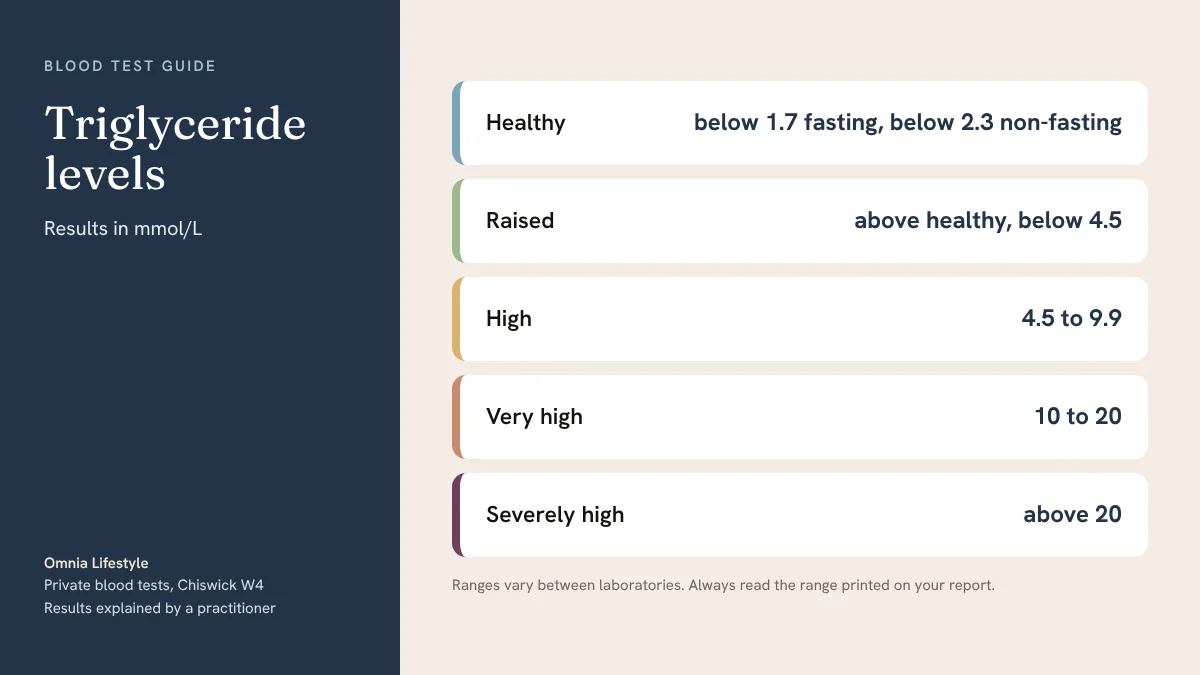
Results are reported in mmol/L. Ranges vary between laboratories, so always check the range on your report. As a guide:
- Healthy: below 1.7 mmol/L fasting, or below 2.3 mmol/L non-fasting.
- Raised: above these levels but below 4.5 mmol/L. Often improved by lifestyle changes, and read together with your cholesterol and overall heart risk.
- High (4.5 to 9.9 mmol/L): NICE says standard heart risk tools may underestimate your risk, and other risk factors should be managed carefully.
- Very high (10 to 20 mmol/L): NICE recommends a repeat fasting test after at least 5 days and within 2 weeks, a check for underlying causes, and specialist advice if the level stays above 10.
- Severely high (above 20 mmol/L): NICE recommends urgent specialist review if this is not due to excess alcohol or poorly controlled diabetes.
High triglycerides and pancreatitis
Very high triglycerides can trigger acute pancreatitis, a painful and serious inflammation of the pancreas. NHS Highland guidance, citing cohort studies, notes that pancreatitis may occur in around 3% of people with triglycerides between 10 and 20 mmol/L and around 15% of those above 20 mmol/L.
Symptoms
Raised triglycerides usually cause no symptoms, which is why a blood test is the only way to know your level. Very high levels may only become obvious if they cause pancreatitis.
What causes high triglycerides?
The NHS and HEART UK list several common causes:
- Diet: too much saturated fat and added sugar
- Weight: carrying extra weight, especially around the middle
- Inactivity: not being physically active
- Alcohol: some people are very sensitive even to small amounts
- Medical conditions: diabetes, an underactive thyroid, kidney disease, non-alcoholic fatty liver disease and gout
- Medicines: including some diuretics, steroids, oral oestrogen and retinoids
- Genes: inherited conditions such as familial combined hyperlipidaemia, and rarer conditions that cause extremely high levels
- Pregnancy and age: levels tend to rise as you get older
How to lower triglycerides
HEART UK describes diet and lifestyle changes as the cornerstone of treatment:
- lose excess weight, especially around the waist
- aim for at least 150 minutes a week of moderate activity, where you breathe harder but are not out of breath
- cut down on added sugars and swap saturated fats for healthier unsaturated fats
- choose wholegrain foods and eat plenty of fruit and vegetables
- limit alcohol, and cut down further if your triglycerides are raised
If lifestyle changes are not enough, or you have an inherited condition, your doctor may recommend medicine. HEART UK notes that statins are usually the first treatment, and that specialists may also use fibrates or omega 3 acid ethyl esters. If an underlying cause such as diabetes or an underactive thyroid is found, treating it can also bring triglycerides down.
When to see a GP or get urgent help
Book a GP appointment if your triglycerides are above 4.5 mmol/L, if you have a family history of very high blood fats or early heart disease, or if your result is raised and you have diabetes or kidney or liver problems. A result above 10 mmol/L should be discussed with a doctor promptly.
Call 999 or go to A&E if you have:
- sudden, severe tummy pain that spreads to your back, or a fast heartbeat or difficulty breathing (possible acute pancreatitis)
- chest pain that feels tight or squeezing, or spreads to your arms, neck or jaw (possible heart attack)
For sudden, severe tummy pain that does not go away or comes with a high temperature, ask for an urgent GP appointment or contact NHS 111.
Who should test their triglycerides?
- Adults over 40 who have not had a cholesterol test before
- People who are overweight, or have diabetes, high blood pressure, fatty liver or gout
- Anyone with a family history of high cholesterol, high triglycerides or early heart disease
- People who drink alcohol regularly and want to check its effect
- Anyone making diet or lifestyle changes who wants to track progress
Preparing for your test
The NHS says most people do not need to fast for a cholesterol test, and a non-fasting result is compared with the non-fasting healthy level of 2.3 mmol/L. However, triglycerides rise after eating, so if you have had a high result before, or we are checking a raised level, we may ask you to fast. HEART UK notes a fasting test usually means no food for 10 to 14 hours. Water is fine. Avoid alcohol and very large or fatty meals the day before, and tell your practitioner about any medicines you take.
How often should you retest?
If your result is very high, NICE recommends a repeat fasting test within 2 weeks. If it is mildly raised, ask your practitioner when a repeat test makes sense, usually after you have given lifestyle changes time to work. If your level is healthy, it can be checked with your routine cholesterol test.
Frequently asked questions
Is a triglyceride level of 2 high?
On a non-fasting test, 2.0 mmol/L is below the NHS healthy level of 2.3 and meets the HEART UK aim. On a fasting test, it is above the healthy level of 1.7 mmol/L, so it is worth discussing with your practitioner.
Is a triglyceride level of 5 dangerous?
A level of 5 mmol/L is high. NICE says that between 4.5 and 9.9 mmol/L your heart risk may be underestimated, so other risk factors should be managed carefully. It is not usually an emergency, but you should see your GP.
What is a normal triglyceride level for women and men?
The NHS healthy levels are the same for men and women: below 1.7 mmol/L fasting and below 2.3 mmol/L non-fasting.
How quickly can triglycerides come down?
Changes to diet, alcohol and activity can lower triglycerides, but how quickly depends on the cause and your starting level. Your practitioner can suggest a sensible time to retest.
Do I need to fast for a triglyceride test?
Not usually, but a fasting test is often used to confirm a high result. If you are asked to fast, it is normally for 10 to 14 hours with water only.
Triglyceride testing in Chiswick
We take your blood sample at our clinic at 8 to 9 Bedford Corner, The Avenue, Chiswick, London W4 1LZ, a short walk from Turnham Green station on the District line (Piccadilly line trains stop there early morning and late evening only), and on the 94, E3 and 272 bus routes. Limited parking is available on request when you book. Your sample is analysed at the Randox accredited laboratory, most results are back within a few working days, and a practitioner talks you through what your result means. No GP referral is needed, and we can send a GP feedback report on request.
Our Cholesterol Profile includes triglycerides, total, LDL and HDL cholesterol and the cholesterol to HDL ratio. If you only want triglycerides, a single Triglycerides test is also available. Explore our heart health blood tests, compare every blood test and price, or read our guides to cholesterol levels and lipoprotein(a).
This article is general information, not medical advice. Discuss your results with your GP or practitioner.
Ready to book?
Blood Test




.jpg)
.jpg)
