




Most people have some variation in their cycle from month to month. Periods become irregular when the length of the cycle changes a lot, periods are missed, or bleeding comes at unexpected times. Irregular periods are common and often harmless, but they can also be a sign of a treatable condition such as PCOS or a thyroid problem.
This guide explains what a normal menstrual cycle looks like, the common causes of irregular and missed periods other than pregnancy, and when to see your GP.
Quick answer
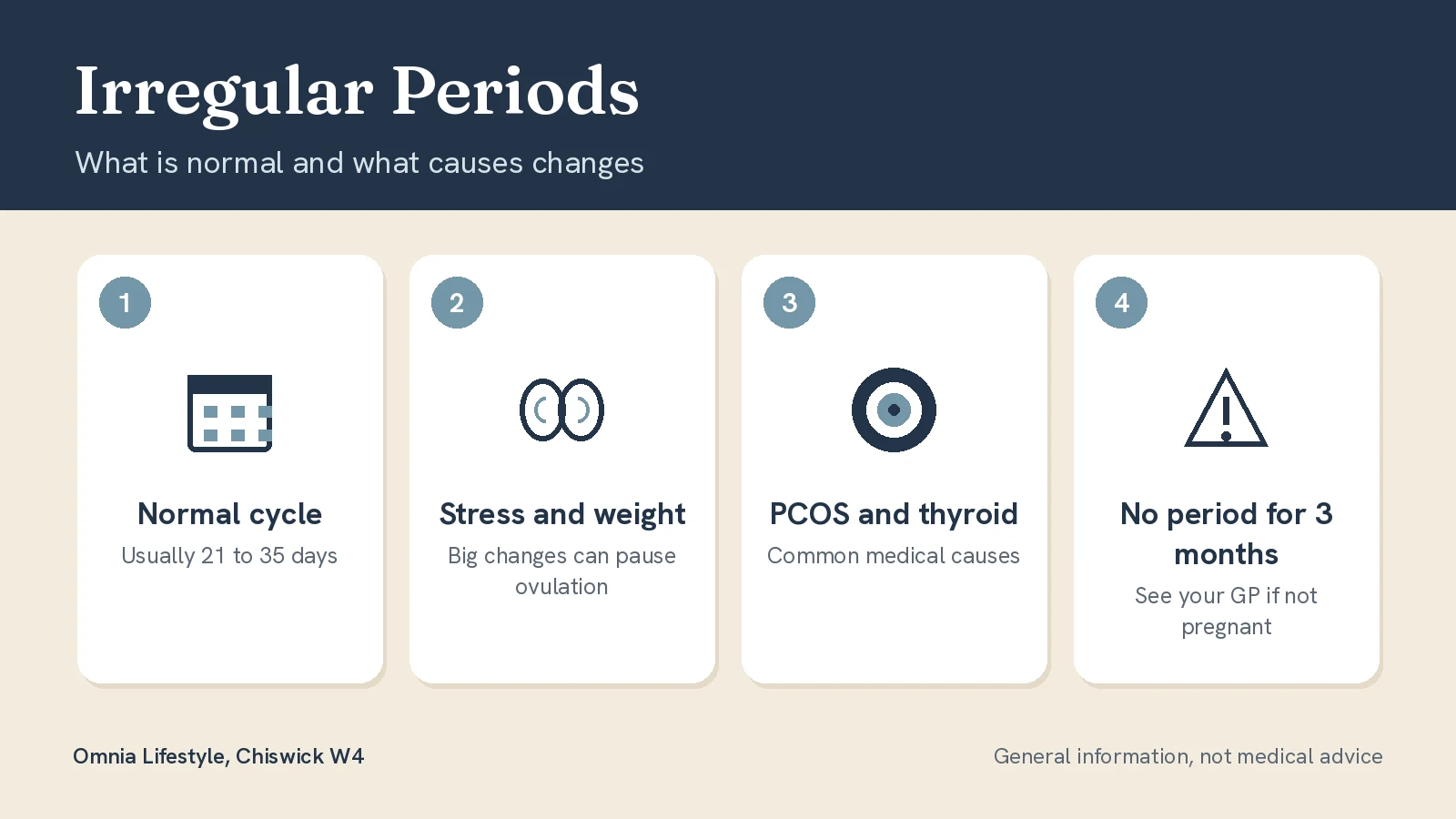
A normal menstrual cycle, counted from the first day of one period to the first day of the next, is usually 21 to 35 days, with bleeding for two to seven days. Periods are irregular if the length of your cycle keeps changing, you miss periods, or you bleed between periods. Common causes are puberty, the perimenopause, stress, significant weight change, intense exercise, PCOS, thyroid problems, hormonal contraception and breastfeeding. Always take a pregnancy test first if a period is late. See your GP if your periods stop for three months or more, or are very irregular.
What is a normal menstrual cycle?
- Cycle length: usually 21 to 35 days in adults, averaging around 28 days
- Period length: usually two to seven days
- Variation: a difference of a few days between cycles is normal
- Teenagers: cycles are often irregular for the first two years after periods start
- The perimenopause: cycles often become shorter, longer or less predictable in your 40s
Tracking your cycle in an app or diary for a few months is the best way to see your own pattern.
Causes of irregular periods
- Polycystic ovary syndrome (PCOS). A common cause of infrequent or absent periods, often with acne, excess hair growth or weight gain. See losing weight with PCOS
- Thyroid problems. Both an underactive and an overactive thyroid can change your cycle
- Stress, which can delay or stop ovulation
- Significant weight loss or gain
- Intense exercise, especially with low energy intake
- Hormonal contraception, including the pill, implant, injection and hormonal coil
- Breastfeeding and the months after having a baby
- The perimenopause
- A raised prolactin level, sometimes caused by medicines
- Premature ovarian insufficiency, when periods stop before the age of 40
Missed period causes other than pregnancy
If a pregnancy test is negative, a missed period is most often caused by stress, illness, travel, weight change, intense exercise, PCOS or starting or stopping hormonal contraception. A single missed period that is followed by a normal cycle is rarely a concern. If you miss periods for three months or more, see your GP.
What about bleeding between periods?
Spotting between periods can happen with hormonal contraception or around ovulation. Bleeding between periods or after sex can also be caused by infections, cervical changes or polyps, so it should always be checked by your GP. Make sure your cervical screening is up to date.
How irregular periods are investigated
Your GP will ask about your cycle, symptoms, weight, exercise, stress, medicines and contraception, and arrange a pregnancy test. Blood tests may check hormones such as FSH, LH, testosterone and prolactin, and thyroid function. A pelvic ultrasound may be arranged if PCOS or another cause is suspected.
How irregular periods are treated
Treatment depends on the cause. Managing stress, reaching a healthy weight and balancing exercise with enough food can bring cycles back. PCOS may be treated with the pill or other medicines, and thyroid problems with thyroid medicines. If you are trying to conceive, your GP can discuss support with ovulation.
When to seek medical help
Call 999 if you have:
- Sudden severe tummy pain, shoulder tip pain or fainting when you are, or could be, pregnant
Get same-day medical advice, from your GP or NHS 111, if:
- You have a positive pregnancy test with pain or bleeding
- You are bleeding very heavily, soaking through protection every hour
See your GP if:
- Your periods have stopped for three months or more and you are not pregnant
- Your cycle is regularly shorter than 21 days or longer than 35 days
- Your periods have become irregular and you are under 45
- You bleed between periods, after sex or after the menopause
- You are struggling to get pregnant
Frequently asked questions
Are irregular periods normal?
A small variation is normal, and irregular periods are common in teenagers and in the perimenopause. Ongoing irregularity at other times is worth checking.
Can stress cause irregular periods?
Yes. Stress can delay ovulation, making a period late or causing a missed period.
Can you get pregnant with irregular periods?
Yes, although it can be harder to predict ovulation. See getting pregnant with PCOS.
How do I regulate my periods naturally?
Regular sleep, managing stress, eating enough and keeping a healthy weight help many people. Treating any underlying condition is also important.
Menstrual health support in Chiswick
Menstrual health is supported at Omnia Lifestyle in Chiswick, W4, close to Turnham Green station, on bus routes 94, E3 and 272. Limited parking is available on request when booking. We take a detailed cycle history, can arrange hormone and thyroid blood tests and share them with your GP, and offer acupuncture, yoga and Ayurvedic diet and routine guidance alongside your medical care.
Read more about menstrual disorders and PCOS, see heavy periods, when the menopause starts and underactive thyroid symptoms, explore blood tests, acupuncture and Ayurveda, or book an appointment.
This article is general information, not medical advice. If you have any of the warning signs listed above, seek medical attention.



.jpg)
.jpg)