






Book at our Chiswick clinic
Blood Test
Insulin is the hormone made by your pancreas that moves sugar (glucose) out of your blood and into your cells, where it is used for energy. When your cells stop responding well to insulin, your pancreas has to make more of it to keep blood sugar steady. This is known as insulin resistance, and over time it can lead to prediabetes and type 2 diabetes.
A fasting insulin test measures how much insulin is in your blood after an overnight fast. This guide explains what the result can and cannot tell you, how it differs from the tests the NHS uses to diagnose diabetes, what HOMA-IR is, and what you can do to improve how your body handles sugar.
Test it in Chiswick: our Diabetes Status blood test costs £69, with your result explained in person by a practitioner. No GP referral needed. Book this test or call 020 4515 0000. Prefer to test at home? A home finger-prick kit is also available, ask us when you enquire.
Quick answer
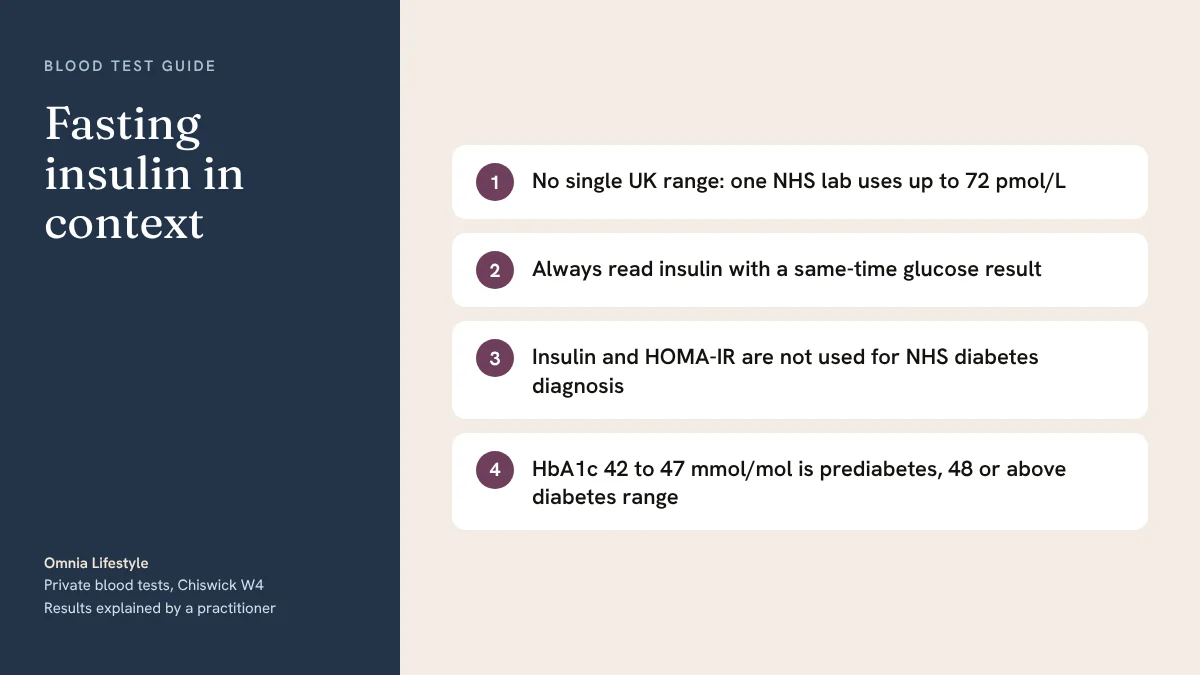
Fasting insulin has no single UK "normal" range. Each laboratory sets its own and units differ: one NHS laboratory uses up to 72 pmol/L for fasting insulin, another uses 2.0 to 25.0 mIU/L. Insulin must be read alongside your glucose level at the same time. Fasting insulin and HOMA-IR are not used to diagnose diabetes in the NHS. Diagnosis uses HbA1c or glucose: an HbA1c of 42 to 47 mmol/mol indicates prediabetes, and 48 mmol/mol or above is in the diabetes range.
What is insulin resistance?
Diabetes UK describes insulin resistance as when your body's cells do not respond properly to insulin, so blood sugar can rise. To compensate, the pancreas makes more insulin. As long as it can keep up, blood sugar may stay in the healthy range for years, which is why some people have a raised insulin level with a normal HbA1c.
Insulin resistance is not the same as diabetes. It can affect people with and without diabetes, and at any weight, although it is more common with excess weight. Diabetes UK notes it is also more common during puberty, pregnancy and the menopause, and is linked with polycystic ovary syndrome (PCOS) and fat stored in and around the liver and pancreas.
Fasting insulin and HOMA-IR: an honest explanation
In NHS hospitals, insulin is mainly measured to investigate unexplained low blood sugar (hypoglycaemia), and laboratories stress that it should always be interpreted together with a glucose result taken at the same time. It is not part of routine NHS testing for diabetes or prediabetes.
HOMA-IR is a score calculated from your fasting insulin and fasting glucose. It was developed for research and is used by some private clinics as an estimate of insulin resistance. It is not used for diagnosis in the NHS, and there is no agreed UK cut-off. Insulin results can also vary between laboratory methods, so a number from one clinic may not match another.
That does not make the test useless. Seen alongside HbA1c, glucose, weight, waist size, blood pressure and cholesterol, a fasting insulin result can help a practitioner build a fuller picture of your metabolic health and track change over time. It simply should not be read on its own.
What your result means
Always use the range printed on your report, as ranges and units vary between laboratories. As a guide:
- Low insulin: can be expected after a long fast with normal glucose. A very low insulin with high glucose can be a sign that the pancreas is not making enough insulin, as in type 1 diabetes, and needs medical review.
- Within the laboratory range: for example up to 72 pmol/L fasting at one NHS laboratory. Your practitioner will read this with your glucose and HbA1c.
- Above the laboratory range: raised fasting insulin can be seen with insulin resistance, type 2 diabetes and obesity, and more rarely with conditions such as Cushing's syndrome, acromegaly or an insulin-producing tumour (insulinoma). It is a reason for a conversation, not a diagnosis.
How the NHS diagnoses prediabetes and diabetes
- HbA1c below 42 mmol/mol: not in the prediabetes or diabetes range.
- HbA1c 42 to 47 mmol/mol: prediabetes, meaning a higher risk of type 2 diabetes.
- HbA1c 48 mmol/mol or above: in the diabetes range. If you have no symptoms, a second test is needed to confirm it.
A fasting plasma glucose of 7.0 mmol/L or above is also in the diabetes range. Read more in our guide to HbA1c levels explained.
Symptoms
Insulin resistance often has no symptoms. Diabetes UK notes that some people notice tiredness, difficulty concentrating and hunger. If it progresses to type 2 diabetes, the NHS lists symptoms such as feeling very tired, peeing more than usual, feeling thirsty all the time, losing weight without trying, blurred vision, cuts that heal slowly, and itching around the genitals or repeated thrush.
What raises the risk of insulin resistance?
- Carrying extra weight, especially around the middle
- Being physically inactive
- Fat stored in and around the liver and pancreas
- Polycystic ovary syndrome (PCOS)
- Life stages such as puberty, pregnancy and the menopause
- A family history of type 2 diabetes
How to improve insulin sensitivity
Diabetes UK says losing weight, if you need to, can improve how your body uses insulin, and that increasing your activity levels can also help. Practical steps include:
- move more each day and build up regular activity you enjoy
- aim for gradual, sustainable weight loss if you are carrying extra weight
- cut down on sugary drinks and snacks and choose wholegrain, high fibre foods
- keep alcohol within recommended limits
If you have prediabetes, your GP can refer you to the NHS Diabetes Prevention Programme for support with diet, activity and weight.
When to see a GP or get urgent help
See your GP if you have symptoms of diabetes, if your HbA1c is 42 mmol/mol or above, or if you do not have diabetes but get symptoms of low blood sugar such as shaking, sweating, a fast heartbeat and feeling confused.
Call 999 if someone has very low blood sugar and is not responding normally or is unconscious. Call 999 or go to A&E if you have symptoms of diabetic ketoacidosis, such as feeling very thirsty, peeing more often, stomach pain or being sick, breathing more deeply than usual, breath that smells fruity, or feeling sleepy or confused. The NHS says this applies even if you have not been diagnosed with diabetes.
Who should consider testing?
- People with a family history of type 2 diabetes
- People who are overweight, especially around the waist
- Women with PCOS or a history of gestational diabetes
- Anyone with high triglycerides, fatty liver or high blood pressure
- People who want a baseline before making diet and lifestyle changes
Preparing for your test
Fasting insulin and fasting glucose need a fasting sample, so do not eat for at least 8 hours beforehand, usually overnight. Water is fine. Book a morning appointment and avoid strenuous exercise just before. Tell your practitioner about any diabetes medicines, steroids or supplements you take, including biotin, which can affect some laboratory tests.
How often should you retest?
If your results are reassuring, there is no need for frequent repeat tests. If you are making changes to improve insulin sensitivity, your practitioner may suggest repeating your HbA1c and fasting tests after a few months. NHS guidance recommends that people with prediabetes are offered an HbA1c check every year at their GP practice.
Frequently asked questions
What is a normal fasting insulin level?
There is no single UK figure. One NHS laboratory uses up to 72 pmol/L, another 2.0 to 25.0 mIU/L. Check the range and units on your own report and read it with your glucose result.
Can you have insulin resistance with a normal HbA1c?
Yes. In the early stages, the pancreas can make extra insulin and keep blood sugar normal. This is why some people look at fasting insulin, but it is not an NHS diagnostic test.
Is HOMA-IR used by the NHS?
Not for diagnosis. The NHS uses HbA1c or glucose to diagnose prediabetes and type 2 diabetes. HOMA-IR is mainly a research tool and has no agreed UK cut-off.
Can insulin resistance be reversed?
Diabetes UK says weight loss and more activity can improve how your body uses insulin. Results vary from person to person, so it is worth tracking progress with your practitioner or GP.
Do I need to fast for an insulin test?
Yes, for a fasting insulin result. Fast for at least 8 hours, usually overnight, drinking only water.
Insulin testing in Chiswick
We take your blood sample at our clinic at 8 to 9 Bedford Corner, The Avenue, Chiswick, London W4 1LZ, a short walk from Turnham Green station on the District line (Piccadilly line trains stop there early morning and late evening only), and on the 94, E3 and 272 bus routes. Limited parking is available on request when you book. Your sample is analysed at the Randox accredited laboratory, most results are back within a few working days, and a practitioner talks you through what your result means. No GP referral is needed, and we can send a GP feedback report on request.
Our Diabetes Status test includes insulin, glucose, HbA1c and C-peptide, so your insulin result can be read in context. A single Insulin test is also available, and our Insulin Resistance Check (HOMA-IR) costs £99. You can also compare every blood test and price, or read our guides to HbA1c levels and triglyceride levels.
This article is general information, not medical advice. Discuss your results with your GP or practitioner.
Ready to book?
Blood Test




.jpg)
.jpg)
