






Book at our Chiswick clinic
Blood Test
Homocysteine is an amino acid your body makes when it breaks down methionine, a building block found in protein foods. Normally it is quickly recycled or cleared, a process that depends on folate, vitamin B12 and vitamin B6. When any of these run low, homocysteine can build up in the blood.
A raised homocysteine level has been linked in research with heart disease, stroke and blood clots, which is why many people ask for the test. The evidence on what to do about it is more mixed than many websites suggest. This guide explains the usual range, what can raise homocysteine, what the research really shows and when to seek help.
Test it in Chiswick: our Homocysteine blood test costs £99, with your result explained in person by a practitioner. No GP referral needed. Book this test or call 020 4515 0000. Prefer to test at home? A home finger-prick kit is also available, ask us when you enquire.
Quick answer
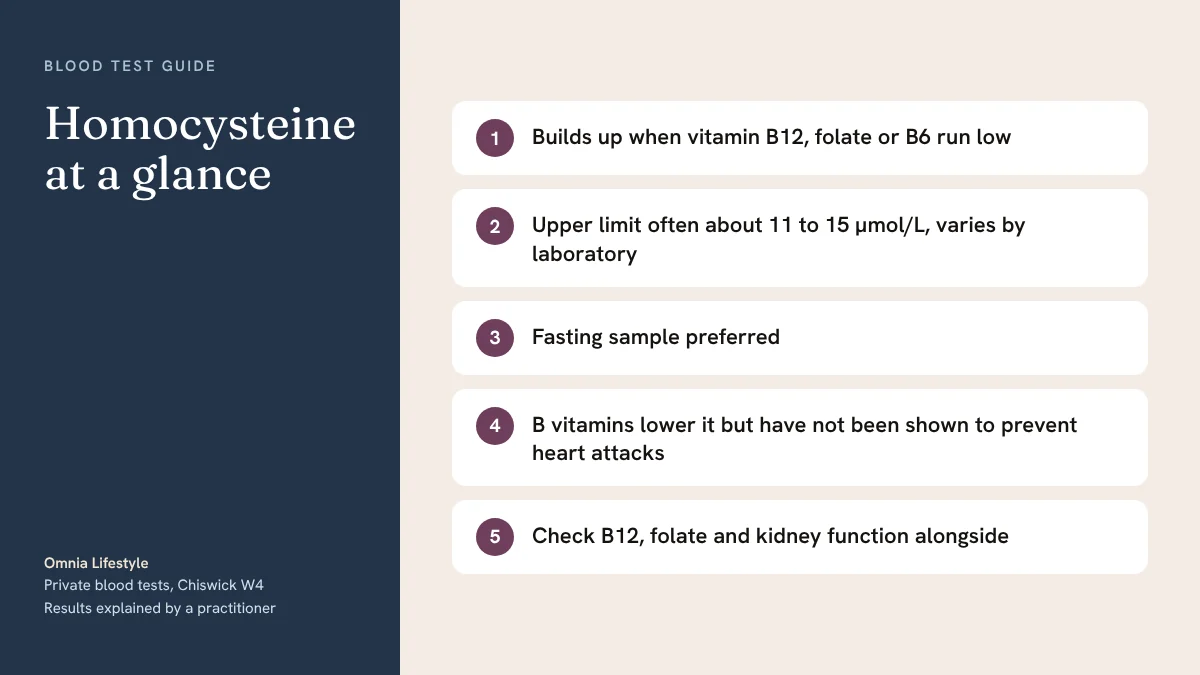
Homocysteine is measured in µmol/L. Laboratories set slightly different upper limits, typically somewhere between about 11 and 15 µmol/L, and some use separate limits for men and women. The most common reasons for a raised level are low vitamin B12, low folate and, less often, low B6, along with reduced kidney function and some medicines. People with high homocysteine have higher rates of heart disease and stroke, but large trials found that lowering it with B vitamins did not reduce heart attacks or deaths. A raised result is best used as a prompt to check B12, folate and kidney function.
What is homocysteine?
Your cells handle homocysteine in two main ways. Folate and vitamin B12 work together to turn it back into methionine, and vitamin B6 helps convert it into another amino acid, cysteine. If either pathway slows down, homocysteine levels rise.
How B12, folate and B6 are involved
Because homocysteine depends on these vitamins, a raised level can be an early clue to a B12 or folate shortage, sometimes before anaemia or other changes appear. This is one of the most practical reasons to measure it. Testing B12 and folate alongside homocysteine helps explain the result. Our guides to vitamin B12 levels and folate levels explain those tests.
What your result means
- Within range (below your laboratory's upper limit, often about 11 to 15 µmol/L): homocysteine is being handled normally.
- Mildly raised (just above the upper limit): common, and often linked to low B12 or folate, reduced kidney function, smoking or alcohol. Worth discussing with your practitioner and checking B12, folate and kidney function.
- Markedly raised (well above the upper limit): may point to a significant B12 or folate deficiency or, rarely, an inherited condition. This needs review by your GP.
Ranges vary between laboratories, so compare your result with the range printed on your own report.
What can raise homocysteine?
- Low vitamin B12: the NHS lists pernicious anaemia as the most common cause of B12 deficiency in the UK. A vegan diet without fortified foods or supplements, and medicines such as metformin and proton pump inhibitors (PPIs), can also lower B12.
- Low folate: often from a diet low in leafy greens, pulses and fortified foods. Regular heavy drinking and some medicines, including methotrexate and certain anti-seizure medicines, can also lower folate.
- Low vitamin B6: less common, but it can contribute.
- Reduced kidney function: the kidneys help clear homocysteine, so levels rise as kidney function falls.
- Lifestyle: smoking and heavy drinking are linked to higher levels.
- Inherited factors: common variations in the MTHFR gene can nudge levels up, mainly when folate is low. Rare inherited conditions such as homocystinuria cause very high levels and are usually picked up in childhood.
High homocysteine and heart risk: what the evidence shows
Large observational studies have found that people with higher homocysteine are more likely to have heart attacks, strokes and blood clots. This led to the hope that lowering homocysteine with B vitamins would reduce that risk.
That hope has not been borne out for heart attacks. A Cochrane review published in 2017, which pooled 15 randomised trials involving more than 71,000 people, found that B vitamin supplements lowered homocysteine but did not reduce heart attacks or deaths from any cause. There may be a small reduction in stroke, but the evidence for this is less certain. In other words, homocysteine looks more like a marker that travels with heart risk than a direct cause that vitamins can fix.
Homocysteine is not part of the standard heart risk calculators used in UK general practice. The things that make the biggest difference remain not smoking, keeping blood pressure, cholesterol and blood sugar in a healthy range, staying active and keeping to a healthy weight. Our Heart Health test (£89) covers cholesterol and wider cardiovascular markers, and our heart health blood tests page compares the options.
What to do about a high result
A raised homocysteine result starts a conversation rather than giving a diagnosis. The most useful next step is usually to check vitamin B12, folate and kidney function. If a deficiency is found, treating it matters for its own sake, because low B12 or folate can cause anaemia, tiredness and, in the case of B12, nerve problems.
Do not start high-dose folic acid on your own before your B12 has been checked. Folic acid can improve some blood test changes while a B12 deficiency continues to affect the nerves. Our Vitamin B12 (£49) and Folate (£49) tests are available on their own, and the Vitamin B Profile (£329) covers B12, active B12, folate, B1 and B6.
When to see your GP or get urgent help
Call 999 if you have signs of a heart attack, such as chest pain or pressure that may spread to your arms, neck, jaw or back, or signs of a stroke, such as a drooping face, weakness in one arm or slurred speech. Also call 999 if you suddenly become breathless or have chest pain that is worse when you breathe in, as this can be a clot in the lung.
Get an urgent GP appointment or call NHS 111 if you have pain, swelling and warmth in one leg, which can be a sign of a blood clot (DVT).
Book a routine GP appointment if your homocysteine is raised and you have symptoms of B12 or folate deficiency, such as tiredness, pins and needles, a sore tongue, mouth ulcers or memory problems, or if you have a strong family history of early heart disease, stroke or blood clots.
Who might consider a homocysteine test
- People with symptoms or risk factors for B12 or folate deficiency, including a vegan diet or long-term metformin or PPIs
- People with reduced kidney function
- People with a strong family history of early heart disease, stroke or clots who want a fuller picture, interpreted alongside cholesterol and blood pressure
Preparing for the test
A fasting sample is preferred, so fast overnight if you can and drink only water before your appointment. A morning appointment makes this easier. Tell your practitioner about any B vitamin or folic acid supplements, as these lower homocysteine and help explain your result. The sample needs to be processed promptly, which our clinic arranges for you.
How often to retest
If your result is in range, routine repeat testing is not usually needed. If a B12 or folate deficiency is being treated, your practitioner or GP can advise when a repeat test is worthwhile, once treatment has had time to work.
Frequently asked questions
Is a homocysteine level of 15 high?
It depends on your laboratory. A level of 15 µmol/L is at or above the upper limit in many UK laboratories. It is worth checking B12, folate and kidney function and discussing the result with your practitioner.
Can high homocysteine be lowered?
Yes. Correcting a B12 or folate deficiency usually brings homocysteine down. Stopping smoking and cutting down on alcohol may also help.
Should I take B vitamins for high homocysteine?
If you are deficient, yes, on the advice of your GP or practitioner. If you are not deficient, taking B vitamins to lower homocysteine has not been shown to prevent heart attacks. Always have B12 checked before taking high-dose folic acid.
Does high homocysteine mean I will have a heart attack?
No. It is linked with higher risk on average, but it does not predict what will happen to one person. Your overall risk depends far more on factors such as smoking, blood pressure, cholesterol, diabetes and family history.
Do I need to fast for a homocysteine test?
A fasting sample is preferred. Fast overnight and drink only water before your appointment if you can.
Homocysteine testing in Chiswick
We take your sample at our clinic at 8 to 9 Bedford Corner, The Avenue, Chiswick, London W4 1LZ. We are a short walk from Turnham Green station (District line, with Piccadilly line trains stopping there early morning and late evening only) and close to the 94, E3 and 272 bus routes. Limited parking is available on request when you book. Your sample is analysed at the Randox accredited laboratory, no GP referral is needed, and most results are ready within a few working days. A practitioner explains your result with you in person, and a GP feedback report is available on request.
Book the Homocysteine blood test, or choose the Vitamin B Profile to check the vitamins behind it. You can also compare every blood test and price, or read our guides to vitamin B12 levels and folate levels.
This article is general information, not medical advice. Discuss your results with your GP or practitioner.
Ready to book?
Blood Test




.jpg)
.jpg)
