








Book at our Chiswick clinic
Blood Test
GGT, short for gamma-glutamyltransferase (sometimes written gamma GT), is an enzyme found mainly in the liver and bile ducts. A GGT blood test measures how much of it is in your blood. GGT is very sensitive: it rises with many things that put the liver under strain, including alcohol, fatty liver and some medicines, so a high GGT is a common finding in people who feel completely well.
This guide goes deeper on GGT alone: what a high result means, typical ranges, when to retest and when to get help. For the full set of liver markers, see our liver function test results guide.
Test it in Chiswick: our GGT blood test costs £49, with your result explained in person by a practitioner. No GP referral needed. Book this test or call 020 4515 0000. Prefer to test at home? See our home kit options.
Better value: our Liver Function Check also costs £49 and measures GGT together with ALT, AST, ALP, bilirubin and albumin, so for most people it is the better choice. Book the Liver Function Check.
Quick answer
GGT is a liver and bile duct enzyme. As an example, one NHS laboratory uses 10 to 71 IU/L for men and 6 to 42 IU/L for women, but ranges vary by laboratory, so check the range on your report. A raised GGT is most often linked to alcohol, fatty liver or medicines. On its own it is sensitive but not specific, so it is read alongside the other liver tests. A result outside the range is a prompt to look for the reason, not a diagnosis. Yellow skin or eyes need urgent advice.
What is GGT?
GGT sits on the surface of cells in the liver and bile ducts. When the liver is exposed to alcohol or certain medicines it can make more GGT, and when bile flow is slowed, GGT leaks into the blood. That is why GGT can rise even when the liver is not damaged. It is reported in IU/L or U/L (units per litre).
One of its most useful roles is explaining a raised alkaline phosphatase (ALP). If ALP and GGT are both raised, the liver or bile ducts are the more likely source. If ALP is high and GGT is normal, bone is more likely. Our ALP levels guide covers this in more detail.
Normal GGT levels
Each laboratory sets its own range, so always use the one printed on your report. As an example, one NHS laboratory uses:
- Men: 10 to 71 IU/L
- Women: 6 to 42 IU/L
GGT tends to be higher in men and can creep up with age and body weight. A result just above the range is common and often settles once the cause is addressed.
An isolated raised GGT
An isolated raised GGT means GGT is high while ALT, ALP, bilirubin and albumin are normal. This very common pattern usually points to alcohol, fatty liver or a medicine that boosts GGT production, rather than serious liver disease. Because GGT is sensitive but not specific, it is never used alone to diagnose a condition. The overall pattern, and whether the rise persists, matter more than the number itself.
Common causes of a high GGT
Alcohol
Regular drinking is one of the most common reasons for a raised GGT, even within amounts some people consider moderate. The NHS advises keeping to no more than 14 units a week, spread over three or more days. GGT can take several weeks to settle after cutting down, so our liver guide suggests stopping alcohol for at least 4 weeks before a repeat test.
Fatty liver (MASLD)
Metabolic dysfunction-associated steatotic liver disease is common in people who carry weight around the waist or have type 2 diabetes, high blood pressure or high cholesterol. GGT and ALT are often both mildly raised. Our guide to blood tests for fatty liver explains how it is assessed, including the FIB-4 score.
Medicines
Some medicines increase GGT production without harming the liver, including certain epilepsy medicines such as phenytoin and carbamazepine. Others can affect bile flow. Do not stop a prescribed medicine without speaking to your GP.
Bile duct problems
Gallstones or narrowing of the bile ducts can slow bile flow and raise GGT and ALP together, sometimes with bilirubin. This pattern needs review, particularly with pain in the upper right tummy.
Smoking, obesity and diabetes are also linked with a higher GGT.
What usually happens after a high GGT
- Look at the whole liver profile. An isolated rise is handled differently from a rise in several markers.
- Review alcohol, weight and medicines. These explain most raised results.
- Recheck after changes to see whether GGT is falling.
- Further tests if it persists. Your GP may suggest an ultrasound or a broader liver screen.
When to get urgent help
- Ask for an urgent GP appointment or contact NHS 111 if your skin or the whites of your eyes look yellow, or you notice dark pee, pale poo or itchy skin.
- Get same-day medical advice if you have pain in the upper right side of your tummy with a high temperature or shivering.
- Call 999 or go to A&E if you vomit blood, have black poo, or feel very confused or drowsy.
Do not wait for a private blood test result in any of these situations.
Who should consider a GGT test?
- People who drink regularly or want to check their liver after cutting down
- People with risk factors for fatty liver, such as extra weight around the waist or type 2 diabetes
- Anyone with a raised ALP who wants to know whether the liver is the likely source
- Anyone following up a previous raised GGT
Preparing for your test
You do not usually need to fast for a GGT test, but we will tell you if another test in your booking needs it. Avoid alcohol for at least 24 hours beforehand, and tell us about prescribed medicines, supplements and herbal remedies.
How often to retest
If alcohol is a likely cause, a repeat after at least 4 weeks without alcohol is a sensible first step. After a medicine change or weight loss, a recheck after 1 to 3 months is common. Your GP will advise if further tests are needed.
Frequently asked questions
Is a GGT of 100 high?
It is above most laboratory ranges. It is worth reviewing alcohol, weight and medicines with your GP, checking the other liver markers and planning a recheck.
Can GGT go back to normal?
Often, yes. GGT usually falls once the cause is removed, although it can take several weeks after stopping alcohol.
Does a high GGT always mean I drink too much?
No. Fatty liver, medicines and other conditions can raise GGT in people who drink little or no alcohol.
What is the difference between GGT and ALT?
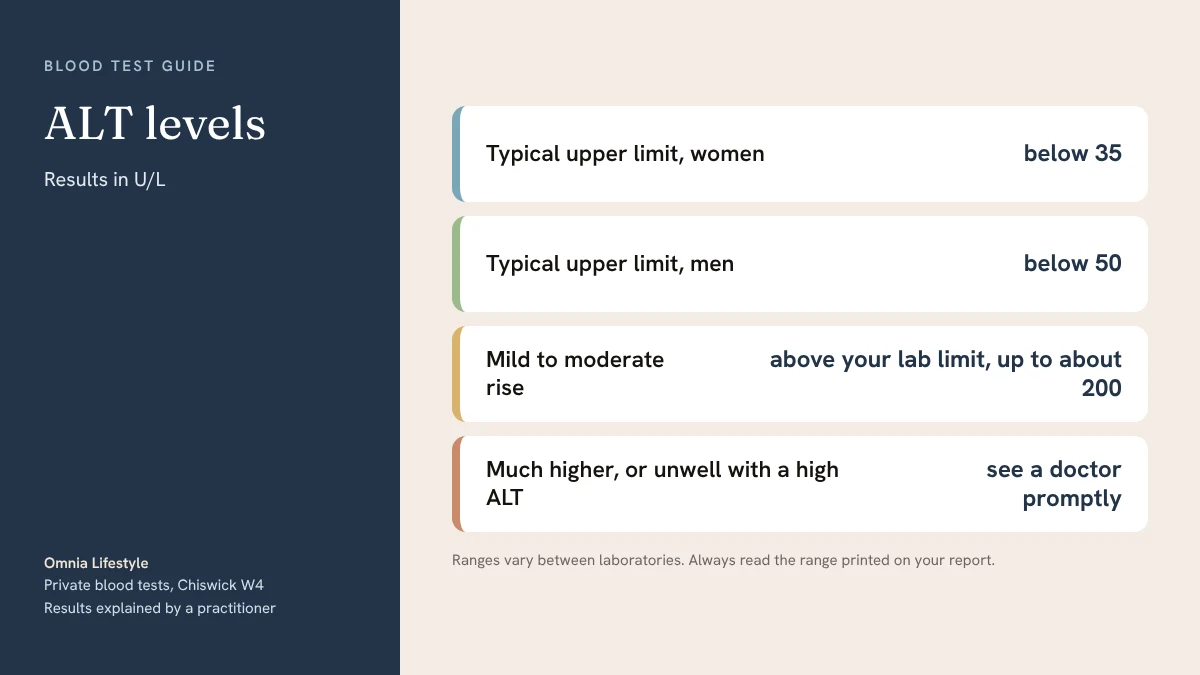
ALT reflects irritation of liver cells, while GGT is more linked to bile ducts and enzyme production. Our ALT levels guide explains ALT in detail.
GGT testing in Chiswick
We take your blood sample at our clinic at 8 to 9 Bedford Corner, The Avenue, Chiswick, London W4 1LZ, a short walk from Turnham Green station on the District line (Piccadilly line trains stop there early morning and late evening only), and on the 94, E3 and 272 bus routes. Limited parking is available on request when you book. Your sample is analysed by the Randox laboratory, and a practitioner talks you through what your result means. No GP referral is needed, and we can send a GP feedback report on request.
Book a single GGT blood test, or check GGT alongside five more markers with our Liver Function Check. You can also compare every blood test and price, read our liver function test results guide, or learn about blood tests for fatty liver.
This article is general information, not medical advice. Discuss your results with your GP or practitioner.
Ready to book?
Blood Test




.jpg)
.jpg)
