








Book at our Chiswick clinic
Blood Test
eGFR stands for estimated glomerular filtration rate. It is a number that shows roughly how well your kidneys are filtering waste from your blood. It is not measured directly. Instead, the laboratory calculates it from your creatinine level, your age and your sex. A lower eGFR suggests the kidneys are filtering less efficiently, but one result on its own does not mean you have kidney disease.
This guide focuses on the eGFR number itself: how it is calculated, what different values can mean, why it can change from one test to the next, when cystatin C helps, when to retest and when to get urgent help. For creatinine, urea, electrolytes and urine ACR, see our kidney function test results guide.
Test it in Chiswick: our Kidney Health Check costs £49 and reports eGFR together with creatinine, urea, sodium, potassium, chloride, calcium, phosphate, magnesium and albumin, with your result explained in person by a practitioner. No GP referral needed. Book this test or call 020 4515 0000.
Want a second measure? Our Kidney Health Extended costs £79 and adds cystatin C and uric acid, which can help when eGFR from creatinine is borderline. See the kidney function test page for both options.
Quick answer
An eGFR of 90 or above is generally reported as normal, and 60 to 89 is common, especially with age. On its own, a value of 60 or more does not mean kidney disease unless there are other signs of kidney damage, such as protein in the urine. An eGFR below 60 that lasts for more than 3 months is one of the ways chronic kidney disease (CKD) is defined. Ranges and reporting vary by laboratory. A single low result is a prompt to repeat the test, not a diagnosis.
How eGFR is calculated
Your kidneys contain about a million tiny filters called glomeruli. The glomerular filtration rate is the volume of blood they clean each minute. Measuring it directly is complicated, so laboratories estimate it from creatinine, a waste product from muscle, using an equation. NICE guidance (NG203) recommends the CKD-EPI creatinine equation and advises that it is used without an adjustment for ethnicity.
eGFR is reported in mL/min/1.73m², which adjusts for an average body size. Many laboratories report values above 90 simply as more than 90, because the equation is less precise at the higher end.
What your eGFR number means
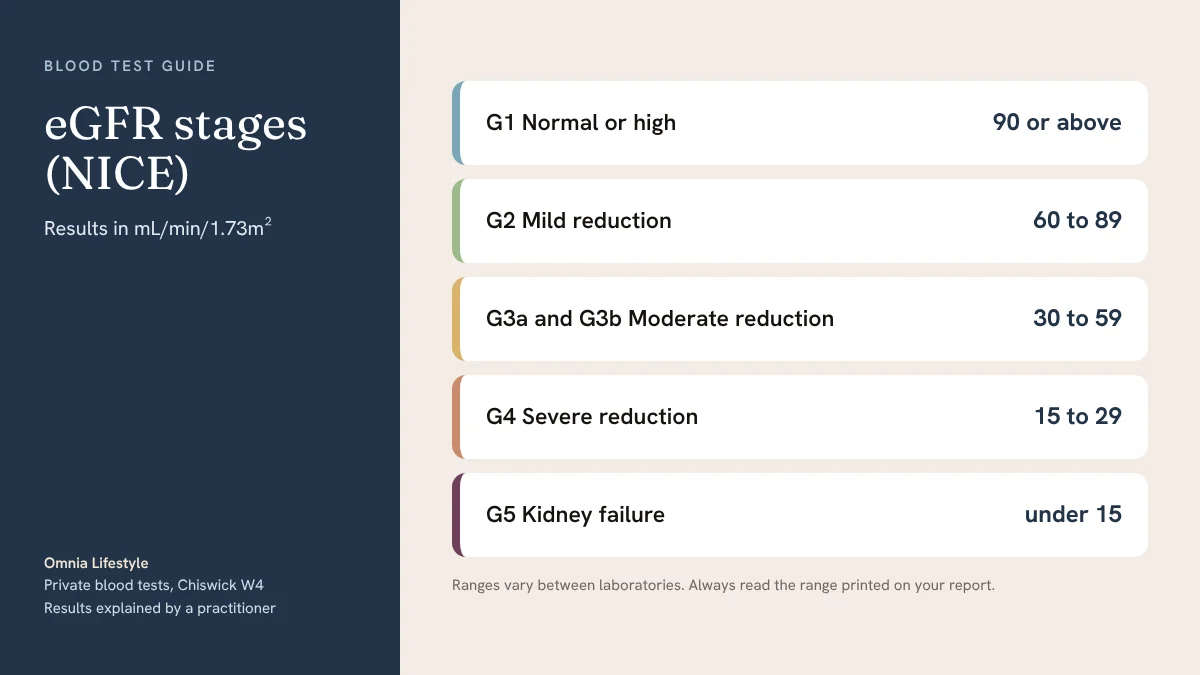
NICE uses eGFR to place kidney function into categories:
- 90 or above (G1): normal or high
- 60 to 89 (G2): mildly reduced, very common with age and usually not CKD unless there are other signs of kidney damage
- 45 to 59 (G3a): mildly to moderately reduced
- 30 to 44 (G3b): moderately to severely reduced
- 15 to 29 (G4): severely reduced
- Below 15 (G5): kidney failure
CKD is only diagnosed when changes last for more than 3 months. Our kidney function guide covers the stages, urine ACR categories and referral thresholds in more detail.
Why eGFR can change between tests
Because eGFR is calculated from creatinine, anything that changes creatinine changes eGFR without the kidneys themselves changing:
- Dehydration, for example after illness, heat or not drinking enough
- Eating cooked meat in the 12 hours before the test, which can raise creatinine
- Muscle mass: very muscular people may have a lower eGFR, and people with low muscle mass may have a higher one
- Creatine supplements and some protein supplements
- Hard exercise in the day or two before the test
- Some medicines, including trimethoprim, which can raise creatinine without harming the kidneys
- Pregnancy, during which eGFR equations are not reliable
eGFR also falls slowly with age. A healthy person in their 70s may have an eGFR in the 60s or 70s.
When cystatin C helps
Cystatin C is another marker filtered by the kidneys, and it is less affected by muscle mass or diet. NICE suggests it can help confirm or rule out CKD when eGFR from creatinine is between 45 and 59 and there is no protein in the urine. A single cystatin C test costs £89, or it is included in the Kidney Health Extended. A related marker, creatinine, can be tested on its own for £59.
Common causes of a low eGFR
- Diabetes, one of the most common causes of CKD. Our HbA1c guide explains blood sugar testing.
- High blood pressure
- Heart disease and narrowing of the blood vessels
- Some long-term medicines, including regular anti-inflammatory painkillers
- Kidney stones, infections or blockages
- Family history of kidney disease
- Short-term causes such as dehydration or a recent illness
When to retest
NICE advises repeating a first eGFR below 60 within 2 weeks to rule out a sudden drop (acute kidney injury), then again after 3 months to see whether it persists. If you have a low result, avoid meat for 12 hours before the repeat, stay well hydrated and avoid hard exercise. A fall of 25% or more, or 15 or more in a year, is something your GP will want to know about.
When to get urgent help
- Contact your GP the same day or NHS 111 if you are passing much less urine than usual, have swelling in your legs, ankles or face, or feel very tired, sick or confused alongside a low eGFR.
- Call 999 or go to A&E if you have chest pain, severe breathlessness, or you stop passing urine.
See your GP soon if your eGFR is below 60 for the first time, if you have blood in your urine, or if your eGFR is below 30. Do not wait for a private blood test result if you feel very unwell.
Who should consider an eGFR test?
- People with diabetes, high blood pressure or heart disease
- People with a family history of kidney disease
- People who take regular anti-inflammatory painkillers or other medicines that affect the kidneys
- Anyone following up a previous low eGFR
Frequently asked questions
Is an eGFR of 58 bad?
It is just below 60. A single result like this is often repeated, as dehydration, meat or exercise can lower it. If it stays below 60 for 3 months, your GP will look at your urine and overall risk.
Can I improve my eGFR?
Some short-term factors, such as dehydration, can be corrected. For long-term kidney health, managing blood pressure, blood sugar and weight is important. Talk to your GP before making changes to medicines.
Is an eGFR of 75 normal at 65?
It is in the 60 to 89 band, which is common at that age and is not CKD on its own unless there are other signs of kidney damage.
eGFR testing in Chiswick
We take your blood sample at our clinic at 8 to 9 Bedford Corner, The Avenue, Chiswick, London W4 1LZ, a short walk from Turnham Green station on the District line (Piccadilly line trains stop there early morning and late evening only), and on the 94, E3 and 272 bus routes. Limited parking is available on request when you book. Your sample is analysed by the Randox laboratory, and a practitioner talks you through what your result means. No GP referral is needed, and we can send a GP feedback report on request.
Book our Kidney Health Check, or test creatinine or cystatin C on their own. You can also compare every blood test and price, read our kidney function test results guide or our guide to sodium and potassium levels.
This article is general information, not medical advice. Discuss your results with your GP or practitioner.
Ready to book?
Blood Test




.jpg)
.jpg)
