






Book at our Chiswick clinic
Blood Test
A kidney function test checks how well your kidneys are filtering waste from your blood. The main result is your eGFR, an estimate worked out from a waste product called creatinine together with your age and sex. Most kidney panels also include urea and the salts sodium and potassium, and a urine test called ACR looks for protein leaking through the kidneys.
Kidney disease often causes no symptoms until it is advanced, so these numbers matter. This guide explains the NICE eGFR stages G1 to G5, what each marker means, which results need repeating and which need urgent care.
Test it in Chiswick: our Kidney Health Check blood test costs £49, with your result explained in person by a practitioner. No GP referral needed. Book this test or call 020 4515 0000. Prefer to test at home? A home finger-prick kit is also available, ask us when you enquire.
Quick answer
An eGFR of 90 or above is normal, and 60 to 89 is a mild reduction that is common with age. NICE uses stages G1 to G5, from G1 (90 or above) to G5 (under 15, kidney failure). Chronic kidney disease (CKD) means changes lasting more than 3 months, so an eGFR below 60 found for the first time should be repeated within 2 weeks. A urine ACR below 3 mg/mmol is normal. A potassium of 6.5 mmol/L or above needs emergency treatment.
What a kidney function test measures
- Creatinine: a waste product from muscle, cleared by the kidneys. One NHS laboratory uses 62 to 106 µmol/L for men and 44 to 80 µmol/L for women. Higher muscle mass gives a higher creatinine.
- eGFR: estimated glomerular filtration rate, in mL/min/1.73m². Healthy kidneys filter more than 90.
- Urea: a waste product from protein. It rises with dehydration as well as reduced kidney function. A common range is 2.5 to 7.8 mmol/L.
- Sodium: the main salt in blood, affected by fluid balance, medicines and hormones. A common range is 133 to 146 mmol/L.
- Potassium: vital for heart and muscle rhythm. A common range is 3.5 to 5.3 mmol/L.
- Urine ACR: albumin to creatinine ratio, which picks up small amounts of protein in urine, an early sign of kidney damage, especially with diabetes or high blood pressure.
Ranges vary between laboratories, so read the range printed on your report.
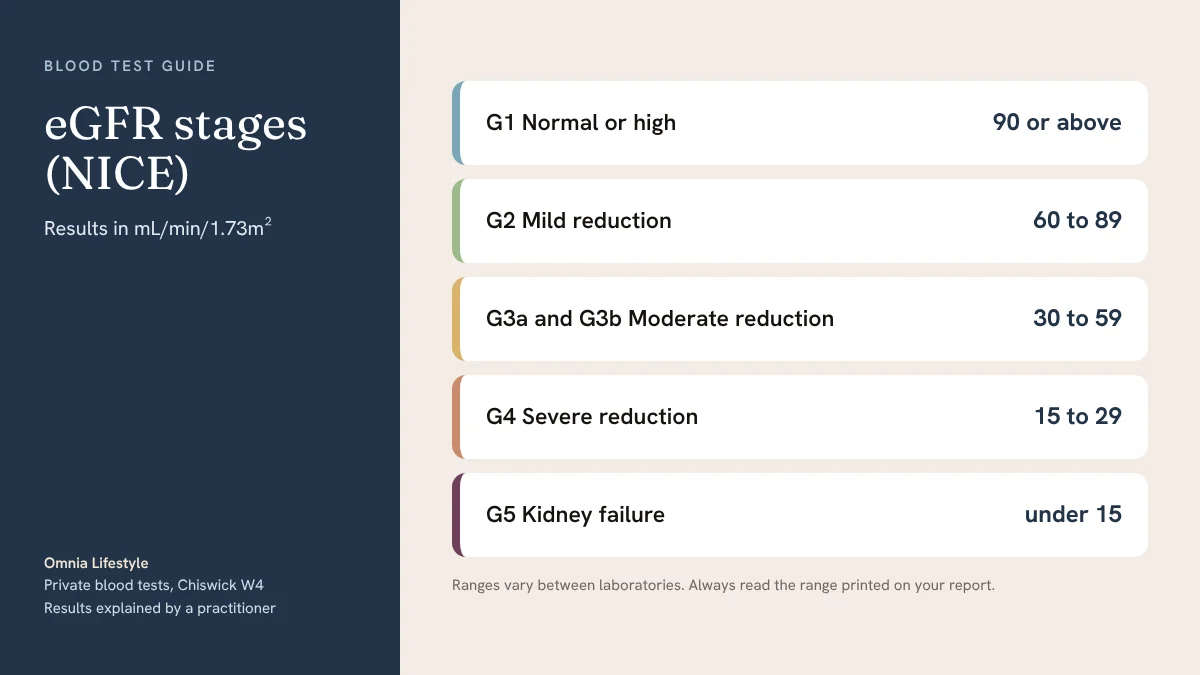
eGFR stages explained (NICE NG203)
- G1, 90 or above: normal or high. Only counts as CKD if there are other signs of kidney damage, such as protein in urine.
- G2, 60 to 89: mild reduction compared with a young adult. Again, only CKD if there are other signs of damage.
- G3a, 45 to 59: mild to moderate reduction.
- G3b, 30 to 44: moderate to severe reduction.
- G4, 15 to 29: severe reduction. NICE advises a kidney ultrasound scan at this level.
- G5, under 15: kidney failure.
NICE also groups urine ACR into A1 (under 3 mg/mmol, normal to mildly increased), A2 (3 to 30 mg/mmol, moderately increased) and A3 (over 30 mg/mmol, severely increased). Your eGFR stage and ACR stage are read together, for example G3a A1.
What your result means
- eGFR 60 or above with normal ACR: no sign of chronic kidney disease.
- eGFR below 60 for the first time: NICE advises repeating the test within 2 weeks to rule out a short-term drop, for example from dehydration, illness or a new medicine.
- eGFR below 60 for more than 3 months, or a raised ACR: this may mean chronic kidney disease, and your GP will look at the cause, your blood pressure and your heart risk.
- ACR between 3 and 70 mg/mmol: NICE advises confirming it with an early morning urine sample. An ACR of 70 mg/mmol or more does not need repeating and is a reason for specialist referral.
Things that can affect your result
- Eating meat in the 12 hours before the test can raise creatinine, so NICE advises avoiding it.
- NICE says eGFR is less reliable with high muscle mass or protein supplements, muscle wasting, amputation, pregnancy, fluid retention and acute kidney injury. A cystatin C test can help in these cases.
- Dehydration can raise urea and creatinine for a short time.
- A sample that takes many hours to reach the laboratory, or that is damaged when it is taken, can show a falsely high potassium. A surprising potassium result is usually repeated.
Symptoms
Early kidney disease rarely causes symptoms. Sudden kidney problems, called acute kidney injury, can cause passing much less urine than usual, feeling very thirsty, feeling or being sick, swollen feet or legs, tiredness, dizziness or confusion, and breathlessness, especially when lying down.
When a result needs a repeat or urgent care
- First eGFR below 60: repeat within 2 weeks (NICE).
- Potassium 5.5 to 5.9 mmol/L: NHS laboratory guidance advises a repeat within a week and a medicines review.
- Potassium 6.0 to 6.4 mmol/L: needs urgent same-day review and a heart tracing (ECG).
- Potassium 6.5 mmol/L or above: potentially life threatening and needs emergency hospital treatment.
- A sharp fall in eGFR: NICE treats a sustained fall of 25% or more with a change in stage within 12 months, or a fall of 15 or more in a year, as a reason for specialist referral.
- eGFR in stage G4 or G5: needs prompt GP review if it has not already been picked up.
Ask for an urgent GP appointment or contact NHS 111 if you have symptoms of acute kidney injury. Call 999 if someone is very drowsy, confused or struggling to breathe.
Who should test
NICE recommends kidney testing with eGFR and ACR for adults with diabetes, high blood pressure, heart or circulation disease, a previous acute kidney injury, kidney stones, an enlarged prostate, gout, lupus, a family history of kidney failure, or blood or protein found in the urine. Some long-term medicines, such as anti-inflammatory painkillers and lithium, can also affect the kidneys.
Preparing for the test and retesting
You do not need to fast, but avoid eating meat for 12 hours beforehand and drink water as normal. Tell us about protein shakes, creatine and any medicines. For a urine ACR, an early morning sample is best. How often to retest depends on your stage and your health, so your GP or practitioner will advise. A first eGFR below 60 should be repeated before any conclusion is drawn.
Frequently asked questions
Is an eGFR of 55 bad?
It falls in stage G3a, a mild to moderate reduction. If it is your first result below 60, NICE advises repeating it within 2 weeks. It only means chronic kidney disease if it stays below 60 for more than 3 months.
Is an eGFR of 75 normal?
It is stage G2, a mild reduction compared with a young adult. Without protein in the urine or other signs of damage, it is not classed as kidney disease.
Is a potassium of 5.6 dangerous?
It is mildly raised. It is usually repeated within a week, as a delayed or damaged sample can give a falsely high reading. Levels of 6.0 and above need urgent review.
Can dehydration affect a kidney blood test?
Yes. Dehydration can temporarily raise urea and creatinine and lower eGFR, which is one reason a first low eGFR is repeated.
Do I need to fast for a kidney function test?
No, but avoid meat for 12 hours beforehand, as NICE advises, and drink water as usual.
Kidney function testing in Chiswick
We take your sample at our clinic at 8 to 9 Bedford Corner, The Avenue, Chiswick, London W4 1LZ. We are a short walk from Turnham Green station (District line, with Piccadilly line trains stopping there early morning and late evening only) and close to the 94, E3 and 272 bus routes. Limited parking is available on request when you book. Your sample is analysed at the Randox accredited laboratory, no GP referral is needed, and most results are ready within a few working days. A practitioner explains your result with you in person, and a GP feedback report is available on request.
Book the Kidney Health Check, add the Urine Albumin to Creatinine Ratio test (£49), or choose Kidney Health Extended with cystatin C (£79) on the same page. You can also compare every blood test and price, read about uric acid levels, or see HbA1c levels explained.
This article is general information, not medical advice. Discuss your results with your GP or practitioner.
Ready to book?
Blood Test




.jpg)
.jpg)
