








Book at our Chiswick clinic
Blood Test
Bilirubin is a yellow pigment made when old red blood cells are broken down. The liver processes it and passes it into bile, which leaves the body in your poo. A bilirubin blood test measures how much is in your blood. When bilirubin builds up, it can turn the skin and the whites of the eyes yellow, which is called jaundice.
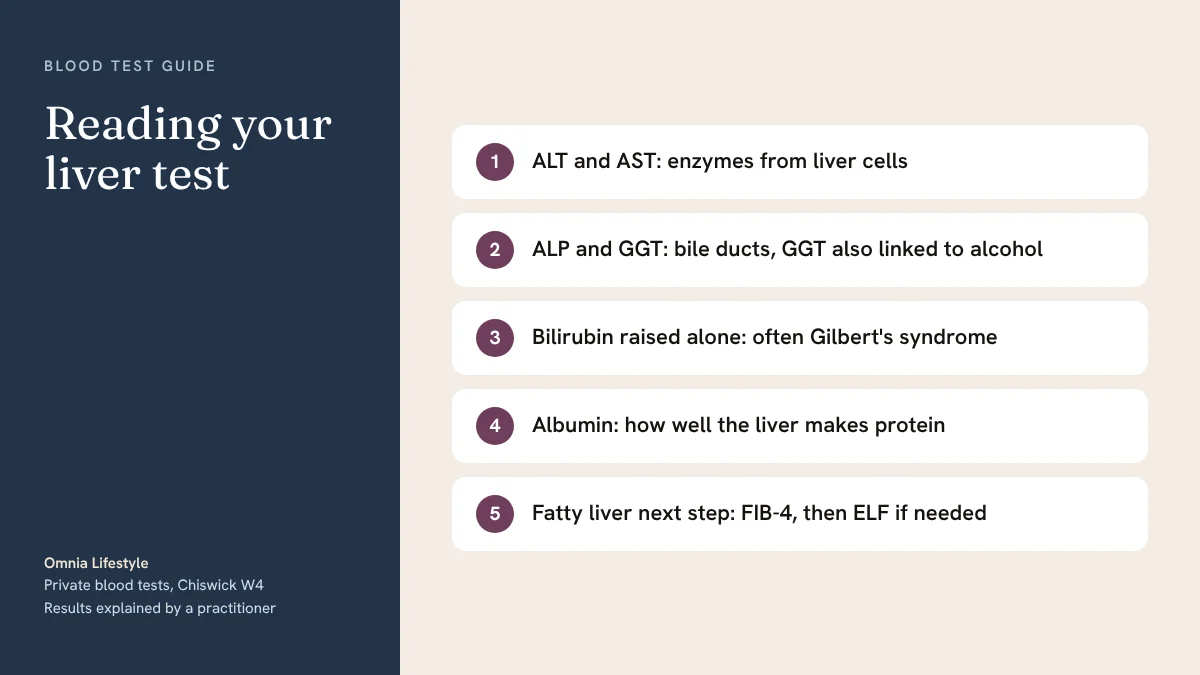
A mildly high bilirubin is a common finding in people who feel well, and the most frequent reason is a harmless inherited trait called Gilbert's syndrome. This guide explains typical ranges, total and direct bilirubin, the common causes of high bilirubin, when to retest and which symptoms need urgent help. For the other liver markers, see our liver function test results guide.
Test it in Chiswick: our total bilirubin blood test costs £59, with your result explained in person by a practitioner. No GP referral needed. Book this test or call 020 4515 0000. Prefer to test at home? See our home kit options.
Better value: our Liver Function Check costs £49 and measures bilirubin together with ALT, AST, ALP, GGT and albumin. A normal set of liver enzymes alongside a mildly raised bilirubin is the pattern that most often points to Gilbert's syndrome. Book the Liver Function Check.
Quick answer
As an example, one NHS laboratory uses an upper limit for total bilirubin of below 21 µmol/L, but ranges vary by laboratory, so check the range on your report. A mildly high bilirubin with otherwise normal liver tests is most often due to Gilbert's syndrome, which is common and harmless. Higher levels can come from faster breakdown of red blood cells, liver inflammation or a blocked bile duct. Yellow skin or eyes with pain, fever, dark pee or pale poo need urgent medical advice. A result outside the range is a prompt, not a diagnosis.
Total and direct bilirubin
Bilirubin travels in two main forms:
- Unconjugated (indirect) bilirubin is the form made from broken-down red cells before the liver has processed it.
- Conjugated (direct) bilirubin is the form the liver has processed so it can pass into bile.
Total bilirubin is the sum of both. When total bilirubin is raised, measuring direct bilirubin (£39) helps show where the problem lies. A mostly unconjugated rise fits with Gilbert's syndrome or faster red cell breakdown. A raised conjugated bilirubin points more towards the liver or the bile ducts.
Normal bilirubin levels
Each laboratory sets its own range. As an example, one NHS laboratory uses a total bilirubin of below 21 µmol/L for adults. Visible jaundice usually appears once bilirubin is well above the range, often around two to three times the upper limit, so many raised results cause no symptoms at all.
Common causes of high bilirubin
Gilbert's syndrome
Gilbert's syndrome is an inherited trait in which the liver processes bilirubin more slowly. The NHS describes it as common and harmless, and it does not need treatment. Bilirubin tends to rise during fasting, illness, dehydration, stress, poor sleep or hard exercise, and settles again afterwards. Our liver guide notes that a raised bilirubin below about 70 µmol/L, mostly unconjugated, with normal liver enzymes and a normal blood count, often fits this pattern. Your GP can confirm it.
Faster breakdown of red blood cells (haemolysis)
If red cells are broken down faster than usual, more bilirubin is produced than the liver can clear. A full blood count and other tests help show this. Our haemoglobin levels guide covers the related blood count markers.
Liver inflammation or damage
Hepatitis, alcohol-related liver disease and some medicines can reduce the liver's ability to process bilirubin. ALT is usually raised too. See our ALT levels guide.
Bile duct blockage
Gallstones, or more rarely a narrowing or growth, can block bile flow. Bilirubin rises with ALP and GGT, and there may be pain, dark pee, pale poo and itching.
Medicines
Some medicines affect how bilirubin is handled. Do not stop a prescribed medicine without speaking to your GP.
What usually happens after a high bilirubin
- Look at the full liver profile and blood count. Normal enzymes and blood count with a mild rise suggest Gilbert's syndrome.
- Check direct bilirubin to see whether the rise is mostly unconjugated or conjugated.
- Repeat the test when you are well, hydrated and have eaten normally.
- Further tests such as an ultrasound may be suggested if conjugated bilirubin or other liver markers are raised.
When to get urgent help
- Ask for an urgent GP appointment or contact NHS 111 if your skin or the whites of your eyes turn yellow, especially with dark pee, pale poo or itchy skin.
- Get same-day medical advice if yellowing comes with pain in the upper right tummy, a high temperature or shivering.
- Call 999 or go to A&E if you have jaundice and become confused or very drowsy, vomit blood or have black poo.
A newborn baby with jaundice needs advice from a midwife, health visitor or GP. Do not wait for a private blood test result in any of these situations.
Who should consider a bilirubin test?
- Anyone following up a previous high bilirubin
- People who have noticed a slight yellow tinge but otherwise feel well, alongside GP advice
- People who drink regularly or take medicines that can affect the liver
- People who think they may have Gilbert's syndrome and want to understand their level
Preparing for your test
Fasting is not needed, and in Gilbert's syndrome a long fast can push bilirubin up. Eat normally, drink enough water and avoid alcohol for 24 hours and heavy exercise the day before. Tell us about medicines and herbal remedies.
How often to retest
A mild isolated rise is often repeated after a few weeks when you are well. If Gilbert's syndrome is confirmed, routine retesting is usually not needed. Other causes are monitored according to your GP's plan.
Frequently asked questions
Is a bilirubin of 30 high?
It is above many laboratory limits but is a mild rise. With normal liver enzymes and blood count, Gilbert's syndrome is a common explanation.
Can stress or fasting raise bilirubin?
Yes, particularly in Gilbert's syndrome. Fasting, illness, dehydration and poor sleep can all push it up for a while.
Is Gilbert's syndrome serious?
No. The NHS describes it as harmless. Some people notice mild yellowing or tiredness at times, but it does not damage the liver.
Is low bilirubin a problem?
A low bilirubin is not usually a concern.
Bilirubin testing in Chiswick
We take your blood sample at our clinic at 8 to 9 Bedford Corner, The Avenue, Chiswick, London W4 1LZ, a short walk from Turnham Green station on the District line (Piccadilly line trains stop there early morning and late evening only), and on the 94, E3 and 272 bus routes. Limited parking is available on request when you book. Your sample is analysed by the Randox laboratory, and a practitioner talks you through what your result means. No GP referral is needed, and we can send a GP feedback report on request.
Book a total bilirubin test, add direct bilirubin, or check bilirubin with five more markers in our Liver Function Check. You can also compare every blood test and price or read our liver function test results guide.
This article is general information, not medical advice. Discuss your results with your GP or practitioner.
Ready to book?
Blood Test




.jpg)
.jpg)
