






Book at our Chiswick clinic
Blood Test
Vitamin B6, also called pyridoxine, helps your body use and store energy from the protein and carbohydrate in food, and helps it form haemoglobin, the part of red blood cells that carries oxygen. The NHS says adults aged 19 to 64 need about 1.4 mg a day (men) or 1.2 mg a day (women), and most people get enough from a varied diet that includes pork, chicken or turkey, some fish, peanuts, soya beans, oats, bananas, milk and fortified cereals.
A vitamin B6 blood test can look for a deficiency, but it is increasingly used for the opposite reason: to check whether supplements have pushed the level too high. This guide explains why B6 ranges vary so much, what low and high results can mean, the UK advice on safe supplement doses and the link between too much B6 and nerve damage.
Test it in Chiswick: our Vitamin B6 (Pyridoxine) blood test costs £189, with your result explained in person by a practitioner. No GP referral needed. Book this test or call 020 4515 0000.
Quick answer
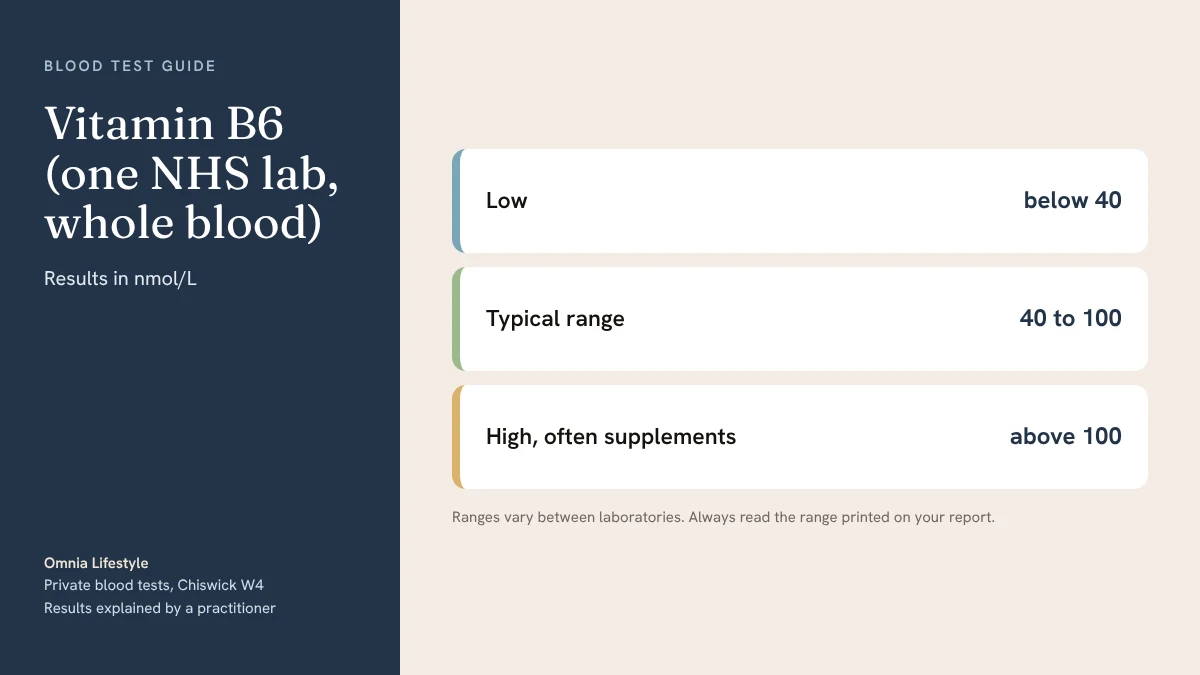
There is no single normal range for vitamin B6. Laboratories measure the active form, pyridoxal phosphate (PLP), in whole blood, plasma or red cells. One NHS laboratory uses 40 to 100 nmol/L for whole blood and another uses 44 to 168 nmol/L, so read the range on your report. Low B6 can come from poor intake, malabsorption or certain medicines. High B6 is usually caused by supplements. The NHS advises taking no more than 10 mg a day of B6 from supplements unless a doctor advises it, because high intakes can cause loss of feeling in the arms and legs.
What a vitamin B6 test measures
Vitamin B6 is a family of related compounds. The one that does the work in your body is pyridoxal phosphate, usually shortened to PLP, and this is what most B6 blood tests measure. The difference between laboratories lies in which part of the blood they test:
- Whole blood PLP: one NHS laboratory quotes an adult range of 40 to 100 nmol/L, and another quotes 44 to 168 nmol/L.
- Red cell PLP: reported against the amount of haemoglobin. One NHS laboratory uses 250 to 680 pmol per gram of haemoglobin.
- Plasma PLP: the same laboratory uses 20 to 140 nmol/L.
These numbers cannot be compared with each other. If you are tracking your level over time, it is best to use the same test and laboratory each time, and to judge each result against the range printed on its report.
Things that can affect your result
- Recent supplements: one NHS laboratory prefers a fasting sample, and a supplement taken shortly before the test can push the result up.
- Serious illness: another NHS laboratory advises avoiding B6 testing during a severe illness or straight after surgery, and waiting at least 14 days.
- Sample handling: B6 breaks down in light, so laboratories protect samples from light. A result that does not fit the picture is worth repeating.
What your result means
- Below the laboratory range: may point to low intake, poor absorption or a medicine that affects B6. Your practitioner will look at your diet, health conditions and medicines, and at related results such as a full blood count and homocysteine.
- Within range: your B6 level is where it is expected to be.
- Above the laboratory range: almost always linked to supplements. One NHS laboratory's guidance for red cell PLP describes results above 2,000 pmol per gram of haemoglobin as over-supplementation, and above 4,000 as a risk of toxicity. Another notes that persistently raised levels are linked to peripheral neuropathy.
Rarely, a high B6 result with a low alkaline phosphatase (ALP) can point to hypophosphatasia, an uncommon inherited bone condition, which needs specialist assessment.
Low vitamin B6: causes and symptoms
Most people get enough B6 from food. NHS laboratory guidance lists these causes of low B6:
- Poor intake: a very limited diet or poor appetite.
- Malabsorption: conditions that stop the gut absorbing nutrients properly.
- Medicines: including isoniazid, used to treat tuberculosis, and penicillamine.
- Rare inherited conditions: that change how the body handles B6.
Symptoms of deficiency can include skin changes, a sore or inflamed tongue, low mood and irritability. Low B6 can also raise homocysteine, and because B6 helps the body form haemoglobin, it may be considered when anaemia has no obvious cause. These symptoms are not specific, so other causes should be looked at too.
Too much vitamin B6: the UK safety advice
The NHS advises: do not take more than 10 mg of vitamin B6 a day in supplements unless advised to by a doctor. Food Standards Scotland gives the same advice. According to the NHS, taking 200 mg or more a day can lead to a loss of feeling in the arms and legs, known as peripheral neuropathy. This usually improves once the supplements are stopped, but after large doses taken for more than a few months it can sometimes be permanent. The effects of doses between 10 mg and 200 mg a day are not clear, so it is not known how long they are safe to take.
Other regulators have become more cautious in recent years. In 2023 the European Food Safety Authority set a safe upper level of 12 mg a day for adults from all sources. In 2025 the Therapeutic Goods Administration in Australia, which received hundreds of reports of nerve symptoms linked to B6 products, decided that products providing more than 50 mg a day will become pharmacist-only from June 2027. At the time of writing, the UK advice remains 10 mg a day or less from supplements.
Check every product you take
Vitamin B6 is added to many products, including multivitamins, B complex tablets, magnesium supplements, some products marketed for PMS or energy, and fortified drinks. Taking two or three of these together can add up to well over 10 mg a day without you realising. Check the labels, and bring them with you to your appointment.
When to see your GP or get urgent help
Call 999 if you have sudden numbness or weakness on one side of the body, a drooping face or slurred speech, as these can be signs of a stroke. Also call 999 or go to A&E if numbness or weakness is spreading quickly over hours or days, or if you have trouble walking, swallowing or breathing.
Book a GP appointment if you take vitamin B6 and notice numbness, tingling, pins and needles or unsteadiness, or if a result is above the laboratory range. Stop any B6 supplement you bought yourself, but do not stop a medicine prescribed by your doctor without speaking to them first.
Who should consider a vitamin B6 test
- People who take supplements containing B6 and have numbness, tingling or pins and needles
- People with a malabsorption condition or a very restrictive diet
- People taking isoniazid or penicillamine, if their doctor suggests it
- People with a raised homocysteine or anaemia without an obvious cause
Preparing for the test
A morning sample before breakfast is ideal. Leave at least 8 hours between your last B6-containing supplement and the test, and tell us about every vitamin, mineral and energy product you take. Drink water as normal.
How often to retest
If your level is high and you stop supplements, your practitioner or GP will advise when to recheck, usually after a few months rather than weeks. If a low level is treated, your GP will plan any repeat test. A normal result does not usually need regular retesting.
Frequently asked questions
Why is my vitamin B6 range different from my friend's?
Laboratories measure B6 in whole blood, plasma or red cells, with different methods and units. Only compare your result with the range printed on your own report.
Can too much vitamin B6 cause numbness?
Yes. High intakes can damage the nerves in the arms and legs, causing loss of feeling, tingling or unsteadiness. Symptoms usually improve after stopping supplements, but not always.
How much vitamin B6 is safe in supplements?
The NHS advises 10 mg a day or less from supplements unless a doctor advises otherwise. Remember to add up B6 from every product you take.
Should I test B6 with vitamin B1?
Sometimes. Both are useful when tingling, heavy drinking or a restrictive diet are part of the picture. Our Vitamin B1 and B6 test (£289) measures both together.
Do I need to fast for a vitamin B6 test?
A fasting morning sample is preferred, and you should leave at least 8 hours after any B6 supplement.
Vitamin B6 testing in Chiswick
We take your sample at our clinic at 8 to 9 Bedford Corner, The Avenue, Chiswick, London W4 1LZ. We are a short walk from Turnham Green station (District line, with Piccadilly line trains stopping there early morning and late evening only) and close to the 94, E3 and 272 bus routes. Limited parking is available on request when you book. Your sample is analysed at the Randox accredited laboratory, no GP referral is needed, and most results are ready within a few working days. A practitioner explains your result with you in person, and a GP feedback report is available on request.
Book the Vitamin B6 (Pyridoxine) blood test on its own, add thiamine with Vitamin B1 and B6, or choose the Vitamin B Profile (£329), which adds vitamin B12, active B12 and folate. You can also compare every blood test and price, or read our guides to homocysteine levels and vitamin B12 levels.
This article is general information, not medical advice. Discuss your results with your GP or practitioner.
Ready to book?
Blood Test




.jpg)
.jpg)
