




Menopause is often talked about as a single moment, but it is really a transition that unfolds over several years. Knowing the stages helps explain why symptoms can start while you are still having periods, and why they can continue after your periods have stopped.
This guide explains how long each stage usually lasts, what signals the end of menopause, and when to speak to a doctor.
The three stages
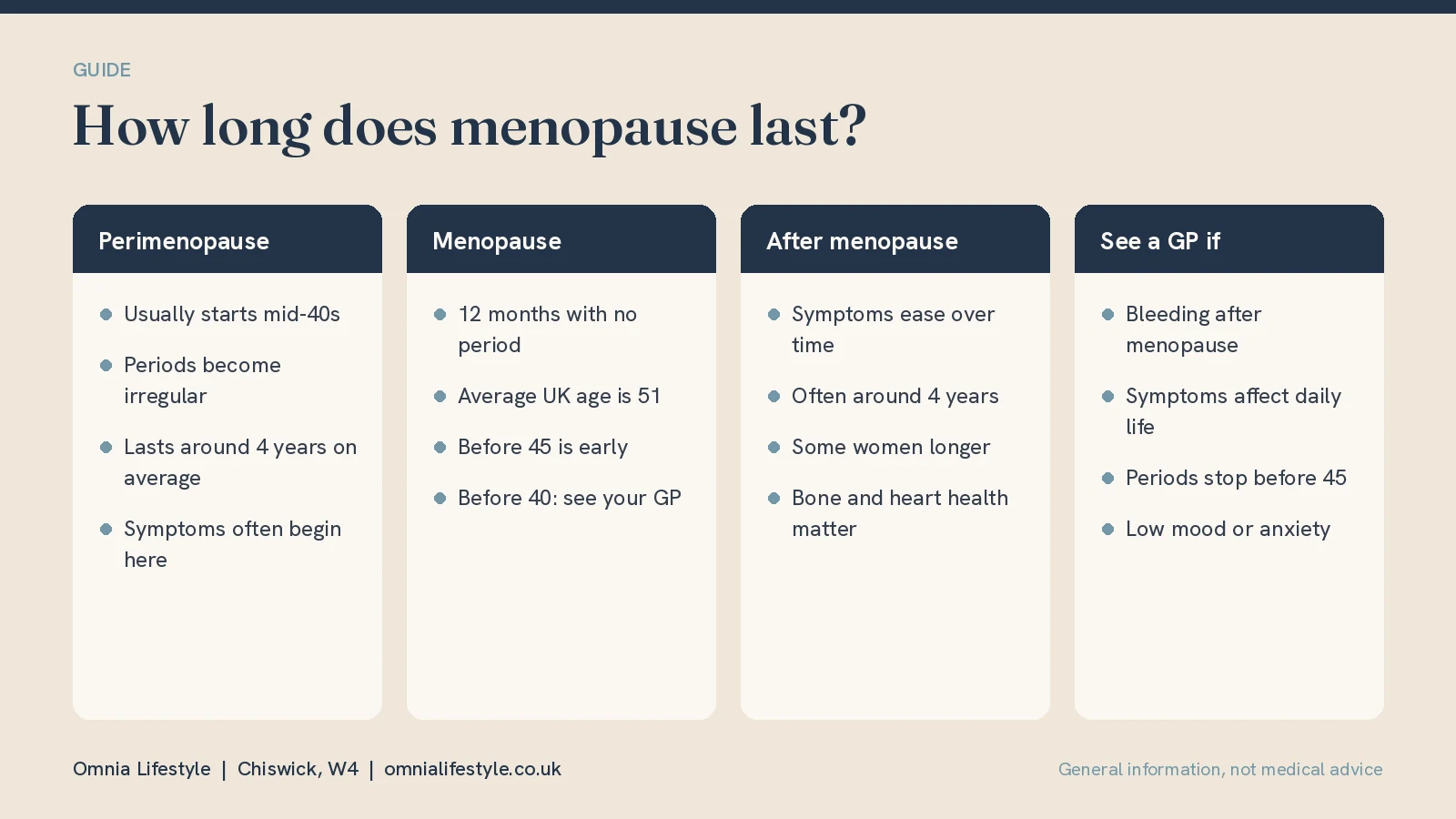
Perimenopause
Perimenopause is the time leading up to your last period, when hormone levels start to fluctuate. It usually begins in your mid-40s and lasts around four years on average, although it can be shorter or considerably longer. Periods become irregular, heavier or lighter, and symptoms such as hot flushes, night sweats, poor sleep, low mood, anxiety and brain fog often begin here.
Menopause
Menopause is the point when you have not had a period for 12 months in a row. In the UK the average age is 51. Menopause before 45 is called early menopause, and before 40 it is called premature ovarian insufficiency. Both should be discussed with your GP.
Postmenopause
Postmenopause is the time after menopause. Symptoms usually ease gradually. For many women they continue for around four years after the last period, and for some they last considerably longer.
So how long does menopause last?
From the first perimenopausal symptoms to symptoms settling, the whole transition commonly lasts around seven years, but it varies widely. Some women have few symptoms for a short time, while others have symptoms for ten years or more.
What signals the end of menopause?
You have reached menopause once you have gone 12 months without a period. After that, symptoms such as hot flushes typically become less frequent and less intense over time. If you are taking hormonal contraception or HRT, your periods may not be a reliable guide, so speak to your GP.
How is menopause diagnosed?
For women over 45 with typical symptoms, NICE guidance says menopause and perimenopause can usually be diagnosed from symptoms alone, without a blood test. Blood tests may be used for younger women or when the picture is unclear.
What helps symptoms
- Hormone replacement therapy (HRT): the most effective treatment for hot flushes and night sweats for most women. Discuss the benefits and risks with your GP.
- Cognitive behavioural therapy: recommended in UK guidance for hot flushes, sleep and mood.
- Regular exercise and strength training: supports mood, sleep, weight and bone health.
- Sleep routine and a cool bedroom for night sweats.
- Cutting back alcohol, caffeine and spicy food if they trigger flushes.
- Acupuncture: some trials suggest it may reduce hot flushes for some women, although the evidence is limited.
Menopause belly and weight gain
Many women notice weight gathering around the middle during menopause, partly because falling oestrogen changes where fat is stored and muscle mass naturally declines. Strength training two or three times a week, enough protein and good sleep help more than dieting alone.
When to see a GP
- Any bleeding after menopause, which should always be checked promptly
- Symptoms are affecting your work, sleep, relationships or mood
- Your periods stop before 45
- You feel persistently low or anxious
Not sure whether it has started? See when menopause starts and the first signs.
Frequently asked questions
Can menopause symptoms last 10 years?
Yes, for some women. Most find symptoms ease within a few years of their last period, but a minority have them for much longer.
Do hot flushes ever stop?
For most women they become less frequent and eventually stop, although some women have occasional flushes for many years.
Can you get pregnant during perimenopause?
Yes. Contraception is recommended until you have gone 12 months without a period if you are over 50, or two years if you are under 50.
Does HRT delay menopause?
No. HRT treats symptoms but does not change when menopause happens.
Menopause support in Chiswick
Omnia Lifestyle supports women through the menopause alongside their GP, at our clinic in Chiswick, W4, close to Turnham Green station, on bus routes 94, E3 and 272. Limited parking is available on request when booking.
Read more about menopause symptoms, hormonal weight gain and poor sleep, see why you may feel tired all the time, explore acupuncture, or book an appointment.
This article is general information, not medical advice. If you have any bleeding after menopause or other concerns, see your GP.


.jpg)
.jpg)