




A full body blood test promises a complete picture of your health from one sample. In practice, the phrase covers everything from a 30-marker check to a panel of more than 160 markers, and more is not always better. This guide explains what a good full body blood test should include, what the larger panels add, what no blood test can tell you, and how to choose the right level for you.
Ready to compare options? See every health check and price at our Chiswick clinic.
Quick answer
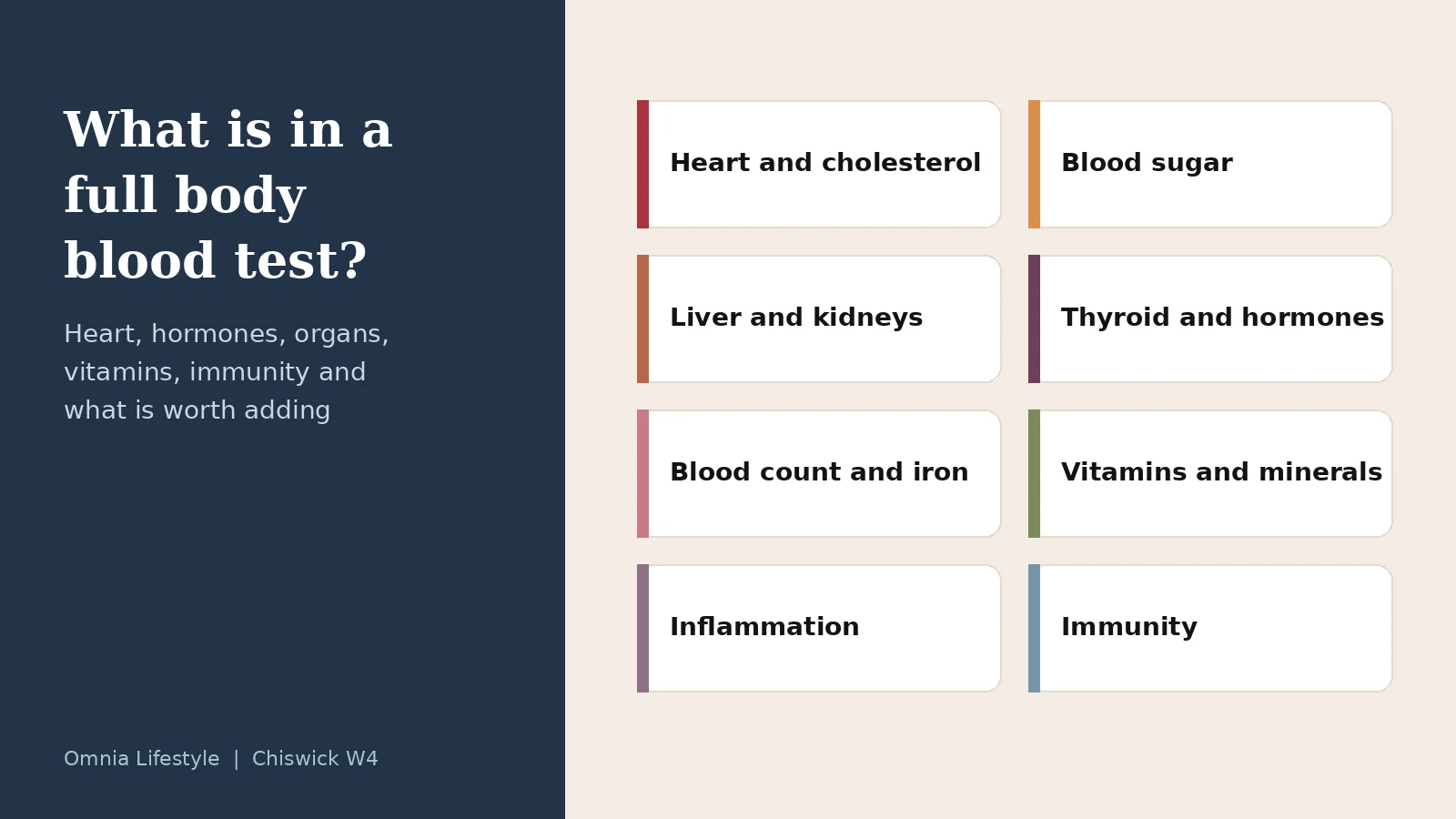
A useful full body blood test covers a full blood count, kidney and liver function, cholesterol, blood sugar (HbA1c), thyroid, iron, vitamin D and B12, and an inflammation marker. Comprehensive checks add hormones, detailed heart risk markers such as apolipoprotein B and Lp(a), immunity and sometimes tumour markers. A full body blood test is a strong baseline and early warning, but it cannot rule out every illness, and tumour markers are not a cancer screening test. Choose the level that answers your questions, and have the results explained.
What a good full body blood test includes
- Full blood count for anaemia, infection and platelet problems
- Kidney function, including creatinine and eGFR
- Liver function, the enzymes that rise with alcohol, fatty liver and medicines
- Cholesterol: LDL, HDL, non-HDL and triglycerides
- Blood sugar: HbA1c for diabetes and pre-diabetes
- Thyroid: TSH and free T4, ideally with antibodies
- Iron: ferritin and iron studies
- Vitamins: vitamin D, B12 and folate
- Inflammation: CRP
That core set catches the common, treatable problems that most often explain tiredness, low mood and changes in weight, and it gives you a baseline to track. See which blood tests to have for a general health check.
What comprehensive panels add
Hormones. Testosterone, oestradiol, progesterone, FSH, LH, prolactin and SHBG, useful for symptoms such as low energy, low libido, irregular periods or suspected PCOS.
Detailed heart risk. Apolipoprotein B counts the particles that carry cholesterol into artery walls, Lp(a) is a largely inherited risk factor that only needs measuring once, and high-sensitivity CRP reflects low-grade inflammation linked to heart disease.
Immunity and autoimmunity. Immunoglobulins, complement proteins and antibodies such as rheumatoid factor or coeliac antibodies.
Tumour markers. Proteins such as PSA, CA-125 and CEA. These are useful for monitoring known conditions, but they are not reliable screening tests on their own: they can be raised by harmless conditions and normal in early cancer. They are always read alongside symptoms and a clinical assessment.
Is more always better?
No. Reference ranges are set so that about 1 in 20 healthy people fall outside them by chance. On a panel of 160 markers, several mild flags in a healthy person are expected. Larger panels are valuable when you want the widest picture and have someone to interpret it, but a focused panel chosen for a reason often answers the question better. See blood test results explained for how to read flags.
What no blood test can tell you
A normal full body blood test is reassuring, but it does not rule out heart disease, cancer or every other condition. It does not replace blood pressure checks, NHS cancer screening programmes, or seeing a doctor about new symptoms. If you have worsening symptoms, unexplained weight loss, bleeding or severe pain, see your GP first.
How to choose the right level
- A thorough annual check of the essentials: the Standard Screen, 46 biomarkers including vitamin D and ferritin, £127
- A full health check with hormones, thyroid antibodies and detailed heart risk: the Randox Everyman or Randox Everywoman, 92 biomarkers, £313. See the difference between them
- The widest picture from one visit: Randox Signature, over 160 biomarkers including cardiac, immune signalling and tumour markers, £961
- A specific question, such as tiredness: a focused panel like Tired All The Time (£165) usually beats a bigger check
Preparing for a full body blood test
- Fast for 8 to 12 hours, with water allowed, because the test includes glucose and cholesterol
- Book a morning appointment, which also suits testosterone and cortisol
- Avoid hard exercise for 24 to 48 hours beforehand
- Tell us about medicines and supplements, especially biotin
Frequently asked questions
How many markers should a full body blood test include?
Around 40 to 50 well-chosen markers cover the essentials. Comprehensive checks of 90 or more add hormones, detailed heart risk and immunity. The right number depends on your questions.
Does a full body blood test check for cancer?
Not reliably. Some panels include tumour markers, but these are not screening tests. Follow NHS screening programmes and see your GP about symptoms.
How long do results take?
Most results return within a few working days. See how long blood test results take.
How much does a full body blood test cost?
At Omnia, from £127 for the Standard Screen to £961 for Randox Signature, including the draw, Randox laboratory analysis and a practitioner review. See private blood test costs in the UK.
Full body blood tests in Chiswick
We offer full body blood tests at Omnia Lifestyle in Chiswick, W4, two minutes from Turnham Green station, on bus routes 94, E3 and 272. Limited parking is available on request when booking. Every sample is analysed by Randox, an ISO/IEC 15189 accredited laboratory, and every result is explained to you by a practitioner. See every blood test and price.
This article is general information, not medical advice. If you have symptoms that worry you, see your GP.



.jpg)
.jpg)