






Book at our Chiswick clinic
Blood Test
ApoB, short for apolipoprotein B, is a protein found on the particles that carry cholesterol and fats around the blood, including LDL. Each of these particles carries one ApoB molecule, so measuring ApoB is a way of counting them. These are the particles that can enter artery walls and build up as plaque.
Interest in ApoB has grown, and some people now ask whether it is a better test than standard cholesterol. This guide explains what ApoB measures, how it compares with LDL and non-HDL cholesterol, what UK and European guidance say, and why there is no single UK target. For the basics of a cholesterol test, see our cholesterol levels guide.
Test it in Chiswick: our Apolipoprotein B blood test costs £79, with your result explained in person by a practitioner. No GP referral needed. Book this test or call 020 4515 0000. Prefer to test at home? A home finger-prick kit is also available, ask us when you enquire, or see our home kit options.
Our ApoB and ApoA1 Heart Ratio (£89) measures ApoB together with ApoA1, the main protein on HDL particles, and reports the ratio between them.
Quick answer
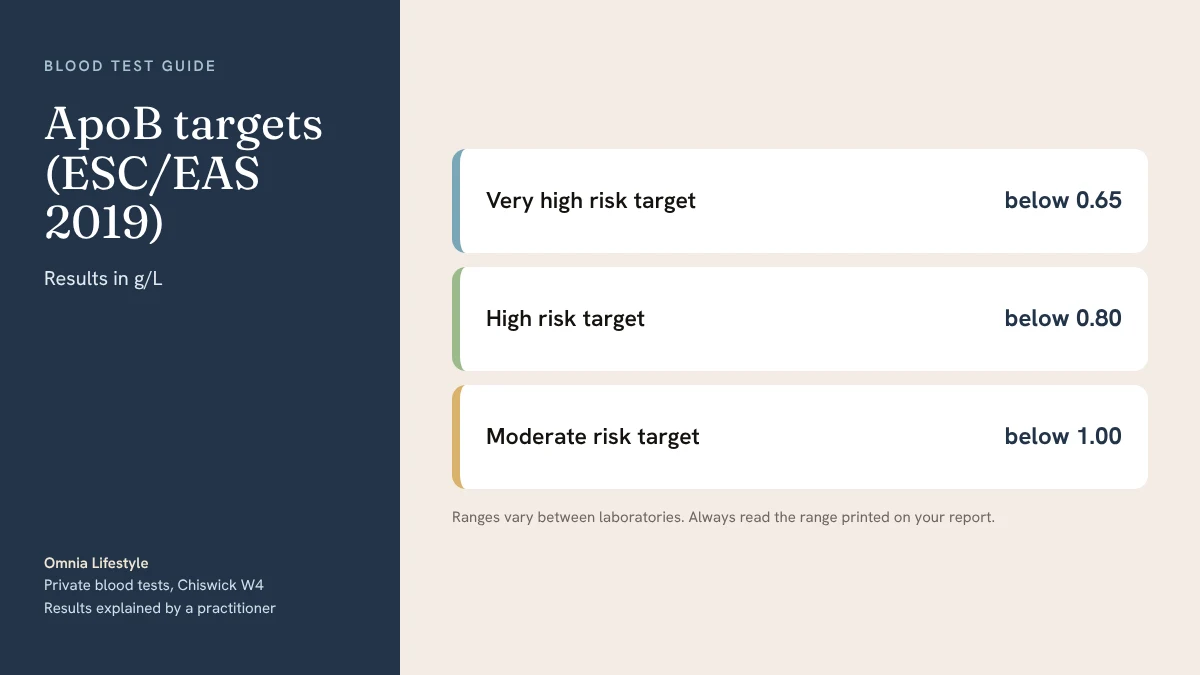
ApoB counts the cholesterol-carrying particles most linked to heart disease. Many lipid specialists see it as a more precise measure than LDL cholesterol, especially if you have high triglycerides, diabetes or obesity. However, there is no single UK ApoB target: NICE guideline NG238 uses your QRISK3 score and non-HDL cholesterol for treatment decisions. European (ESC/EAS 2019) targets, quoted in a 2025 HEART UK joint statement, are below 0.65 g/L at very high risk, below 0.80 g/L at high risk and below 1.00 g/L at moderate risk.
What is ApoB?
Cholesterol cannot travel in blood on its own, so it is packed into particles called lipoproteins. LDL, VLDL and lipoprotein(a) all carry ApoB. A standard cholesterol test measures how much cholesterol is inside these particles. ApoB tells you how many particles there are. Most of the time the two tell the same story, but they can differ, for example when the particles are small and dense, or when triglycerides are high.
In the UK, ApoB is usually reported in g/L. European and American sources often use mg/dL: 1 g/L is the same as 100 mg/dL, so 0.80 g/L equals 80 mg/dL.
ApoB compared with LDL and non-HDL cholesterol
Non-HDL cholesterol is your total cholesterol minus HDL. It captures the cholesterol in all the ApoB-carrying particles, which is why it is often described as a close relative of ApoB. A 2025 joint statement from HEART UK and the Association for Laboratory Medicine notes that:
- non-HDL cholesterol is very highly correlated with both LDL cholesterol and ApoB
- ApoB is recommended as the best measure in people with high triglycerides, diabetes and obesity
- many lipid specialists consider ApoB more valuable than non-HDL or LDL cholesterol, but whether it adds benefit over non-HDL is still debated
- ApoB does not have validated decision thresholds for UK practice and is not available in every UK laboratory
So ApoB is a useful extra measure for some people rather than a replacement for a standard lipid profile.
What UK guidance says
NICE guideline NG238 (cardiovascular disease risk assessment and lipid modification, 2023) does not use ApoB. Instead:
- a full lipid profile measures total cholesterol, HDL and triglycerides, with non-HDL and LDL calculated, and a fasting sample is not required
- NICE recommends offering atorvastatin 20 mg for primary prevention to people with a 10-year QRISK3 score of 10% or more
- for primary prevention, the aim is a reduction in non-HDL cholesterol of more than 40%
- for people who already have cardiovascular disease, the target is LDL cholesterol of 2.0 mmol/L or less, or non-HDL cholesterol of 2.6 mmol/L or less
- a non-HDL cholesterol above 7.5 mmol/L should prompt specialist assessment for inherited high cholesterol
The HEART UK statement suggests that an enhanced lipid profile may include ApoB and lipoprotein(a) where clinically indicated, but UK treatment decisions are still based on QRISK3 and non-HDL cholesterol.
What European guidance says
The 2019 European Society of Cardiology and European Atherosclerosis Society (ESC/EAS) dyslipidaemia guidelines set ApoB as a secondary treatment target. As reported in the 2025 HEART UK statement, these targets are:
- Very high risk: below 65 mg/dL (0.65 g/L)
- High risk: below 80 mg/dL (0.80 g/L)
- Moderate risk: below 100 mg/dL (1.00 g/L)
These risk groups are defined in the European guideline and do not map exactly onto QRISK3, so they are a reference point for a conversation with your GP rather than a UK target.
What your ApoB result means
Your report will show a laboratory reference range. This describes typical values in the population, not a treatment goal. For example, one NHS laboratory lists 0.8 to 1.6 g/L for women, which reaches well above the European targets. A result is best read alongside:
- Your full lipid profile: total, LDL, HDL and non-HDL cholesterol and triglycerides
- Your overall risk: your QRISK3 score, blood pressure, smoking, diabetes and family history
- Lipoprotein(a): an inherited particle that also carries ApoB. See our lipoprotein(a) guide.
If your ApoB is higher than your cholesterol results would suggest, it may mean you have more, smaller particles. Your GP can take this into account when looking at your QRISK3 score.
Who might consider an ApoB test?
- People with high triglycerides, type 2 diabetes, obesity or metabolic syndrome, where HEART UK notes ApoB is the best measure
- People with a strong family history of early heart disease
- People with a borderline cholesterol result who want more detail before talking to their GP
- People already on cholesterol treatment who want a fuller picture
What to do if your ApoB is high
Share the result with your GP together with a full lipid profile, so your QRISK3 score can be worked out and NICE guidance applied. Lifestyle steps help both ApoB and cholesterol. The NHS advises cutting down on fatty food, especially saturated fat, aiming for at least 150 minutes of moderate exercise a week, stopping smoking and drinking no more than 14 units of alcohol a week. Some people will also be offered a statin. Do not change prescribed medicines without speaking to your GP.
When to get urgent help
A raised ApoB is a long-term risk marker and does not cause symptoms. Call 999 if you have chest pain that feels tight or squeezing, chest pain spreading to your arms, neck or jaw, severe difficulty breathing, or if someone collapses and is not responding normally. Do not wait for a blood test result.
Preparing for your test
NICE does not require fasting for a lipid profile. We will tell you if any test in your booking needs fasting. Tell us about cholesterol-lowering medicines, as these change how your result is read.
How often to retest
There is no UK schedule for repeating ApoB. If you start treatment or make big lifestyle changes, your GP will usually recheck your lipid profile, and a repeat ApoB can show how the particle count has changed.
Frequently asked questions
Is ApoB better than LDL cholesterol?
Many lipid specialists think so, particularly with high triglycerides, diabetes or obesity. The evidence that it adds benefit over non-HDL cholesterol is still debated, and UK guidance uses non-HDL.
What is a good ApoB level?
There is no single UK target. The European ESC/EAS 2019 targets are below 1.00 g/L at moderate risk, 0.80 g/L at high risk and 0.65 g/L at very high risk. Your GP can tell you which risk group applies to you.
Does the NHS test ApoB?
Not routinely. NICE guidance does not include it, and the HEART UK statement notes it is not available in every UK laboratory.
Is ApoB the same as non-HDL cholesterol?
No, but they are closely linked. Non-HDL measures the cholesterol inside ApoB-carrying particles, while ApoB counts the particles themselves.
Do I need to fast for an ApoB test?
NICE does not require fasting for a lipid profile, and we will let you know if anything in your booking needs it.
ApoB testing in Chiswick
We take your blood sample at our clinic at 8 to 9 Bedford Corner, The Avenue, Chiswick, London W4 1LZ, a short walk from Turnham Green station on the District line (Piccadilly line trains stop there early morning and late evening only), and on the 94, E3 and 272 bus routes. Limited parking is available on request when you book. Your sample is analysed at the Randox accredited laboratory, most results are back within a few working days, and a practitioner talks you through what your result means. No GP referral is needed, and we can send a GP feedback report on request.
Book a single Apolipoprotein B test or our ApoB and ApoA1 Heart Ratio, or browse all our heart health blood tests. You can also compare every blood test and price, or read our guides to cholesterol levels and lipoprotein(a).
This article is general information, not medical advice. Discuss your results with your GP or practitioner.
Ready to book?
Blood Test




.jpg)
.jpg)
