





Tennis elbow is pain on the outer side of the elbow, caused by overload of the tendon that anchors the muscles which lift the wrist and fingers. Clinicians call it lateral elbow tendinopathy. Despite the name, most people who develop it have never played tennis. It is far more often brought on by repeated gripping, lifting, typing, DIY or manual work, and it is most common between the ages of 35 and 55.
This guide covers the exercises that help tennis elbow, how hard to push, the everyday changes that take strain off the tendon, and the signs that mean your elbow should be assessed rather than exercised.
What tennis elbow actually is
The forearm muscles that extend the wrist share a common tendon, which attaches to the bony point on the outside of the elbow. When that tendon is asked to do more than it is conditioned for, it becomes painful and less able to tolerate load. It is a problem of tendon capacity rather than inflammation, which is why rest and anti-inflammatory approaches alone tend to give only temporary relief.
Typical features are pain on the outer elbow when gripping, lifting a kettle, turning a door handle, shaking hands or lifting with the palm facing down, together with tenderness over the bony point and a weaker grip.
General principles before specific exercises
Reduce the load, do not remove it. Complete rest lets the tendon weaken further. The aim is to cut back the aggravating activities for a few weeks while rebuilding the tendon with exercise.
Tendons respond to progressive loading. Slow, controlled strengthening, increased gradually over weeks, is the best supported treatment.
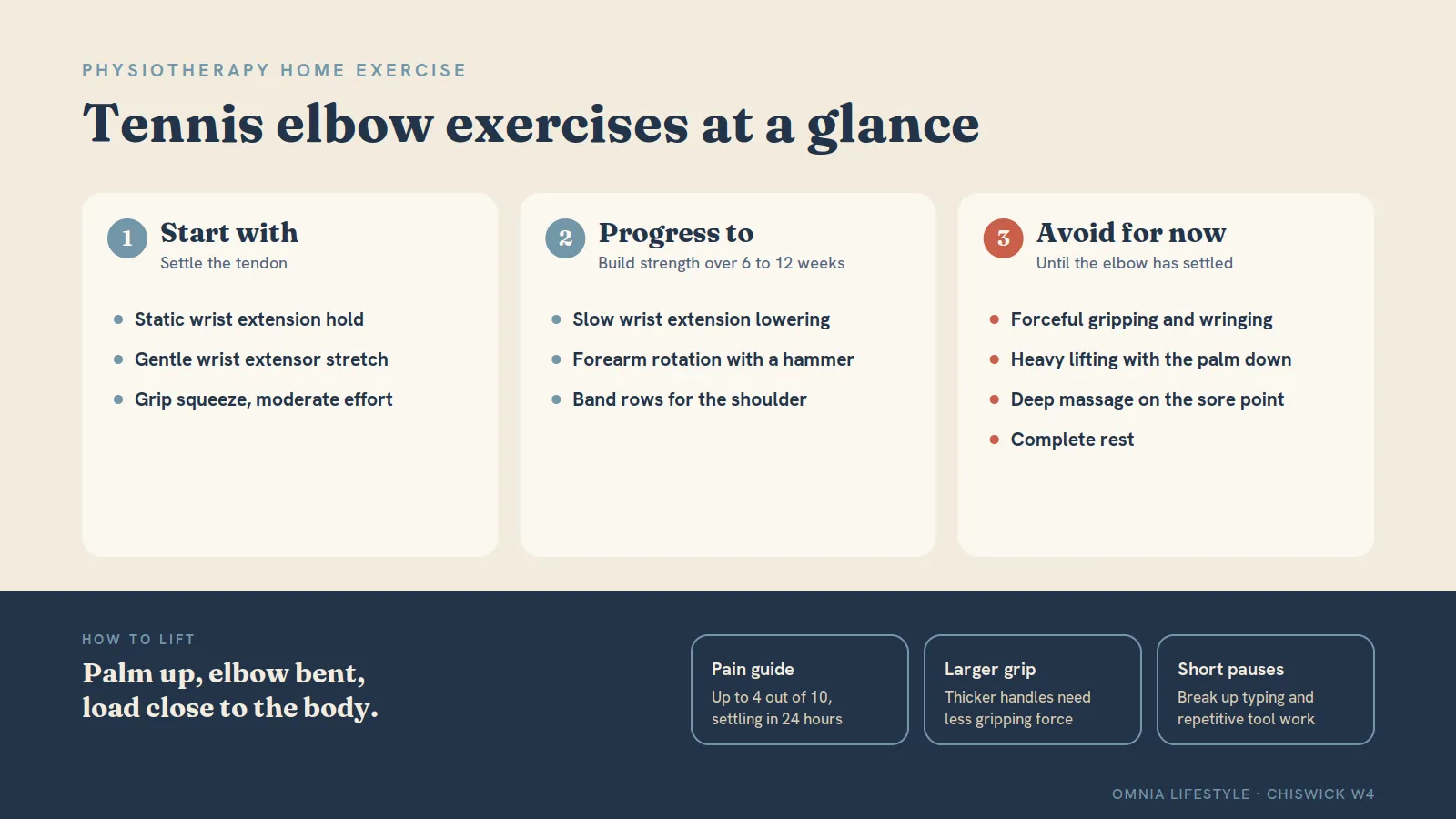
Some discomfort is acceptable. Pain of up to about 4 out of 10 during exercise is fine if it settles within 24 hours. If the elbow is worse the next morning, reduce the weight or the repetitions.
Be patient. Tendons adapt slowly. Expect to work at this for six to twelve weeks before judging the result.
Exercises to start with
Static wrist extension hold
Rest your forearm on a table with the palm facing down and the hand over the edge. Hold a light weight, such as a tin or a 1 kilogram dumbbell, with the wrist level, and keep it still for 30 to 45 seconds. Rest for a minute and repeat five times. Sustained holds of this kind often ease tendon pain as well as beginning to strengthen it.
Gentle wrist extensor stretch
Straighten the affected arm in front of you with the palm facing down. Use the other hand to bend the wrist gently downwards until you feel a mild stretch along the top of the forearm. Hold for 15 to 30 seconds and repeat three times. Keep it gentle. A forceful stretch can irritate the tendon.
Grip squeeze
Squeeze a rolled towel or soft ball at a moderate effort for five seconds and release. Repeat 10 times. Keep the effort below the level that brings on sharp pain.
Exercises to progress to
Slow wrist extension lowering
With the forearm supported and palm down, use your other hand to help lift the weight so the wrist is bent upwards. Then lower it slowly, over three to four seconds, using the affected arm alone. Build up to three sets of 15. When this is comfortable, lift and lower with the affected arm and increase the weight gradually.
Forearm rotation
Hold a hammer or a light dumbbell by one end, with the elbow bent to 90 degrees and tucked into your side. Slowly rotate the forearm so the palm turns up, then down. Build up to three sets of 10. Hold nearer the head of the hammer to make it easier.
Shoulder and upper back strengthening
Rowing movements with a resistance band, pulling the elbows back and squeezing the shoulder blades together, strengthen the muscles further up the arm. A stronger shoulder takes strain off the forearm during lifting and gripping.
Everyday changes that help
- Lift with the palm facing up and the elbow bent, keeping objects close to your body.
- Avoid lifting with a straight elbow and the palm down, which puts the greatest load on the tendon.
- Use a larger grip. Thicker handles on tools and rackets reduce the gripping force needed.
- Break up repetitive tasks such as typing, mouse work and screwdriver use with short pauses.
- A counterforce strap worn just below the elbow can ease pain during activity in the short term. It does not replace strengthening.
What to avoid, at least initially
- Repeated forceful gripping and wringing.
- Heavy lifting with the palm facing down.
- Complete rest or immobilising the arm.
- Aggressive stretching or deep massage directly over the sore point.
- Relying on repeated steroid injections. Research shows they can relieve pain in the short term but are associated with worse outcomes and more recurrence at one year than exercise-based care.
Why a generic exercise sheet sometimes fails
The most common reason is load set at the wrong level: too light to stimulate the tendon, or too heavy for an irritable elbow. The second is diagnosis. Pain at the outer elbow can also be referred from the neck, or come from an irritated nerve in the forearm or from the elbow joint itself, and none of these respond to a tendon loading programme.
An assessment establishes the source of the pain and sets the starting weight and progression for your elbow.
When to seek medical attention
Seek urgent medical attention if:
- The elbow is hot, red and swollen, or you feel feverish and unwell
- You felt a sudden pop or tearing sensation, followed by bruising or marked weakness
- The pain followed a fall or injury and you cannot straighten or bend the elbow
See your GP or a physiotherapist if:
- Pain has lasted more than a few weeks without improvement
- You have numbness, tingling or weakness in the hand or fingers
- You also have neck pain, or pain that travels up and down the arm
- The elbow locks or catches
- Pain regularly wakes you at night
Frequently asked questions
How long does tennis elbow last?
It varies widely. Many cases settle within six months to a year, and most improve within two years. Progressive strengthening tends to shorten the course and reduces the chance of recurrence.
Should I rest tennis elbow completely?
No. Reduce the activities that aggravate it, but keep using the arm and begin loading exercises. Complete rest weakens the tendon.
Does a tennis elbow strap work?
It can reduce pain during gripping for some people. Treat it as a short-term aid alongside exercise.
Is heat or ice better?
Either can help with comfort. Neither changes the underlying tendon problem.
Can I keep playing tennis or going to the gym?
Often yes, at a reduced level, provided pain stays low during activity and settles within 24 hours. Pulling exercises with the palms up are usually better tolerated than palms down.
What is the difference between tennis elbow and golfer's elbow?
Tennis elbow affects the outer side of the elbow and the muscles that lift the wrist. Golfer's elbow affects the inner side and the muscles that bend the wrist. The principles of treatment are the same, but the exercises are reversed.
Tennis elbow assessment and treatment in Chiswick
Elbow pain is assessed and treated at Omnia Lifestyle in Chiswick, W4, close to Turnham Green station, on bus routes 94, E3 and 272. Limited parking is available on request when booking. Assessment confirms whether the tendon is the source of the pain and sets a loading programme at the right starting level for it.
Read more about tennis elbow and sports injuries, explore physiotherapy, or book an assessment.
This article is general information, not medical advice. If you have any of the warning signs listed above, seek medical attention.



.jpg)
.jpg)