




Red light therapy before-and-after photos are everywhere, from smoother skin to faster recovery. Some reflect real, measurable change. Many are taken in different light, at different times, with different skincare. If you are deciding whether red light therapy is worth your time and money, it helps to know what the research actually shows and how long results take.
This guide sets out realistic before-and-after timelines by goal, what to expect from a full-body bed compared with a panel, and how to get the best result.
Quick answer
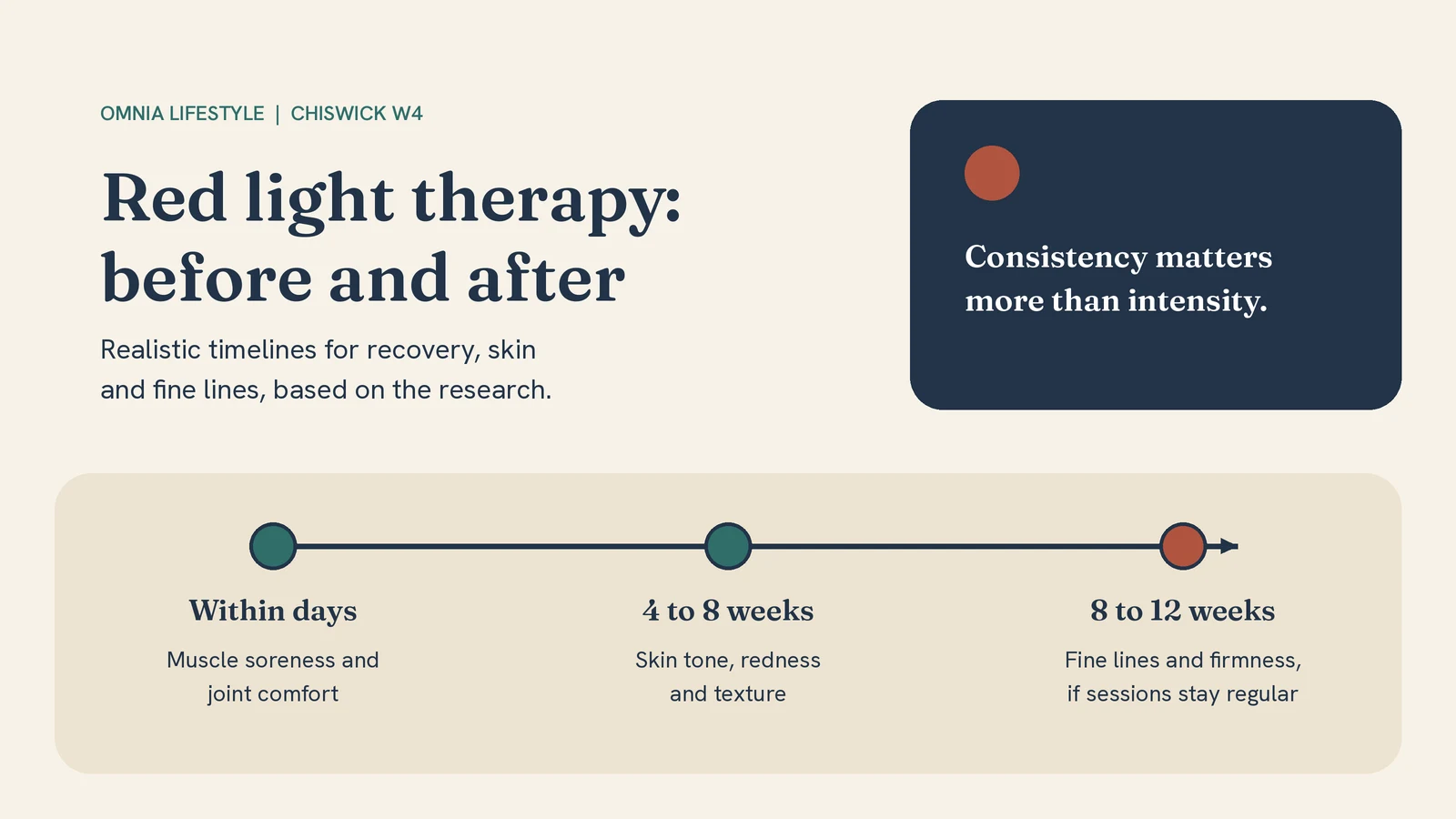
Red light therapy results build gradually. Muscle soreness and joint comfort can improve within days. Skin tone, redness and texture typically improve over four to eight weeks of regular sessions, and fine lines and firmness over eight to twelve weeks. Results depend on consistency, usually two to three sessions a week, and they fade if sessions stop. Red light therapy does not cause fat loss.
How red light therapy works
Red and near-infrared light at specific wavelengths is absorbed by cells, where it is thought to support energy production in the mitochondria and influence inflammation and repair. The technical term is photobiomodulation. It is not a tanning bed: there is no ultraviolet light and no heat damage. For a full explanation of the evidence and safety, see is red light therapy safe.
Before and after by goal
Skin tone, texture and fine lines
This is the best-studied cosmetic use. Controlled trials have reported improvements in skin roughness, collagen density and the appearance of fine lines after around eight to twelve weeks of twice-weekly sessions. Changes are gradual and modest rather than dramatic, and they are more visible in photographs taken under identical conditions than in the mirror from day to day.
Redness, acne and skin conditions
Red light, sometimes combined with blue light, has evidence for mild to moderate acne and some inflammatory skin conditions. Our guide to red light therapy for skin conditions covers eczema, rosacea and psoriasis in detail.
Muscle recovery and joint pain
Studies in athletes and people with musculoskeletal pain show benefits for soreness, stiffness and recovery, though results vary between studies. People often notice a difference within the first few sessions, particularly when sessions are timed around training.
Hair
Low-level light devices have evidence for pattern hair thinning, but results take three to six months and most studies use dedicated caps or helmets applied to the scalp.
Weight and fat loss
There is no good evidence that red light therapy causes meaningful fat loss. Be sceptical of before-and-after photos claiming otherwise.
Realistic timeline
- Within days: relaxation, muscle soreness and joint comfort
- Four to eight weeks: skin tone, redness and texture
- Eight to twelve weeks: fine lines and skin firmness
- Three to six months: hair density, with a dedicated scalp device
Why online before-and-after photos mislead
Lighting, camera angle, make-up, filters and skin hydration all change how skin looks. A photo taken straight after a session can show a temporary glow from increased circulation. Fair comparisons use the same light, the same angle, no make-up and the same time of day, several weeks apart.
Full-body bed vs panel
Panels treat one area at a time and are commonly used at home. A full-body bed treats the whole body in one session with even coverage, which matters if your goals include recovery, joint comfort or skin across the body. Omnia uses the NovoTHOR full-body bed; our guides to whether NovoTHOR works and red light therapy beds explain the differences, and laser vs LED compares light sources.
How to get the best result
- Be consistent. Two to three sessions a week for at least eight weeks. Consistency matters more than intensity.
- Start with clean skin. Remove make-up and sunscreen so light reaches the skin.
- Protect your eyes. Wear the goggles provided and keep your eyes closed during treatment.
- Track fairly. Take photographs in the same light every four weeks.
- Support it. Sleep, sun protection and a simple skincare routine all affect skin results.
Red light therapy at Omnia
Omnia offers full-body red light therapy on the NovoTHOR bed in Chiswick. A single session is £70, or eight sessions a month for £225, which makes the regular schedule that results depend on affordable. See how much red light therapy costs for a wider comparison.
Frequently asked questions
How long does red light therapy take to work?
Days for recovery and comfort, four to eight weeks for skin tone and texture, and eight to twelve weeks for fine lines.
How often should I have red light therapy?
Two to three times a week is the pattern used in most studies. Daily sessions are not necessary and more is not always better.
Should my eyes be open or closed during red light therapy?
Closed, with protective goggles. Do not look directly at the lights. The goggles are provided at every session.
Do the results last?
Skin and comfort improvements fade gradually if you stop completely. Many people continue with one session a week for maintenance.
Is red light therapy safe?
It is well tolerated by most people. It is not recommended during pregnancy on the abdomen, with photosensitising medication, or with certain eye conditions without advice.
Red light therapy in Chiswick
Red light therapy is available at Omnia Lifestyle, 8-9 Bedford Corner, The Avenue, Chiswick, London W4 1LZ, a short walk from Turnham Green station and on bus routes 94, E3 and 272. Limited parking is available on request when booking.
Learn more about red light therapy in London or book online.
This article is general information, not medical advice. If you take medication that increases light sensitivity or have an eye condition, check with your GP before starting.


.jpg)
.jpg)