


Omnia Lifestyle Field notes
Thinking costs something
We accept that sleep, movement and food shape the body. The stranger claim — and the one the science keeps arriving at — is that they shape the thought.
Scroll
01 The bill
Two per cent of your weight. A fifth of your fuel.
The brain is a small organ with an enormous appetite. Sitting still, doing nothing you would call work, it draws close to a fifth of the body's energy — from a mass of roughly two per cent.
Nothing it does is free. Recalling a name, weighing a decision, arriving at the idea you have circled all week: each one is paid for in fuel.
Share of body weight0%
Share of energy used at rest0%
Ten times its weight in demand. No other organ runs a ratio like it.
Outer membrane
02 Inside the cell
Something has to pay it
Mitochondria turn what you eat and what you breathe into energy a cell can spend. Billions of them, running without pause, are the reason any of the above is possible.
— The correction
Not batteries. Participants.
The old picture cast them as a power supply, indifferent to what the cell did with the current. The newer picture has them taking part in the work: in how a brain adapts, how it learns, how well it ages, how much stress it absorbs before it buckles.
— The currency
Everything you do is bought with ATP
Adenosine triphosphate is the only currency your cells accept. Firing a neuron, holding a thought in working memory, repairing a muscle fibre after training — all of it is settled in ATP.
You cannot stockpile it. Your body makes and spends something close to its own weight in ATP every day, which is why the supply line matters more than the reserve. Neuroscientist Dr Hannah Critchlow makes the case at length in The 21st Century Brain: if cognition runs on energy, the quality of your thinking depends on how well you produce it.
03 The older mistake
We spent centuries treating thought as if it floated free of flesh
It doesn't. Thought is produced by living tissue, and living tissue has to capture and convert energy continuously just to keep existing. The mind was never sitting above the body. It has been running on it the whole time.
We are used to picturing ourselves as machinery assembled from molecules. It may be more useful to picture ourselves as processes made of energy. A paraphrase of the mitochondrial psychobiologist Martin Picard
04 What we take from it
Sleep, movement, food and stress are not four separate pillars
They are four inputs to one system. Each lands on the same cellular machinery that has to keep a very expensive organ supplied — which is why improving one tends to move the others, and why neglecting one is rarely contained.
-
Deep sleep is when the brain's waste-clearance runs hardest. Cut it short and you start the next day paying interest on the last one.
-
Training doesn't just spend energy, it tells the cell to expand its capacity to make it. This is the one input that raises the ceiling rather than topping up the tank.
-
Carbohydrate, fat and protein all end up feeding the same chain. What changes is how cleanly they burn and what else arrives alongside them.
-
Chronic stress keeps the system in a state of readiness it was never meant to hold. The bill arrives as fatigue that sleep alone doesn't clear.
05 At the clinic
Then there is the input you can lie down in
Red and near-infrared light is absorbed by cytochrome c oxidase — an enzyme sitting at the end of the chain inside your mitochondria. Delivered at the right wavelength and dose, it supports ATP production directly, at the site where energy is actually made.
Wavelength decides how far in it reaches. Drag the scale.
660nm
Visible red
Skin and just beneath
Skin and just beneath
4005507008501000
Illustrative. Actual penetration depends on tissue type, delivered dose and how long you're under it. NovoTHOR runs both wavelengths at once.
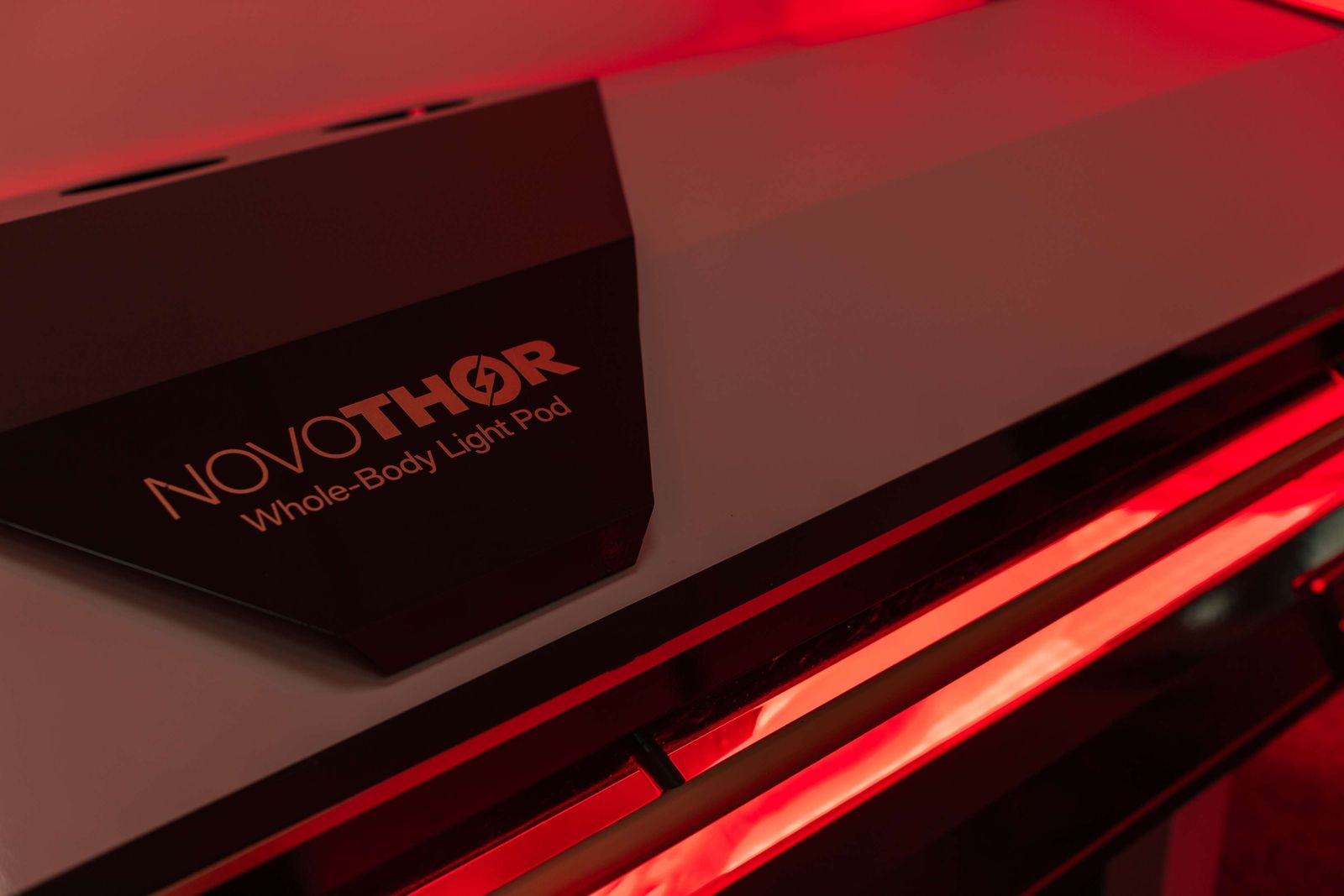
NovoTHOR is the whole-body version of that technology: a bed rather than a panel, treating everything at once. We have one at Omnia Lifestyle.
660 nmRed
850 nmNear-infrared
~15 minWhole body, per session
This is why it turns up in professional sport. NovoTHOR beds are used by teams and athletes across the NFL, NBA, NHL, MLB, MLS and Olympic programmes — where recovery between sessions is the thing that decides how hard you can train.
Book a NovoTHOR sessionMade by Omnia Lifestyle. Prompted by an essay on brain energetics in the Guardian, 9 August 2026 — read the original — and by The 21st Century Brain by Dr Hannah Critchlow (Penguin, 2026). Photobiomodulation is not a treatment for any specific condition here; if you are pregnant, photosensitive or under care for a medical condition, speak to your clinician before booking.