Tai chi · Chiswick W4
The oldest balance training we have, taught in a clinic by people who have spent their lives inside the form.
Moving slowly is what gives you time to feel where your weight is. Everything the research measures follows from that one constraint.
Feel it before you read about it
It crosses the arc in sixteen seconds, about the speed a hand travels in class. Rest your cursor or finger on it and go with it. It is harder than it sounds, and that difficulty is the training.
What you're actually learning
Tai chi looks like choreography. Underneath it you are rehearsing a small set of skills that keep people upright, mobile and out of pain: how weight moves, how the body stacks, and where attention goes.
Almost every posture is a controlled transfer of load from one foot to the other. A whole class is spent doing consciously what stairs and kerbs ask you to do unconsciously a few thousand times a day. Move the slider — this is the range a class lives in.
Drag the slider to move through a single pour
Tai chi doesn't ask for a military posture. It asks for verticality: head resting over ribs, ribs over pelvis, pelvis over the feet, spine long but still curved. Held that way, the neck and lower back stop doing work that was never theirs, which is why posture is usually the first change people notice.
A head tipped forward multiplies the load the neck carries
Sitting still to clear your mind is hard. Tracking a weight shift, a turning waist and two moving hands is absorbing enough that the mental chatter has nowhere to sit. It's why people who have bounced off seated meditation often stay with tai chi: the movement holds the attention for you.
Scattered attention, gathered
Try it before you come in
Belly breathing sits underneath every posture. Sit or stand, put a hand below your navel, and let the hand travel out on the way in and back on the way out. Follow the circle for a minute and notice whether your shoulders drop.
Don't force the volume of the breath. If you feel light-headed, stop and breathe normally.
A class, in five moves
Move one of fiveThe first thing you learn. Ankles and knees bend as the arms float up, then everything settles as they come down. Nothing here is held; the weight stays even and the shoulders stay low.
Feet hip-width and parallel · weight stays 50 / 50
Trace the path with your finger or cursor, starting at the clay dot, as slowly as you can manage. If you rush, it will tell you. The line on the left tells you what the feet are doing.
Where the evidence sits
Tai chi has been through proper randomised trials, mostly in older adults and in people living with a long-term condition. Here is what those trials found, with the papers, so you can read them yourself.
670 adults aged 70 and over at high risk of falling were randomised to tai ji quan, a multimodal exercise programme, or stretching, for six months. The tai chi group fell least: 58% fewer falls than stretching, 31% fewer than the multimodal programme.
Li et al. JAMA Intern Med 2018;178(10):1301 ↗Adults with painful knee osteoarthritis did either tai chi or standard physical therapy for twelve weeks. Pain and function improved comparably and held at 52 weeks; the tai chi group did better on depression scores and quality of life.
Wang et al. Ann Intern Med 2016;165(2):77 ↗Measured against supervised aerobic exercise, tai chi produced similar or greater improvement in fibromyalgia symptoms, and longer courses did better than shorter ones.
Wang et al. BMJ 2018;360:k851 ↗Sleep was measured by wrist actigraphy rather than self-report. Twelve weeks of tai chi improved sleep as much as conventional exercise, and the gains were still measurable when participants were retested two years later.
Siu et al. JAMA Netw Open 2021;4(2):e2037199 ↗In adults over 50 with central obesity, twelve weeks of tai chi reduced waist circumference about as much as conventional cardio and strength training, useful when higher-impact exercise is not an option.
Siu et al. Ann Intern Med 2021;174(8):1050 ↗The American College of Physicians' guideline on low back pain recommends non-drug treatment first for chronic cases, and lists tai chi among the options alongside exercise, yoga and mindfulness-based stress reduction.
Qaseem et al. Ann Intern Med 2017;166(7):514 ↗Trials describe averages across groups of people, not promises about any individual. Tai chi is exercise and lifestyle support; it does not replace medication, physiotherapy, or advice from your GP or consultant.
Six generations
Tai chi was never a syllabus. A teacher took students, corrected them by hand over years, and passed on a version of the form carrying his own understanding of it.
Each generation inherits the whole thing: postures, principles, and the reasoning behind them. You are expected to have practised long enough to teach the reasoning, not only the shapes.
Through the twentieth century the emphasis moved from martial skill to health. The movements stayed; what they were being trained for changed.
Dr Zhu holds the sixth generation of her family's Wu-style lineage, trained from childhood by her father. She teaches it here the way it reached her: slowly, in detail, and adjusted to what the body in front of her can safely do that day.
Tai chi instruction is unregulated in the UK; anyone may advertise a class. Lineage and clinical experience are the only real signals that a teacher knows what they are correcting.
Who teaches it
Sixth-generation Wu-style lineage · Clinic lead, therapy
Dr Zhu trained in Wu-style tai chi from childhood under her father, a fifth-generation practitioner, and carries the whole family art: hand form, sword, sabre and pushing hands. She teaches beginners the way she was taught — one principle at a time, with hands-on correction, adjusted to what each body can do that day.
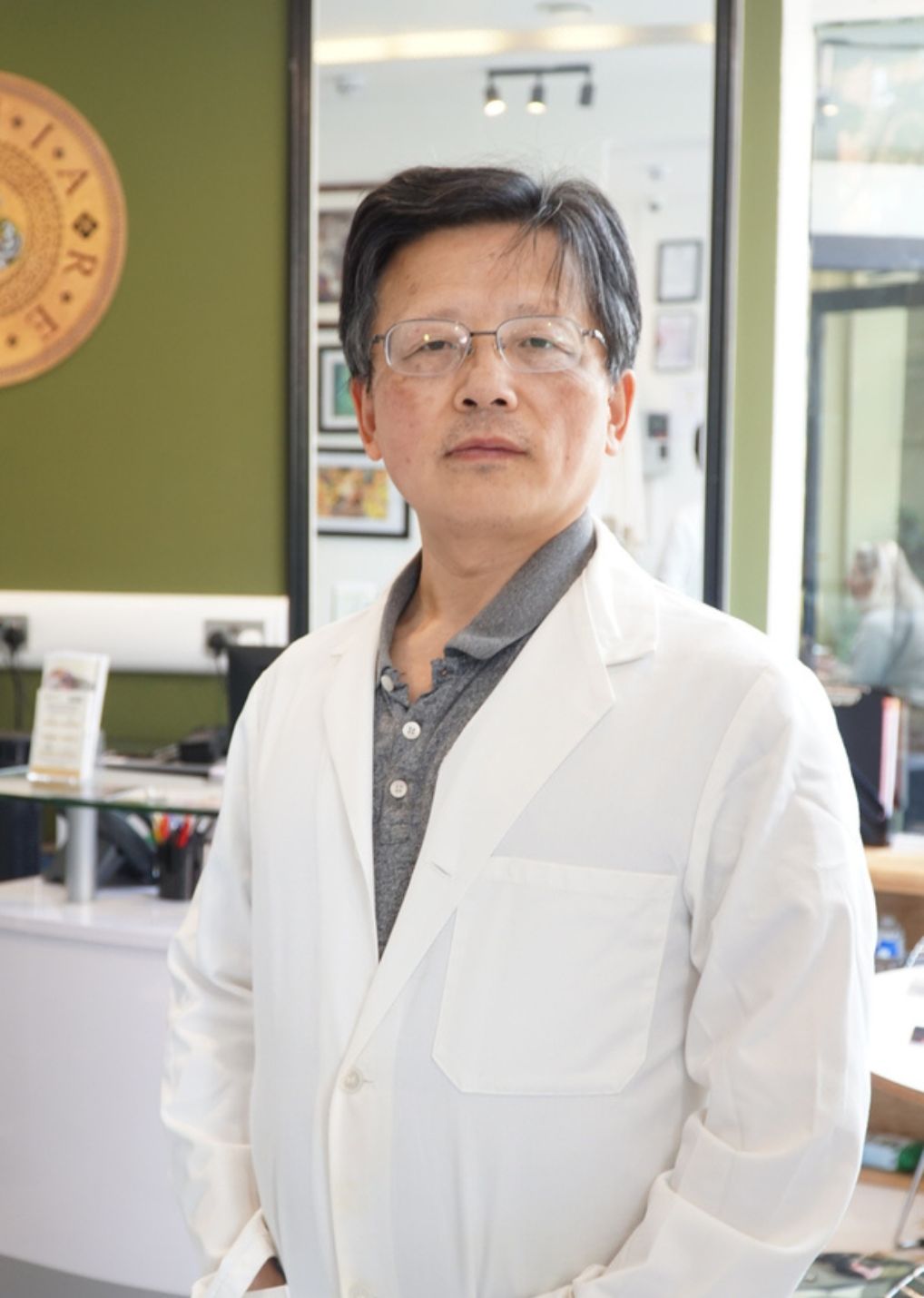
Tai chi & qigong master · Teaching since 1994
Dr Wu has taught tai chi and qigong professionally since 1994, alongside three decades of clinical practice in both conventional and Chinese medicine. His classes centre on the hand form, qigong and meditation, adapted around arthritic knees, replaced hips and post-stroke balance rather than asking you to keep up.
Both also practise clinically at Omnia, so if something in your body needs looking at properly, you are already in the right building.
Who's in the room
Some come because a consultant or physiotherapist suggested something low-impact. Some have had a fall, or want to stop worrying about having one. Some want an hour a week where their head goes quiet. All good reasons.
Not sure it's the right fit? It's always better to speak to us so we can get to know your problem properly and book you in for the right appointment.
That's roughly where the trials started measuring, and roughly when people tell us the stairs feel different.
Before you book
None of these necessarily rules tai chi out. Tell us and we'll plan around it.
Questions
That's the usual starting point. Nothing in a beginner's class needs flexibility, floor work, or getting up and down. You stay standing, or sitting if you prefer, and move within a comfortable range. The instruction is to stay around seventy per cent of what you could do, never at your limit.
Loose clothes you can move in, and flat flexible shoes or bare feet. Avoid thick-soled trainers; you want to feel the floor. Socks on their own can be slippery.
There's a seated version covering the same ground: spine, shoulders, hands, feet and breathing. Tell us when you book and we'll set you up accordingly.
Once a week in class, with short practice at home in between, is the pattern that works. Ten minutes most days beats an hour once a fortnight.
Balance and posture changes show up over weeks rather than days, and they show up in ordinary life first: reaching a high cupboard, coming down stairs without holding the rail.
Historically yes. The postures come from a fighting form and the names still reflect it. What we teach is the health side. There's no sparring and no contact.
Yes, and it often works best that way. If you already see someone here, mention tai chi to them and they'll tell you how it fits your treatment plan.
Chiswick, W4
Not sure whether tai chi or something else fits what you're dealing with? It's always better to speak to us so we can get to know your problem properly and book you in for the right appointment.
Omnia Lifestyle · 8–9 Bedford Corner, The Avenue, Chiswick, London W4 1LZ
omnialifestyle.co.uk
Sources
Further reading: An Introduction to Tai Chi, a Special Health Report from Harvard Health Publishing (2022), medical editor Peter M. Wayne PhD, Director of the Osher Center for Integrative Medicine at Harvard Medical School. Available from health.harvard.edu. Cited as background reading only; no affiliation with or endorsement by Harvard is implied.